
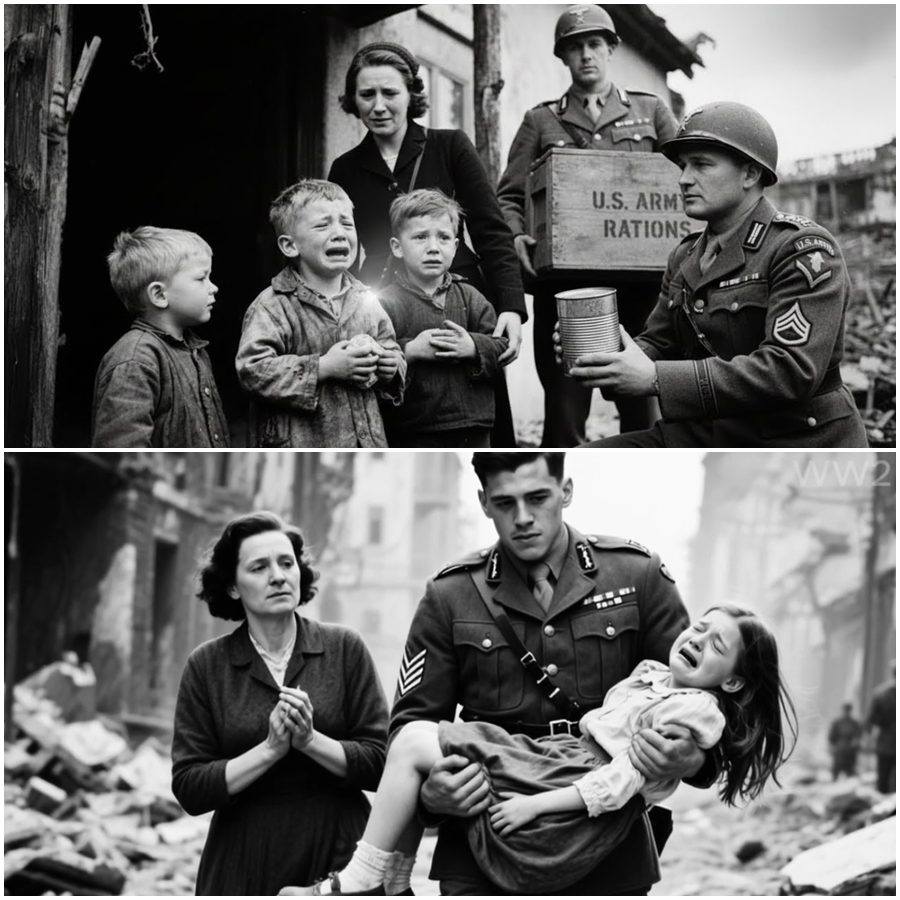
In the final months of World War II, across shattered German towns and silent countryside roads, scenes unfolded that few photographs captured and even fewer history books tried to explain.
Families stood motionless as unfamiliar soldiers approached.
Children clutched empty bowls, too tired to cry.
Parents hesitated—caught between fear, pride, and a desperation that felt dangerous to reveal.
Then something unexpected happened.
Not everywhere. Not always. But often enough that those who lived through it never forgot.
A Winter That Arrived Before Peace Did
The war in Europe was collapsing faster than daily life could adjust.
Railways were broken. Supply chains were shattered. Cities were reduced to fragments of walls and smoke-blackened streets. Winter came early and stayed hard. Coal was scarce. Food was scarcer.
For many German families, survival became a daily calculation: who eats today, who waits until tomorrow, who pretends they are not hungry.
Children were the hardest to shield.
They did not understand politics, borders, or surrender documents. They understood cold. They understood hunger. And they understood when adults stopped pretending everything was fine.
When the Soldiers Came Closer
The sound of vehicles was often the first warning.
Heavy engines rolling slowly into town. Boots on frozen ground. Voices speaking a language families recognized but did not understand.
U.S. soldiers.
Some families hid. Some stayed still. Some gathered their children closer, instinctively forming a barrier with their bodies.
Years of fear had taught them one lesson: uniforms brought consequences.
No one knew what kind this would be.
Pride Was a Fragile Thing
Parents had been taught to endure. To endure bombing. To endure loss. To endure hunger without asking.
Asking was dangerous. Accepting help from the enemy felt worse.
Many parents hesitated even when their children’s faces were hollow, their clothes too thin, their hands trembling.
Pride did not vanish just because the war was lost.
It cracked instead—slowly, painfully.
The Moment That Broke Everything Open
The moment rarely began with a speech.
More often, it began with a glance.
A soldier noticing a child watching too closely.
A bowl held out without words.
A small body swaying slightly while standing still.
Sometimes a soldier reached into a pack.
Sometimes a truck stopped.
Sometimes food appeared where no one expected it.
Bread. Soup. Canned rations. Something warm. Something real.
The reactions were immediate and overwhelming.
Parents Who Could Not Hold It Together
Many parents broke down.
Not loudly. Not dramatically.
They turned away and cried where their children could not see. Or they stood frozen, hands clenched, faces unreadable as tears slid down anyway.
For months, they had carried responsibility like a weight pressed into their lungs. Now, in front of strangers they had been taught to fear, that weight shifted—and they almost collapsed under the release.
Some whispered thanks.
Some said nothing at all.
Some could not even look up.
Silence Was the Common Language
The exchanges were often wordless.
Soldiers did not always explain. Families did not always ask.
Food passed from one hand to another. Children ate carefully at first, unsure if the meal would disappear if they moved too quickly.
Parents watched every bite.
This silence was not awkward.
It was heavy.
Both sides felt the weight of it.
Soldiers Facing Their Own Conflict
For the soldiers, the moment was not simple.
They had fought hard. They had lost friends. They had seen destruction that left permanent marks.
Now they stood in front of families who looked nothing like the enemy they had imagined.
Children did not match propaganda.
Hunger did not feel deserved.
Some soldiers hesitated before acting—not because they lacked compassion, but because they knew the power imbalance was absolute.
Helping felt right. It also felt complicated.
Orders and Reality Did Not Always Match
Official instructions existed. Distribution rules existed. Boundaries existed.
But war had already blurred those lines.
Some soldiers acted within rules. Some bent them. Some acted first and worried later.
They gave what they could without ceremony.
No photographs. No records. No public acknowledgment.
Just food. Warmth. A pause in suffering.
Children Who Remembered Everything
Children remembered the details adults forgot.
The smell of soup.
The sound of a tin opening.
The way a soldier knelt instead of standing tall.
The look on their mother’s face when she realized the meal was real.
Decades later, many could still describe that day with startling clarity.
Not because it was joyful.
But because it was unexpected.
Broken Towns, Intact Humanity
These moments often unfolded in places that barely resembled towns anymore.
Walls stood without roofs. Streets ended in rubble. Doors led nowhere.
Yet inside those ruins, something fragile reappeared: trust.
Not trust in governments. Not trust in systems.
Trust in individual choice.
Fear Never Fully Left
Even as children ate, fear lingered.
Would the food be taken back?
Would accepting it bring punishment later?
Would neighbors judge them?
Some parents refused help at first, only to accept later when desperation won.
Others accepted once and never again.
No choice was easy.
The Thin Line Between Enemy and Rescuer
The uniforms did not change.
But meaning did.
To a child, the soldier who fed them was not an enemy. Not a liberator. Just a human who noticed.
To a parent, the moment was harder to name.
Gratitude mixed with humiliation. Relief mixed with shame. Safety mixed with uncertainty.
Nothing about it fit cleanly into a story of victory or defeat.
Why History Softened This Story
These moments complicated the narrative.
They suggested that suffering was not exclusive.
That power could choose restraint.
That mercy could appear without strategy.
History prefers clarity.
So these stories were softened. Generalized. Sometimes ignored.
They did not fit the shape of triumph or condemnation.
They lived instead in memory.
Moral Questions No One Wanted to Answer
Who was responsible for feeding children after a war?
What did mercy mean when power was unequal?
Was help an act of kindness—or a reminder of defeat?
No official answer existed.
Only lived experience.
Quiet Acts With Loud Consequences
For many families, that single meal became a turning point.
Not because it solved hunger.
But because it restored the idea that survival was possible.
That the world had not entirely abandoned them.
The Long Shadow of That Winter
Years passed.
Germany rebuilt. Children grew older. Soldiers went home.
But that winter stayed with them.
In kitchens rebuilt from rubble.
In meals never taken for granted again.
In the way some parents insisted plates be cleaned—not out of discipline, but memory.
What the Soldiers Carried Home
Many soldiers never spoke about these moments.
They did not see them as heroic.
They saw them as necessary.
But sometimes, late in life, they remembered a child.
A face.
A pair of hands holding bread like it was fragile glass.
Power Seen Up Close
For families, power had always been abstract—governments, armies, decisions far away.
That day, power stood in front of them, holding food.
And chose to give.
That choice mattered.
The Question That Still Lingers
Was it mercy?
Was it responsibility?
Was it instinct?
Perhaps it was all three.
Perhaps it was something simpler: a refusal to let children starve when help was possible.
Why These Stories Matter Now
They remind us that war is not only fought on maps and timelines.
It is fought in kitchens without food.
In streets where children wait.
In moments where someone must decide whether to look away.
These stories do not erase the harm of war.
They reveal its complexity.
The Children Who Never Forgot
Many of those children lived long lives.
They remembered fear.
They remembered hunger.
And they remembered that one moment when the enemy did not act like an enemy.
That memory stayed.
Not as propaganda.
As truth.
A Final Quiet Image
A ruined street.
A cold wind.
A soldier kneeling.
A child eating.
A parent crying without sound.
No cameras.
No applause.
No history book waiting.
Just a moment where survival crossed a line no one expected—and humanity stepped through first.