

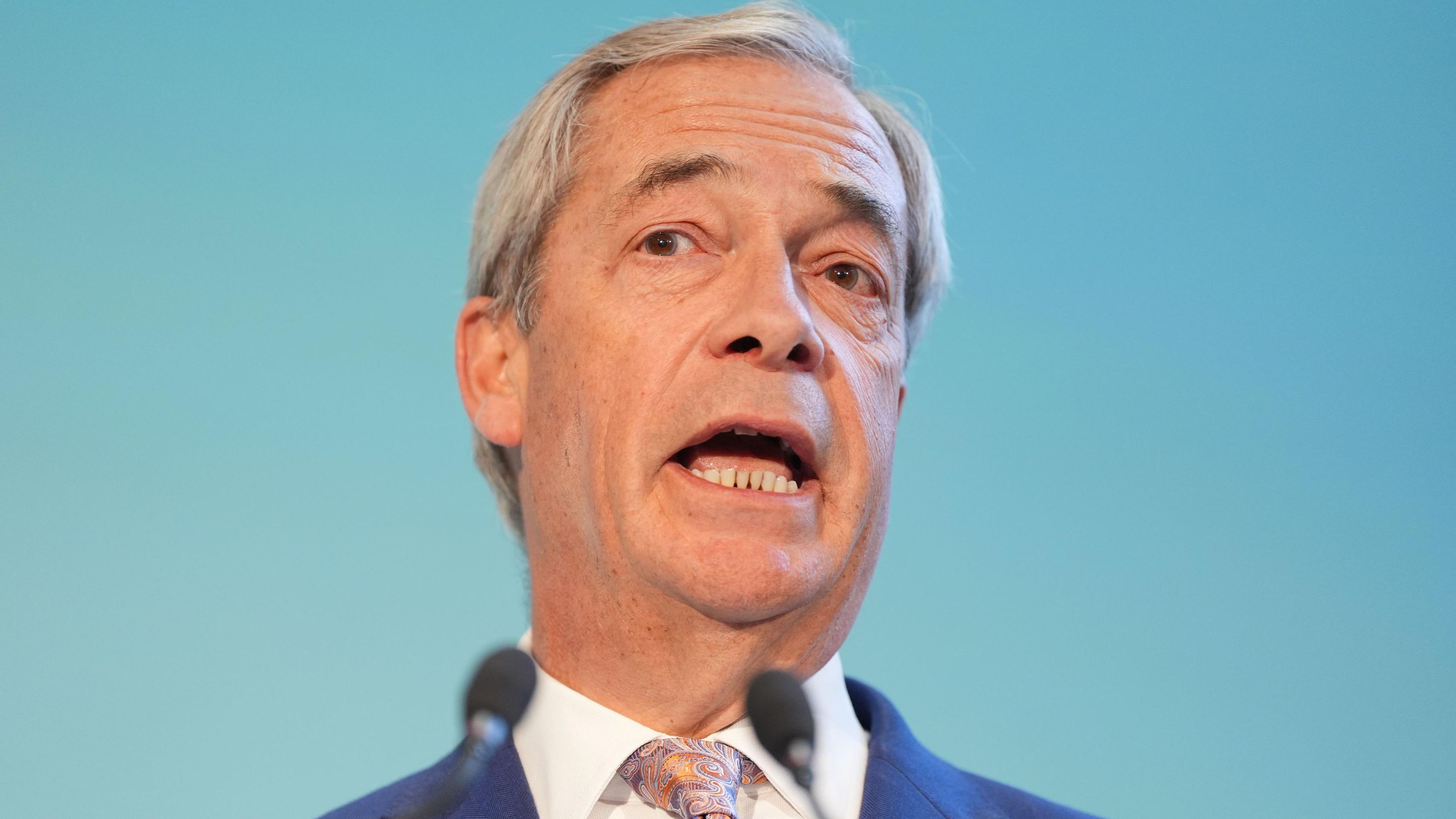
Nigel Farage Hits Back at Keir Starmer as Reform Faces Furious “Racist” Accusations
Nigel Farage is no stranger to political confrontation.
For decades, the Reform UK leader has built his career around challenging Britain’s political establishment, particularly on immigration, national sovereignty and the question of who should be allowed to settle permanently in the United Kingdom.
But the latest clash with Labour has taken the political argument into even more explosive territory.

Keir Starmer and senior Labour figures have attacked Reform’s immigration proposals as discriminatory, with Starmer describing aspects of the party’s plans as “racist”. The confrontation has created one of the clearest dividing lines in British politics: Labour presenting itself as the defender of equal rights, while Reform argues that Britain’s immigration system has become fundamentally unfair and must be radically changed.
Farage, predictably, has refused to retreat.
Instead, he has responded by accusing Labour of deliberately using the language of racism to avoid discussing what he believes is the central issue: whether Britain should have the right to determine who can permanently remain in the country.
That argument is likely to become increasingly important as the next general election approaches.
A battle over immigration — and language
Politics is often about policy.
Increasingly, however, it is also about language.
The word “racist” carries enormous political force. For Labour, accusing Reform of racist policies is an attempt to draw a moral boundary between mainstream politics and a party it regards as dangerous.
For Reform, the accusation provides an opportunity to argue that its opponents are unwilling to debate immigration honestly.
That creates a political feedback loop.
Labour attacks Reform.
Farage accuses Labour of trying to silence legitimate concerns.
Reform supporters become more convinced that the establishment is against them.
Labour supporters become more convinced that Reform must be stopped.
The argument becomes increasingly emotional, while the possibility of compromise becomes increasingly remote.
That may be precisely why immigration has become such a powerful political weapon.
Farage’s central argument
Farage’s position is relatively straightforward.
He argues that citizenship and permanent residency should not automatically be treated as rights that can be acquired simply through years of residence.
Reform has proposed significant changes to Britain’s immigration system, including tougher rules around settlement and citizenship. These proposals have attracted fierce criticism from Labour, while Reform insists that they are necessary to restore control over the country’s borders and immigration system.
Farage’s supporters see this as common sense.
His opponents see something very different.
They argue that proposals targeting people who have legally lived and worked in Britain for years could create a two-tier system in which some residents are treated as less deserving because of their immigration status or country of origin.
This is where the political dispute becomes much deeper than a disagreement about numbers.
It becomes a question about national identity.
A fictional voter illustrates the divide
Consider a fictional voter named Michael, a 52-year-old electrician living in the Midlands.
He voted Conservative at the last election but now supports Reform.
“I don’t hate immigrants,” he says.
“I work with immigrants. My neighbours are immigrants. But I don’t think the government should lose control of immigration.”
A few streets away, another fictional voter, Aisha, sees the issue differently.
Her parents arrived in Britain decades ago. She was born and raised in the country.
“I don’t understand why people like my family should constantly have to prove that we belong here,” she says.
Neither character represents a real interview. They are fictional examples of the competing arguments increasingly visible in British politics.
And both reveal why the issue is so difficult.
One side sees immigration primarily through the lens of control and fairness.
The other sees it through the lens of equality and belonging.
Starmer’s political calculation
For Keir Starmer, confronting Reform is becoming increasingly unavoidable.
The party has grown into a serious electoral force, and recent elections have demonstrated the ability of Reform to attract voters from both Conservative and Labour backgrounds.
Polling has also indicated that perceptions of Reform are sharply divided. YouGov’s research found that views of the party differ considerably across the electorate, while Labour has increasingly focused its attacks on Reform’s immigration policies.
Starmer therefore faces a difficult strategic choice.
Should Labour attempt to outbid Reform on immigration?
Should it focus on economic issues and public services?
Or should it make the election a broader referendum on the values represented by Farage?
Each strategy carries risks.
If Labour attacks Reform too aggressively, Farage can portray himself as the victim of an establishment campaign.
If Labour ignores Reform, the party risks allowing Farage to dominate the immigration debate.
And if Labour adopts substantially tougher immigration policies itself, it risks alienating voters who believe the government should take a more liberal approach.
There is no easy answer.
Reform’s opportunity — and its danger
For Reform, the controversy could be politically useful.
Farage has spent years arguing that the established parties refuse to address voters’ concerns about immigration.
Now he can point to Labour’s attacks and say:
“Look at what happens when we propose changing the system.”
That message is likely to resonate with voters who already believe Westminster politicians are afraid of discussing immigration honestly.
But there is also a serious danger.
Reform cannot simply rely on anger.
If the party wants to become a governing force, voters will eventually demand detailed answers.
What happens to people who have lived in Britain legally for decades?
How would new settlement rules work?
What happens to families with different immigration statuses?
Would businesses face labour shortages?
How would the policy interact with international law?
What would happen to the NHS, universities and industries that rely heavily on workers born overseas?
These are not questions that can be answered with a slogan.
They require legislation, administration and careful implementation.
The “racist” label may backfire
There is another possibility that Labour should consider.
Calling Reform’s proposals racist may strengthen the very movement Labour wants to weaken.
That is because many Reform voters do not necessarily consider themselves racist.
They may regard themselves as voters concerned about housing, wages, public services, border control or population growth.
When politicians describe their concerns as morally unacceptable, they may not change their minds.
They may become more determined.
Imagine a fictional Reform supporter named Helen.
“I don’t think I’m racist,” she says.
“I just think the country needs a limit. If Labour calls me racist every time I say that, I’m not going to suddenly vote Labour. I’m probably going to vote Reform even more strongly.”
Again, this is an imagined example rather than a reported interview.
But politically, the phenomenon is familiar.
When voters believe their concerns are being dismissed, political anger can intensify rather than disappear.
The argument over “two-tier” Britain
Farage’s broader political message also relies heavily on the belief that Britain has developed what he and his supporters describe as a “two-tier” system.
He has used that argument in debates about policing, immigration and the treatment of different communities.
The controversy surrounding the death of 18-year-old Henry Nowak has further intensified arguments over whether accusations of racism can influence police decision-making. Farage used the case to argue that concerns about anti-white prejudice should be taken seriously, while critics accused him and others of exploiting a tragedy to deepen racial division. An independent investigation into the police response was underway.
That episode demonstrates how rapidly individual incidents can become symbols in Britain’s wider culture war.
For Farage, they reinforce the argument that ordinary white Britons feel increasingly ignored.
For his critics, they demonstrate the danger of turning complex individual cases into evidence of a nationwide conspiracy or systematic bias.
The disagreement is profound.
Britain is becoming politically unpredictable
The larger story is not simply about Farage and Starmer.
It is about the transformation of Britain’s electorate.
Traditional party loyalties have weakened.
Conservative voters have moved towards Reform.
Some Labour voters have moved towards Reform.
Others have moved towards the Greens, Liberal Democrats or nationalist parties.
Millions of voters now appear more willing to change parties from one election to another.
That creates an extraordinary political environment.
A party can be hated by one section of the electorate and enormously popular with another.
Reform’s supporters see Farage as someone willing to say what other politicians will not.
His critics see him as a politician who deliberately provokes division.
Both perceptions can exist simultaneously.
And that may be the secret of his political success.
The next election could become a referendum on Reform
The coming election is therefore likely to be about much more than tax or public spending.
It could become a referendum on what Britain believes immigration should look like.
Should the country pursue substantially lower migration?
Should permanent settlement be harder to obtain?
Should immigration rules prioritise economic contribution?
Should Britain place greater emphasis on humanitarian obligations?
Or should the government take a fundamentally more restrictive approach?
Farage wants these questions at the centre of the campaign.
Starmer wants voters to understand the consequences of Reform’s proposals.
Both men have powerful political incentives to continue the confrontation.
And neither appears likely to blink.
A fight that could define British politics
The most important consequence of the dispute may be that immigration is once again becoming the central dividing line in British politics.
For Labour, the challenge is to criticise Reform without appearing to dismiss the concerns of millions of voters.
For Reform, the challenge is to campaign on immigration without allowing opponents to define the party entirely through accusations of racism and extremism.
That will not be easy.
Farage’s political career has always depended on confrontation.
Starmer’s premiership increasingly depends on demonstrating that Labour can confront Reform without allowing the party to dictate the national conversation.
The result could be one of the fiercest political battles Britain has seen in years.
For Farage, the calculation is simple: keep immigration at the top of the agenda and convince voters that Reform is offering control rather than chaos.
For Starmer, the calculation is equally clear: persuade voters that Reform’s proposed solutions would create deeper divisions than the problems they claim to solve.
Between those two arguments lies a country increasingly uncertain about its political future.
And when Britain finally goes to the polls, voters will have to decide whether Farage’s revolution represents the solution to their frustrations — or whether it is a warning about how far Britain’s political divisions have already gone.