


Reform Tipped to Win 381 Seats at Next Election as Farage Surge Puts Rayner and Reeves in Danger
Nigel Farage’s Reform UK has been handed a sensational boost after a major new poll suggested the party could win as many as 381 seats at the next general election.
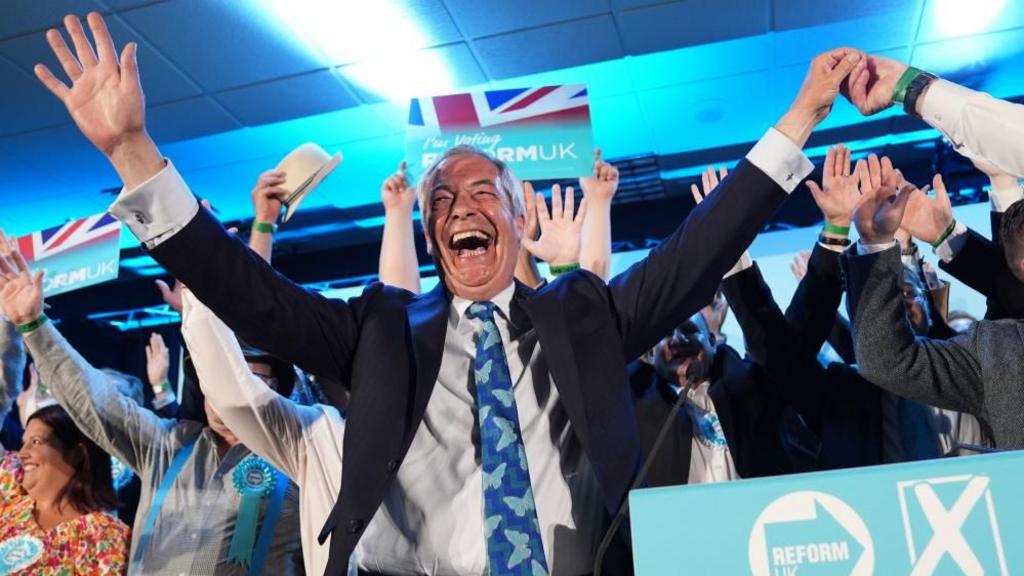
If such a result were repeated at the ballot box, it would represent a political earthquake.
Reform would not merely become a major opposition force.
It would be in a position to dominate Parliament.
The poll, based on research involving more than 16,000 people, projected Reform to win 381 seats, giving Nigel Farage’s party a large Commons majority. Labour was projected to fall dramatically to just 85 seats, while the Conservatives were forecast to win 70.
The numbers are only a projection.
They are not an election result.
But politically, the message is impossible to ignore.
Some of the most dramatic predictions concern senior Labour figures, including Angela Rayner and Rachel Reeves.
The idea that prominent Labour politicians could lose their own constituencies demonstrates just how far Britain’s political landscape may have shifted.
From protest party to potential governing force
For years, Reform was treated by Westminster as a protest movement.
Its supporters were often described as disillusioned Conservatives, Brexit voters or people angry with the political establishment.
The assumption was that Reform could win votes but struggle to translate those votes into parliamentary power.
That assumption is now being challenged.
The latest MRP projection paints an entirely different picture.
Instead of being a party capable of taking a handful of seats, Reform is presented as a potential governing force.
A projected 381 seats would give Farage an extraordinary parliamentary position.
It would mean that the political question was no longer whether Reform could win seats.
It would be whether the established parties could prevent Reform from becoming the dominant force in British politics.
The nightmare scenario for Labour
For Keir Starmer’s Labour Party, the projection is particularly alarming.
Labour entered government with a huge Commons majority after the 2024 general election.
Yet the party’s electoral coalition has always contained an important weakness.
Its enormous parliamentary majority was not matched by overwhelming support across the country.
The first-past-the-post electoral system transformed Labour’s vote distribution into a very large number of seats.
That means a relatively modest movement of voters can produce enormous changes in parliamentary representation.
If Reform takes significant numbers of votes from Labour in key constituencies, the consequences could be devastating.
The latest projection suggests precisely that possibility.
Angela Rayner’s seat becomes part of the story
One of the most striking elements of the forecast is the suggestion that Reform could take seats associated with some of Labour’s most recognisable figures.
Angela Rayner has long been one of the party’s most prominent politicians.
Her political identity is strongly connected to Labour’s traditional working-class appeal.
That makes the possibility of Reform defeating her particularly symbolic.
If a party campaigning heavily on immigration, taxation, political reform and opposition to the Westminster establishment can win in a constituency associated with a senior Labour figure, the message would be enormous.
It would suggest that traditional Labour loyalties are no longer reliable.
Rachel Reeves faces the same political threat
Rachel Reeves is another senior Labour figure whose political future could become part of the wider debate.
As Chancellor, Reeves is closely associated with the government’s economic policies.
That gives her enormous influence.
It also makes her vulnerable to political criticism.
Every tax rise, spending decision and economic disappointment can be attached directly to the Chancellor.
If Reform is able to turn economic dissatisfaction into electoral support, constituencies represented by senior Labour figures could become battlegrounds.
The symbolism would be powerful.
The party controlling the Treasury could find itself struggling to hold its own political heartlands.
Farage’s central argument
The poll strengthens Farage’s central political argument.
He has repeatedly told voters that the traditional parties are losing touch with ordinary people.
He argues that Labour has failed to deliver the change voters expected.
He argues that the Conservatives failed to address issues such as immigration and public spending.
And he presents Reform as the alternative.
The latest projection gives him a powerful rhetorical weapon.
He can now point to numbers suggesting that voters may actually be willing to replace the old political order.
That is very different from simply winning a protest vote.
The psychological effect of polling
Polling can influence politics even before a single vote is cast.
If voters believe a party cannot win, they may hesitate to support it.
They may fear wasting their vote.
But once polling suggests that a party could win hundreds of seats, that psychological barrier begins to disappear.
A voter who previously thought:
“Reform will never govern.”
could begin thinking:
“Reform could actually win.”
That change in perception can become self-reinforcing.
More support creates stronger polling.
Stronger polling creates greater media attention.
Greater attention creates more credibility.
And greater credibility can attract even more voters.
The Conservative nightmare
The Conservatives also have reason to be deeply concerned.
A projection of just 70 seats would represent a dramatic reduction in Conservative representation.
It would raise an existential question:
What is the purpose of the Conservative Party if Reform becomes the main political alternative to Labour?
For decades, Conservatives benefited from being the principal party of the British right.
But Farage is attempting to destroy that political monopoly.
His message to Conservative voters is straightforward.
If you want lower taxes, tougher immigration policies and a smaller state, why vote Conservative when Reform claims to offer a more decisive alternative?
That argument could be devastating.
Reform’s unusual coalition
One reason the 381-seat projection is so striking is that Reform’s potential coalition is politically unusual.
The party can attract former Conservatives.
It can attract former Labour voters.
It can attract people who previously supported UKIP.
It can attract Brexit voters.
And it can attract voters who rarely participate in elections but are angry about the direction of the country.
These groups do not necessarily agree on everything.
But they can agree on one thing:
They want political change.
That can be enough to produce a powerful electoral coalition.
The working-class realignment
The biggest long-term threat to Labour may be the continued realignment of working-class voters.
Traditional Labour politics was built around industrial Britain.
But Britain’s economy has changed.
Manufacturing has declined in many communities.
Trade union membership has fallen.
Cultural issues have become more important.
And Brexit transformed political identities.
Many voters who once considered Labour their natural political home no longer feel the same attachment.
Reform is attempting to capture that dissatisfaction.
If successful, it could permanently change British politics.
Immigration remains central
Immigration is one of Reform’s strongest issues.
Farage has made reducing immigration a central part of his political message.
The party argues that high levels of migration can put pressure on housing, public services and infrastructure.
Labour has attempted to address immigration while balancing economic and humanitarian considerations.
But Reform believes the government’s approach is too weak.
The political advantage for Farage is that immigration is an issue where many voters have strong emotional views.
That makes it an effective mobilisation tool.
Taxation and the cost of living
Economic pressure provides another opportunity.
Households care about what they have left after taxes and essential expenses.
If voters feel that government takes too much while delivering too little, opposition parties can exploit that frustration.
Reform’s promise of lower taxation and reduced government spending is therefore designed to appeal directly to voters who feel squeezed.
But that message also creates a challenge.
Lower taxes require lower spending, faster economic growth or both.
If Reform ever becomes government, voters will demand detailed answers.
Promises will have to become budgets.
The difference between a poll and reality
Despite the excitement surrounding the projection, caution is essential.
MRP models are not crystal balls.
They depend on assumptions about voting behaviour, turnout, constituency-level support and the stability of polling data.
A dramatic projection can change rapidly.
An election could still be years away.
Political parties can recover.
Leaders can be replaced.
Economic conditions can improve.
Scandals can reshape campaigns.
And Reform itself could make mistakes.
Therefore, 381 seats should be understood as a scenario rather than a prediction of what will definitely happen.
Reform’s biggest challenge
The more successful Reform becomes, the more scrutiny it will face.
As a protest party, Reform can focus heavily on what is wrong with Britain.
As a potential governing party, it must explain how it would fix those problems.
That is a much harder task.
How would Reform fund public services?
How would it reduce taxes?
How would it manage the NHS?
How would it negotiate Britain’s international relationships?
How would it handle immigration within the law?
How would it manage local government?
How would it respond to economic shocks?
These are the questions voters will eventually ask.
Farage’s leadership will be tested
The entire Reform project remains heavily associated with Nigel Farage.
That is both its greatest strength and one of its biggest vulnerabilities.
Farage has enormous name recognition.
He is an experienced campaigner.
He understands media politics.
And he has demonstrated an extraordinary ability to remain politically relevant for decades.
But a party seeking government needs more than one personality.
It needs a deep bench of credible politicians.
It needs disciplined candidates.
It needs experienced ministers.
And it needs a coherent long-term programme.
The 381-seat projection makes that challenge much more urgent.
Labour cannot simply dismiss the poll
Labour politicians would be perfectly entitled to point out that the projection is only a poll.
But dismissing it would be dangerous.
The numbers reflect something more important than the exact seat count.
They reflect the possibility of a dramatic shift in voter sentiment.
If even a fraction of the projected movement occurs, Labour could lose substantial numbers of seats.
That should force the party to ask difficult questions.
Why are voters leaving?
Which communities feel ignored?
Why is Reform gaining support?
What can Labour do to rebuild trust?
Those questions cannot be answered by attacking the pollster.
The next election could be unrecognisable
British politics has entered a period of extraordinary instability.
The old Conservative-Labour competition is weakening.
Reform is rising.
Smaller parties are becoming more significant.
Voters are changing allegiance more frequently.
And political identities inherited from previous generations are losing their power.
That means the next general election could look very different from the last one.
Seats that once appeared safe could become battlegrounds.
Senior politicians could lose.
Entire regions could change colour.
And the meaning of a “safe seat” could become increasingly difficult to define.
The 381-seat question
Ultimately, the most important question is not whether Reform will literally win 381 seats.
The important question is whether Britain is moving towards a political realignment in which Reform becomes one of the country’s dominant parties.
If the answer is yes, then the implications are enormous.
Labour would have to rebuild its coalition.
The Conservatives would have to redefine themselves.
And Reform would have to transform from an insurgent movement into a professional governing organisation.
For Farage, the latest projection is therefore both an opportunity and a warning.
It proves that his political strategy has the potential to take Reform far beyond its original role as a protest party.
But it also means voters will begin asking whether the party is genuinely ready for power.
A political earthquake in waiting?
Imagine the scene on election night.
A Reform candidate takes a traditional Labour seat.
Then another.
Then another.
The map begins changing colour.
A senior Labour politician loses.
A Conservative stronghold falls.
Broadcasters begin asking whether Britain is witnessing the biggest political realignment in generations.
That scenario remains hypothetical.
But the latest poll has made it easier to imagine.
And that may be the most important thing about it.
Politics often changes before election results confirm that it has changed.
Voters begin to shift.
Old loyalties weaken.
New parties gain credibility.
And eventually, the numbers catch up.
For now, 381 seats is only a projection.
But if Nigel Farage can turn the political anger reflected in the polling into a durable electoral coalition, the next general election could be far more dramatic than Westminster expects.
The question is no longer simply whether Reform can win.
The question is how far it can go.