
High Court Flags Row Explodes as Oxfordshire Bans Unauthorised Displays on Lampposts
Britain has always had a complicated relationship with its national symbols.
For some people, the Union Flag and the St George’s Cross represent pride, history and a sense of belonging.
For others, the sight of hundreds of flags appearing along streets can be politically charged, particularly when the displays are connected to wider arguments about immigration, national identity and Britain’s future.
Now that debate has reached the High Court.
A legal battle in Oxfordshire has resulted in an injunction preventing the unauthorised placing of flags on or near public highways, including lampposts and other street infrastructure.
The ruling has immediately become politically explosive.
Critics have portrayed the decision as an attack on British and English identity.
Supporters say that interpretation completely misses the point.
According to Oxfordshire County Council, the issue was never whether people should be allowed to love their country or display national flags.
It was about whether individuals could attach objects to public infrastructure without permission, potentially creating safety risks and obstructing council workers.
That distinction is important.
But politically, it has proved almost impossible to keep the two questions separate.
The controversy began with the rise of the “Raise the Colours” movement, an online campaign that encouraged people to display Union and St George’s flags around the country.
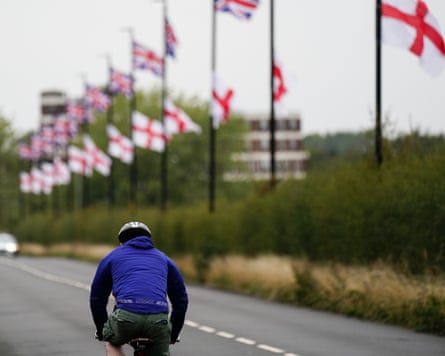
Since 2025, flags have appeared on lampposts, road furniture, roundabouts and other public infrastructure in various parts of England.
Supporters say they are simply showing national pride.
But some councils have complained about the consequences.
In Oxfordshire, the county council said flags had repeatedly been attached to highway infrastructure without permission. It also reported incidents involving obstruction, confrontation and alleged harassment of workers attempting to remove them.
The council eventually went to the High Court.
And it won.
The court granted an injunction preventing the continued unauthorised placement of flags on or near the public highway.
Several individuals associated with Raise the Colours agreed not to put up flags, encourage others to do so or obstruct people carrying out removal work.
The judgment went further than a simple disagreement about decorations.
Mr Justice Dexter Dias noted that the activity had continued persistently despite previous attempts by the council to stop it.
He also heard evidence that council staff had faced abuse and intimidation while removing flags.
According to ITV’s report of the judgment, some maintenance workers were reportedly so concerned about their safety that they were working in fear, with additional precautions being taken.
If that account is accurate, the council had a legitimate reason to seek court intervention.
Public highways belong to everyone.
Lampposts are not private property.
Road infrastructure exists for public purposes.
And attaching objects to it without permission can create legal and practical problems regardless of what the objects represent.
A British flag does not automatically become exempt from ordinary rules simply because it is a British flag.
That should be the starting point of the discussion.
Yet it would also be naïve to pretend that the controversy is purely about highway safety.
The political context matters enormously.
The explosion in national flag displays has coincided with intense arguments over immigration and national identity.
In some communities, flags have become symbols of opposition to immigration.
In others, they are viewed as expressions of patriotism.
That means the same piece of fabric can communicate entirely different messages depending on who is looking at it.
This is why the Oxfordshire case has become such a lightning rod.
For critics of the council, the court order looks like another example of authorities being uncomfortable with visible British identity.
They ask an obvious question:
If councils are happy to display the Union Flag and St George’s Cross themselves, why should ordinary residents be prevented from putting them on public lampposts?
That question has political force.
Oxfordshire County Council itself acknowledges that it proudly flies both flags at County Hall.
Council leader Tim Bearder has also said that residents have the right to display flags on their own private property.
So this is not a blanket prohibition on British flags.
It is a restriction on unauthorised use of public infrastructure.
That distinction should not be lost.
But neither should another distinction.
Patriotism is not the same thing as ownership of public space.
Someone can be deeply proud of being British or English without having an automatic right to attach objects to a council-owned lamppost.
The same principle would apply to political posters, commercial advertisements, football banners or any other material.
The question is not necessarily what the object represents.
The question is whether it has been placed lawfully and safely.
That principle should apply consistently.
If a council allows national flags during major sporting events but prohibits unauthorised permanent attachments, it should explain the rules clearly.
If it allows one organisation to use public infrastructure while preventing another from doing so, it needs a defensible reason.
And if flags are removed, the authorities should be able to explain why.
Transparency matters because the political atmosphere surrounding the issue is already highly charged.
The St George’s Cross has increasingly become entangled with Britain’s immigration debate.
That is unfortunate.
A national flag should be capable of representing everyone.
Someone who supports stricter immigration controls should be able to display the St George’s Cross.
Someone who supports high immigration should also be able to display it.
Someone who simply loves English football should be able to wave it.
The flag itself should not belong to one political movement.
This is precisely why the Oxfordshire dispute matters beyond the legal details.
Britain needs to avoid creating a situation in which national symbols become permanently associated with political conflict.
If the flag becomes identified exclusively with one side of a culture war, everyone loses.
The government has previously encouraged councils and public bodies to take sensible approaches to flag flying while recognising that local authorities have to deal with individual circumstances.
Current guidance broadly supports national, regional and sporting flags when they are displayed safely and within the relevant rules.
That suggests the real issue is not whether Britain should fly its flags.
It is where and how those flags are displayed.
That should be a relatively straightforward question.
Unfortunately, British politics rarely leaves anything straightforward.
For Reform UK and other critics of the establishment, the Oxfordshire ruling offers another opportunity to argue that traditional British identity is being pushed aside.
Nigel Farage and Reform politicians can point to the court decision and ask why people should need permission to display their own national symbols.
That message is likely to resonate with voters who already feel that patriotism has become politically suspect.
But the council has a powerful response.
It can say that the issue is not patriotism.
It is public safety and lawful use of public infrastructure.
That argument also has public support.
Most people would probably agree that councils should be able to maintain roads and street furniture without workers being confronted or obstructed.
Most would also agree that people should not attach objects to public infrastructure simply because they disagree with the authority responsible for maintaining it.
The difficult question is where the line should be drawn.
Could councils eventually use the same logic to remove almost any politically inconvenient display?
Could national flags be treated differently from commercial signs?
Could councils decide that certain symbols make some residents uncomfortable and therefore remove them?
Those are legitimate concerns.
A democracy should be careful when “community cohesion” becomes a justification for suppressing lawful expression.
But that is not necessarily what has happened in Oxfordshire.
The court order is focused on unauthorised activity involving public highways.
It does not prevent people from flying flags from their homes.
It does not outlaw the St George’s Cross.
It does not make patriotism illegal.
And it does not give local authorities unlimited power to ban national symbols.
Those facts matter.
So does the conduct that led to the case.
If council workers really were being intimidated or obstructed while carrying out lawful duties, then the authorities had a responsibility to protect them.
Nobody should be threatened because they are removing an unauthorised object from a lamppost.
That would be true whether the object was a St George’s Cross, a Union Flag or a political banner.
The principle should be universal.
The same is true of public property.
If residents want to decorate their own homes with flags, that is a very different matter.
Private property is not the same as public infrastructure.
That is why headlines suggesting that the High Court has simply “banned Brits from flying their flags” risk oversimplifying what the judgment actually does.
The ruling is narrower.
But the political argument surrounding it is much wider.
It touches on questions that Britain has struggled with for years.
What does patriotism mean?
Who owns national identity?
Can people be proud of Britain without being accused of hostility towards others?
Can councils maintain neutral public spaces without appearing hostile to national culture?
And can national symbols remain genuinely national in an increasingly divided political environment?
There are no easy answers.
But there is one principle worth defending.
Britain should not be embarrassed by its national symbols.
The Union Flag and St George’s Cross are legitimate symbols of British and English identity.
People should be able to display them proudly and peacefully.
At the same time, pride does not create an automatic licence to ignore laws governing public infrastructure.
A free society requires both expression and rules.
The challenge is ensuring that those rules are applied fairly.
Oxfordshire’s leaders now have a responsibility to demonstrate that the injunction is about precisely what they say it is about: safety, lawful use of highways and protecting workers.
They should not turn it into a broader campaign against patriotism.
And critics have a responsibility too.
They should not pretend that a restriction on attaching flags to public lampposts is equivalent to banning people from displaying the flag.
It is not.
The distinction may sound technical.
But in a politically polarised country, technical distinctions matter.
Because once people believe that their identity is under attack, even an ordinary council regulation can become a symbol of something much larger.
That is exactly what has happened here.
A dispute over lampposts has become a national argument about Britain itself.
And perhaps that tells us something important.
The real battle is not about pieces of fabric.
It is about trust.
People want to know that their national identity is respected.
Councils want to know that their public spaces can be managed safely.
Workers want to know that they can do their jobs without intimidation.
And everyone should expect the law to apply consistently.
The High Court has now drawn a line in Oxfordshire.
Unauthorised placement of flags on or near public highways can be stopped.
That does not mean Britain has banned its own flags.
It means that public infrastructure comes with rules.
The political question is whether those rules will be applied fairly — without turning patriotism into something suspicious, and without allowing claims of patriotism to become an excuse for ignoring the law.
That is the balance Britain now needs.
Because there is nothing wrong with flying the Union Flag.
There is nothing wrong with flying the St George’s Cross.
And there is nothing wrong with being proud of Britain or England.
But neither is there anything wrong with insisting that public roads and lampposts are managed safely and lawfully.
A confident country should be able to defend both principles at once.