
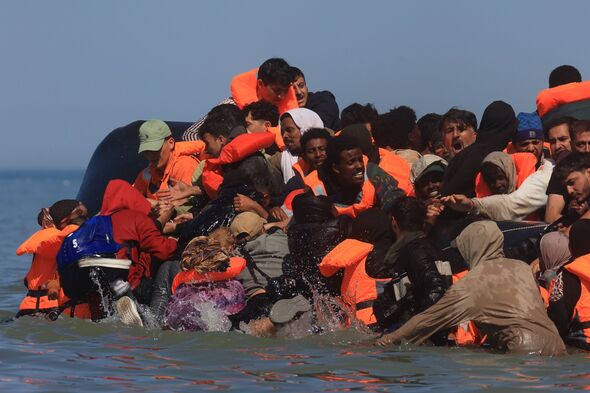
Migrant Dinghy Carrying 160 People Catches Fire in Channel, Sparking Huge Rescue Rational
A major rescue operation was launched in the English Channel after an overloaded migrant boat carrying around 160 people caught fire during an attempted crossing from France to Britain.
The incident unfolded on Tuesday morning, with French and British authorities responding to a rapidly developing emergency at sea. Reports initially put the number of people aboard at around 160, while later accounts gave different totals, with some authorities reporting that 157 people were rescued and other reports putting the number at more than 170.
The dramatic incident has once again highlighted the dangers faced by people attempting to cross one of the world’s busiest shipping routes in small, overcrowded vessels.
According to reports, the boat’s engine caught fire as it was travelling in the Channel, causing the situation to deteriorate rapidly. French and British rescue teams were mobilised, with vessels from both countries taking part in the operation.
The rescue took place near Boulogne-sur-Mer, on the French coast, close to the boundary between French and British search-and-rescue zones.
French vessels rescued more than 100 people, while British vessels brought dozens more to safety. The people rescued were subsequently expected to be taken to Boulogne-sur-Mer for medical assessment and assistance.
The incident demonstrates just how quickly a Channel crossing can turn into a life-threatening emergency.
A small boat that may appear capable of travelling towards Britain can become dangerously unstable when carrying a very large number of passengers. An engine fire adds another potentially catastrophic risk, particularly when there is limited space for people to move and little protection from the cold waters surrounding them.
Reports said the vessel was severely overcrowded.
That detail is particularly significant because overcrowding has repeatedly been identified as one of the greatest dangers associated with Channel crossings. When dozens or even more than 100 people are packed onto a small inflatable vessel, any sudden movement, mechanical failure or attempt to escape a fire can create a serious risk of capsizing.
In this case, the situation became so dangerous that people had to be rescued from the boat.
Some reports said the vessel eventually capsized, although accounts differed over the precise circumstances and the number of people aboard. The Independent reported a figure of 173 people, while other reports gave a lower figure of 157 rescued.
Despite those discrepancies, the scale of the emergency is clear.
More than 150 people were involved in a major maritime rescue after the vessel caught fire.
A huge operation involving France and Britain
The rescue required cooperation between French and British authorities.
French vessels were responsible for rescuing a substantial proportion of those aboard, while British vessels also took people from the stricken boat.
According to the reported figures, 103 people were rescued by French vessels and 54 by British vessels, giving a total of 157.
The operation demonstrates the importance of close cooperation between the two countries when emergencies occur in the Channel.
Although Britain and France have frequently disagreed over how to tackle irregular migration, their maritime authorities must work together when lives are at immediate risk.
There is no room for political argument when a vessel is on fire.
The priority is simply to prevent people from drowning or suffering serious injury.
French maritime authorities have previously stressed the difficulty of intervening in overloaded migrant boats. Trying to force passengers off an unstable inflatable vessel can itself cause a mass casualty event, because people may suddenly move to one side and cause the boat to capsize.
That is one reason rescue operations can be complicated.
In this particular case, the fire changed the situation dramatically.
Once the engine caught fire and the condition of the vessel deteriorated, rescuers faced a rapidly escalating emergency.
Passengers had reportedly refused earlier assistance
One of the most striking aspects of the incident was that some passengers had reportedly refused rescue assistance before the fire became critical.
According to reporting compiled from several sources, five people requested assistance during the night, while the remaining passengers initially refused help and continued towards Britain.
That decision illustrates the enormous pressure facing people attempting the journey.
For many migrants, reaching Britain is considered the objective of the journey, and being returned to France may be viewed as a failure.
But the Channel is not a normal stretch of water.
It is a busy international shipping route with strong currents, rapidly changing weather conditions and extremely cold water. A small inflatable boat can become difficult to control even in relatively moderate conditions.
An engine fire adds another layer of danger.
Once flames or smoke begin affecting a boat carrying a large number of people, panic can spread quickly.
The political argument returns
The incident has inevitably become part of Britain’s wider immigration debate.
Channel crossings have become one of the most politically sensitive issues in the country, with successive governments promising to reduce the number of people making the dangerous journey.
Andy Burnham’s Government has said it intends to be “relentless” in tackling small-boat crossings, while also arguing that safe routes for people seeking protection are necessary to reduce the incentive to use criminal smuggling gangs.
The latest incident provides ammunition to both sides of that argument.
Supporters of tougher immigration controls will point to the sheer number of people packed onto one boat as evidence that the current system is out of control.
They will argue that criminal gangs are willing to place enormous numbers of people onto vessels that are plainly unsuitable for the journey because the demand for crossings remains high.
Those concerned primarily with humanitarian issues will emphasise a different point.
They will argue that the fact people are willing to risk their lives in such conditions demonstrates how desperate some migrants are to reach Britain.
Both arguments can coexist.
The immediate reality is that people were placed in serious danger.
The role of criminal gangs
The incident has also renewed scrutiny of the organised criminal networks behind many Channel crossings.
Smugglers have a financial incentive to put as many passengers as possible onto each boat.
The more people transported on a single crossing, the more money can potentially be generated.
But that business model creates extraordinary risks.
A vessel carrying 20 people is already vulnerable.
A vessel carrying more than 150 people is a completely different proposition.
The sheer number of passengers makes evacuation difficult, while the lightweight construction of many boats means that they can be damaged or destabilised relatively easily.
The engine fire therefore exposed the consequences of an overcrowded crossing in dramatic fashion.
It is also why British and French authorities have repeatedly sought to disrupt departures before boats enter the Channel.
Once a vessel is already at sea, stopping the crossing becomes significantly more difficult.
A dangerous route
The English Channel is among the busiest waterways in the world.
Large commercial ships, ferries and other vessels operate throughout the area, creating additional hazards for small boats.
A dinghy packed with passengers can be difficult for larger ships to see, particularly in darkness or poor weather.
The risk does not end once a boat reaches British waters.
Mechanical failure can leave passengers stranded.
Strong waves can overwhelm an inflatable vessel.
And if people panic, the boat can rapidly become unstable.
The latest fire demonstrates how several of these dangers can combine within minutes.
What begins as an attempted journey can become a major search-and-rescue operation before passengers have any opportunity to reach safety.
The numbers remain politically significant
The scale of the Channel migration phenomenon has made individual incidents increasingly important in Britain’s political debate.
According to the reporting surrounding the latest rescue, thousands of people have crossed from France to Britain by small boat this year, although the precise total changes as new arrivals are recorded.
The British and French governments have therefore been under growing pressure to demonstrate that their policies are working.
The UK has sought increased cooperation with France, including additional patrols and surveillance aimed at preventing boats from launching.
But the continued appearance of increasingly large boats suggests that smugglers are adapting.
The phrase “mega-dinghy” has increasingly appeared in media coverage because some vessels now carry numbers of passengers far beyond what ordinary people would associate with a small inflatable boat.
The latest incident is an extreme example.
A vessel carrying around 160 people is effectively operating at a scale that creates enormous safety problems.
What happens to those rescued?
After the rescue, the migrants were expected to be taken to Boulogne-sur-Mer for medical checks and assistance.
The British Government said those rescued would be safely returned to France, according to reports.
That response reflects the broader policy challenge facing Britain.
Rescuing people from a dangerous boat is one issue.
Determining what happens afterwards is another.
The Government wants to deter people from making the crossing, while France wants to prevent Britain from becoming the preferred destination for irregular migration.
At the same time, international obligations relating to search and rescue mean that people in immediate danger at sea must be assisted.
That creates an unavoidable tension.
A successful rescue saves lives, but governments also want to prevent smugglers from viewing rescue arrangements as part of the business model.
Finding a solution requires cooperation rather than simply blaming one another.
A warning of what could have happened
The most important feature of this incident is that it ended in a rescue rather than a mass-casualty tragedy.
With more than 150 people aboard an overcrowded vessel, an engine fire could easily have produced a far worse outcome.
If passengers had entered the water in large numbers, rescuers would have faced a desperate race against time.
Cold water can quickly become life-threatening.
Panic can lead to people becoming separated from one another.
And an overloaded boat can capsize with little warning.
The fact that a major rescue operation was necessary is therefore a warning in itself.
It demonstrates the extraordinary risks involved in the current Channel migration route.
A political test for Burnham
For Andy Burnham, the incident will intensify pressure on the Government.
The Prime Minister has promised stronger enforcement and closer cooperation with France.
Opposition parties will argue that those measures are not going far enough if increasingly large numbers of people continue attempting the journey.
Reform UK in particular is likely to use the incident to reinforce its argument for much tougher immigration policies.
The Government, however, can point to the cooperation between British and French authorities as evidence that enforcement and rescue operations are already working together.
It can also argue that tackling the criminal gangs requires more than simply preventing boats from leaving France.
It requires disrupting the networks that organise crossings, strengthening international cooperation and creating credible alternatives for people who genuinely qualify for protection.
That is a far more complicated task.
The human cost
Behind the political arguments are more than 150 individual people whose lives were suddenly placed in danger.
Whatever their reasons for attempting the journey, the fire demonstrated how little control passengers can have once a crossing goes wrong.
They depend heavily on the vessel’s crew, the weather, the engine and ultimately the ability of French or British rescuers to reach them.
The Channel does not forgive mistakes.
A mechanical failure can become an emergency.
An emergency can become a disaster.
And a disaster involving more than 150 people could have consequences that would reverberate across Britain and France for years.
This time, rescuers managed to bring those aboard to safety.
That should be recognised.
But the fact that such a large number of people were placed on an overloaded vessel in the first place remains deeply troubling.
The incident is therefore more than another headline about Channel crossings.
It is a reminder of the dangerous reality behind the statistics.
A boat carrying around 160 people caught fire.
French and British teams were forced into a major rescue operation.
More than 150 people were ultimately brought to safety, although reports differ over the precise number involved.
And once again, Britain is confronting the same difficult question: how can it stop dangerous small-boat journeys without creating an even greater humanitarian crisis at sea?
For Burnham’s Government, the answer will be judged not by promises but by what happens next.
If crossings continue to involve increasingly large and dangerously overcrowded boats, political pressure will only intensify.
But if Britain and France can disrupt the smuggling networks, reduce dangerous departures and create workable alternatives for those who genuinely need protection, the number of people placed in this kind of peril could eventually fall.
Until then, the burning dinghy in the Channel stands as a stark warning of the dangers facing everyone involved.
Leave a Reply
You must be logged in to post a comment.