

Nigel Farage Issues Huge Warning to Rivals After Clacton By-Election Win

Nigel Farage has delivered a powerful warning to his political rivals after securing a decisive victory in the Clacton by-election, insisting that Reform UK remains a major force in British politics. The result has renewed attention on Farage’s political influence and raised fresh questions about the future direction of the country’s political landscape.
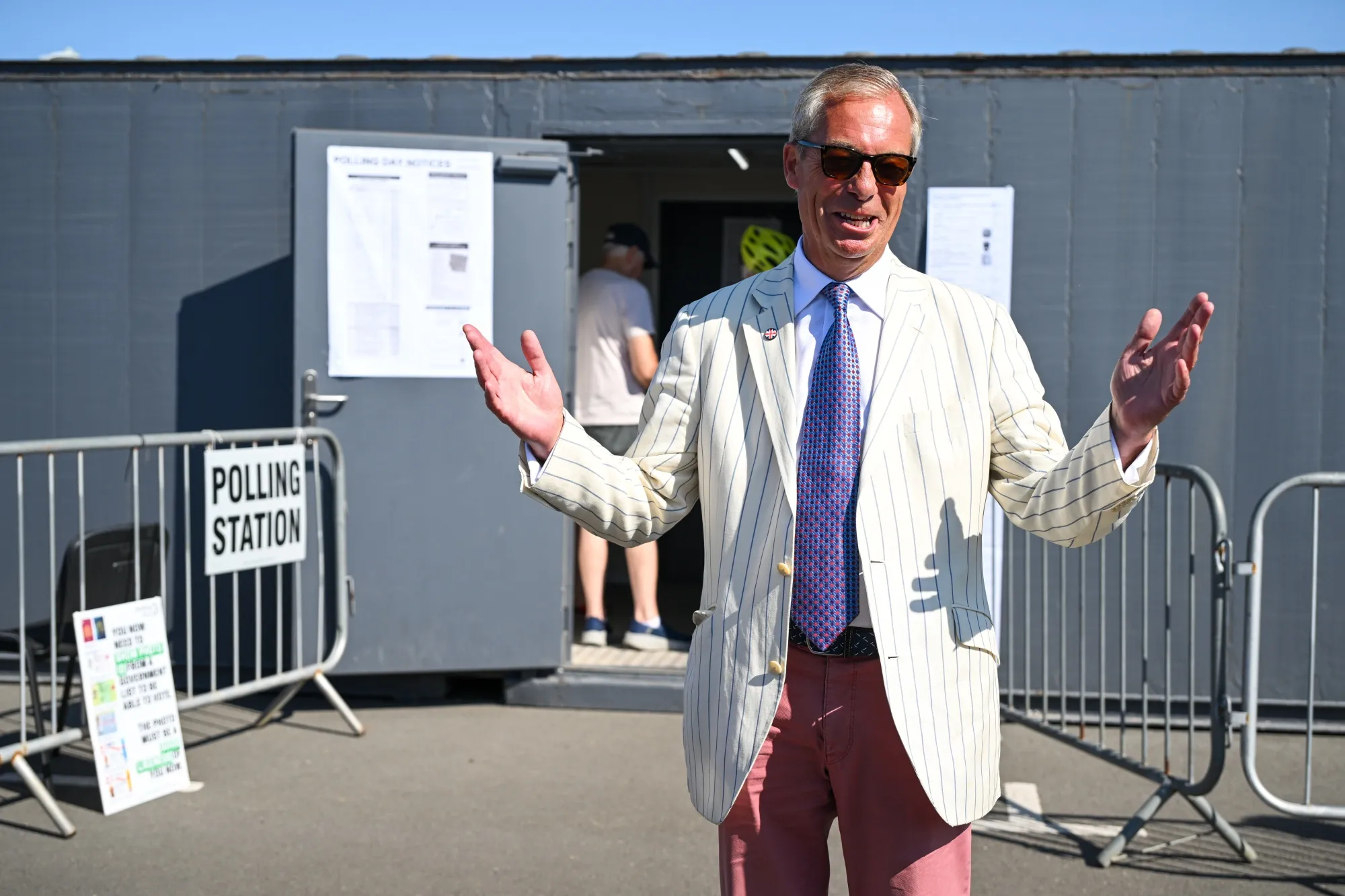
Farage won the Clacton seat with 22,239 votes, representing around 63 per cent of the ballots cast. His nearest rival was the satirical candidate Count Binface, who secured 9,455 votes, or roughly 27 per cent. The unusual nature of the contest attracted national attention because the major established parties did not field candidates, leaving Farage to campaign against a large field of independent and novelty candidates.
Although the result was widely expected, the scale of Farage’s victory allowed him to claim that his political message continues to resonate strongly with voters in one of Reform UK’s most important constituencies. More importantly, the result gives Farage an opportunity to send a message beyond Clacton itself. His argument is that opponents should not mistake recent difficulties for the disappearance of Reform UK’s electoral appeal.
The Clacton contest was unusual from the beginning. Farage had previously won the constituency at the 2024 general election, taking 46.2 per cent of the vote. In 2026, he voluntarily resigned his parliamentary seat and immediately sought to win it again through a by-election. His decision was linked to continuing scrutiny surrounding financial declarations and donations. Farage argued that voters should have the opportunity to make their own judgment about him rather than allowing parliamentary procedures or political opponents to determine his future.
The strategy was controversial, but it produced the result he wanted. Farage returned to Parliament with a considerably larger share of the vote than he achieved in 2024. For his supporters, this is evidence that the Reform leader has strengthened his personal mandate. For his critics, however, the result must be interpreted with caution because the traditional political parties chose not to contest the election and turnout was relatively low.
Nevertheless, Farage’s victory carries political significance. Clacton has become more than an ordinary parliamentary constituency for Reform UK. It represents a test of whether Farage can transform his long-standing reputation as a protest politician into sustained electoral power. His victory suggests that, at least in parts of England, there remains a substantial electorate prepared to support his approach to immigration, national identity, government reform and dissatisfaction with established political parties.
The result also presents a dilemma for Reform UK’s rivals. If mainstream parties dismiss Farage’s victory as nothing more than the product of an unusual by-election, they risk underestimating the underlying political mood. Yet if they treat the result as proof that Reform is destined to dominate British politics, they could exaggerate its national importance. The challenge for Labour, the Conservatives and other parties is therefore to understand what the Clacton result actually represents.
One interpretation is that Farage has successfully created a highly motivated political base. His supporters are often attracted to his direct language and his rejection of traditional political conventions. Reform UK has built much of its identity around the argument that established parties are too cautious, too bureaucratic and too disconnected from ordinary voters. Farage’s political style deliberately contrasts with the language normally associated with Westminster.
This was particularly visible during the Clacton campaign. Farage did not behave like a conventional candidate throughout the contest. He also did not attend the final count, instead addressing supporters elsewhere. His absence became a subject of controversy, particularly because his team referred to security concerns while police statements reportedly indicated that appropriate security arrangements had been made.
For his opponents, this provided an opportunity to question Farage’s political judgment. They argued that a candidate should be present when voters’ decisions are formally announced. Supporters, however, saw the controversy differently, viewing it as another example of Farage refusing to follow what they regard as unnecessary political conventions.
That difference in interpretation is central to understanding Farage’s appeal. To his critics, his rejection of established conventions can appear irresponsible or theatrical. To his supporters, it reinforces the image of a politician who refuses to play by Westminster’s traditional rules.
The biggest question now is whether the Clacton result can be translated into a wider national movement.
Reform UK’s national position is not identical to its strength in Clacton. The constituency has particular political characteristics and has previously demonstrated strong support for Eurosceptic and anti-establishment politics. Farage therefore cannot automatically assume that a 63 per cent vote share in Clacton will be repeated across the country.
Even so, his victory provides a valuable psychological boost. Politics is partly about momentum and perception. A successful by-election can create the impression that a party is growing stronger, while a defeat can generate questions about leadership and strategy. Farage has emerged from Clacton able to argue that Reform remains electorally relevant.
This is the warning that his rivals cannot easily ignore.
If established parties assume that voters who support Reform will automatically return to them, they could make a serious strategic mistake. Reform’s success has been driven partly by dissatisfaction with traditional political choices. Some voters are not necessarily committed to every Reform policy, but they are willing to use their vote to express frustration with the political establishment.
That frustration can be particularly powerful in communities that feel overlooked by national government. Issues such as immigration, public services, economic insecurity, housing, crime and the cost of living can combine to create a sense that political promises have not produced meaningful improvements.
Farage has repeatedly attempted to position himself as the politician willing to articulate those frustrations without the language of traditional party politics. Whether voters agree with his solutions is a separate question. His political strength lies partly in his ability to identify issues that generate strong emotional reactions.
The presence of Count Binface in the Clacton contest added another unusual dimension. The satirical candidate won almost 9,500 votes, making the result one of the most extraordinary by-elections in recent British political history. His performance demonstrated that some voters were not treating the contest as a conventional ideological battle. Instead, the election became a mixture of serious political protest, humour and dissatisfaction with the political system.
This should concern Farage as well as his opponents. A large vote for a satirical candidate may suggest that a section of the electorate is disengaged from conventional politics altogether. While Farage can celebrate his victory, the result also demonstrates that not every dissatisfied voter is automatically attracted to Reform UK.
There is another major issue that will continue to follow Farage: scrutiny of his financial affairs. The parliamentary standards investigation connected with alleged undeclared financial support has resumed following the by-election. Reports have focused particularly on a £5 million donation associated with cryptocurrency businessman Christopher Harborne, as well as other financial matters. Farage denies wrongdoing and has described the scrutiny as politically motivated.
This means that his political future will not be determined by elections alone. Parliamentary investigations, public confidence and the ability of Reform UK to demonstrate effective political leadership will also matter.
For Farage, therefore, the Clacton victory is both an achievement and a new test. He has demonstrated that he can win the seat comfortably, but now he must show what he intends to do with the renewed mandate.
The wider political question is even more important. Britain has experienced substantial changes in its electoral politics over recent years. The decline of traditional party loyalties, the rise of populist movements and increasing dissatisfaction with Westminster have created opportunities for new political forces. Reform UK is one of the clearest beneficiaries of this transformation.
Farage’s message to his rivals is consequently straightforward: do not assume that Reform UK will simply disappear.
The Clacton result gives him a platform from which to continue challenging the established parties. It strengthens his authority within Reform UK and provides evidence that his personal political brand remains powerful. His opponents may question the circumstances of the by-election, the turnout or the unusual list of candidates, but they cannot erase the fact that Farage won decisively.
Whether this victory becomes the beginning of another major political advance or simply a strong result in a uniquely favourable constituency remains uncertain.
What is clear, however, is that Nigel Farage has once again placed himself at the centre of Britain’s political conversation. His return to Parliament means that Reform UK will continue to demand attention, while Labour and the Conservatives will have to decide how seriously to respond to the challenge.
For Farage’s supporters, Clacton represents confirmation that the political establishment has underestimated him before and may be making the same mistake again. For his critics, it is a victory that should be kept in perspective.
The truth probably lies somewhere between those two positions. Clacton does not prove that Reform UK has conquered Britain, but neither does it support the idea that Farage’s political influence is fading away.
Instead, the result demonstrates something more important: there remains a significant appetite among British voters for political disruption. Farage has built his career around understanding and exploiting that appetite. His victory in Clacton ensures that, for now at least, he remains one of the country’s most consequential and controversial political figures.
And that is the warning his rivals will find hardest to ignore.