
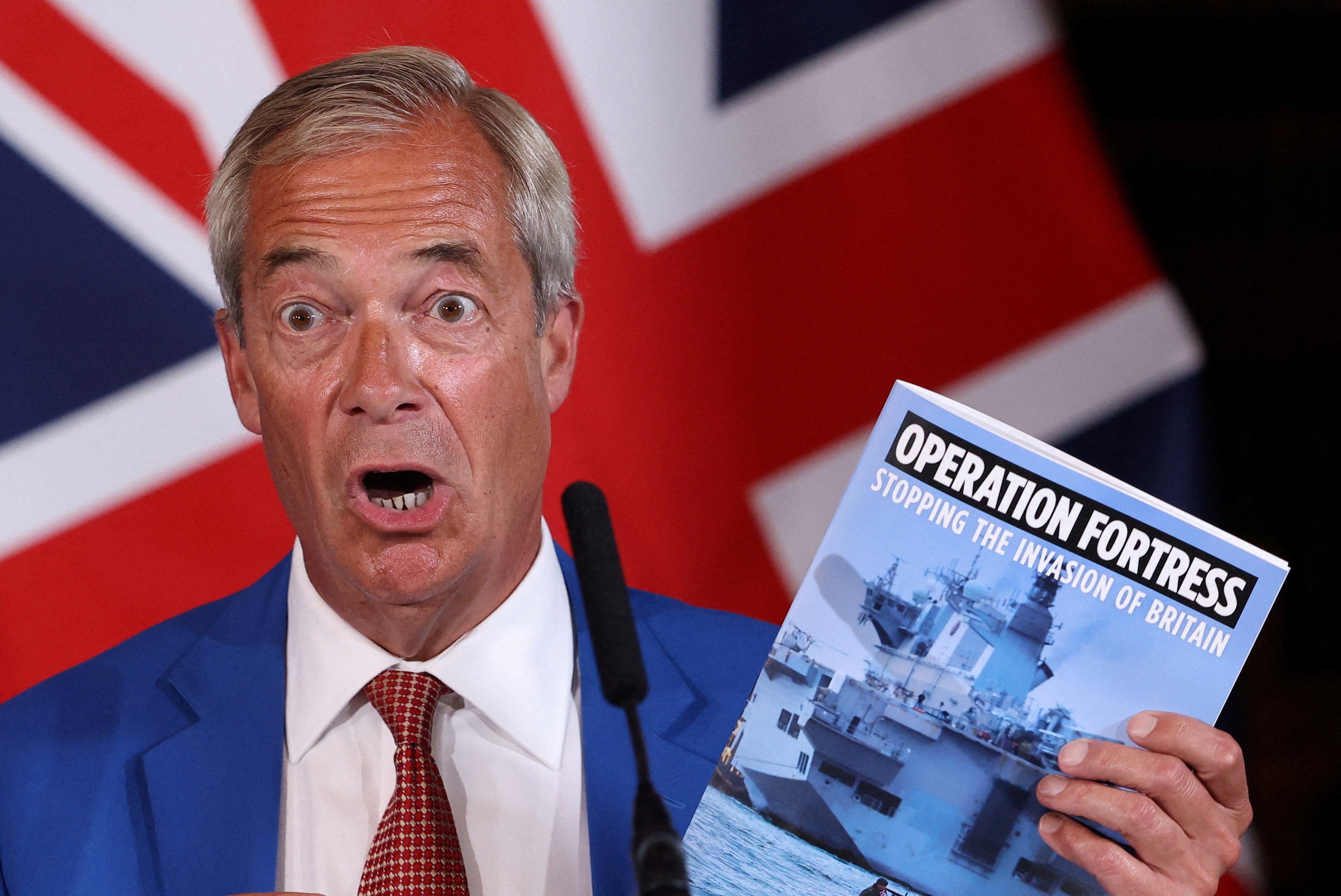
Farage Warns France Exactly What He Plans to Do on Migrants – ‘You’ll Have to Lump It!’
Nigel Farage has delivered a blunt warning to France over the future of Channel crossings, insisting that a Reform UK government would intercept small boats carrying migrants and return those on board to French territory.
The Reform leader has challenged Paris to stop the policy if it objects, declaring that France would simply “have to lump it” if his party comes to power.
The extraordinary warning comes as the Channel migration crisis once again dominates British politics. Farage has unveiled an ambitious plan known as Operation Fortress, under which the Royal Navy would be deployed to prevent unauthorised small boats from reaching Britain. The proposal would represent a dramatic escalation in Britain’s response to Channel crossings.
Farage argues that the policy is necessary to break the business model of people-smuggling gangs and prevent further deaths at sea.
But the proposal has immediately raised questions about international law, French sovereignty and whether Britain could legally return migrants without the cooperation of French authorities.
Farage’s warning to Paris
The Reform UK leader’s message to France was uncompromising.
If Reform were to enter government, Farage says Britain would no longer simply allow small boats to cross the Channel and then process passengers after they arrive on British soil.
Instead, the Royal Navy would intercept the vessels and return people to France or, in some circumstances, Belgium.
Farage has acknowledged that the French government may initially oppose the policy.
His response has been characteristically blunt: France would have to accept the consequences.
The confrontation illustrates how dramatically Reform wants to change Britain’s approach to the Channel.
Rather than treating the crossings primarily as an immigration and asylum-processing issue, Farage is framing them as a border-security problem requiring a military response.
Operation Fortress
Reform’s proposal, branded Operation Fortress, would involve the Royal Navy intercepting small boats before they reach Britain.
The party has described it as potentially the largest military operation in the English Channel since the Second World War.
Under the plan, military personnel would monitor boats approaching British waters, intercept unauthorised vessels and transfer passengers to larger naval ships. Those on board would receive food, water and medical assistance before being returned towards France or Belgium.
Reform argues that the policy could dramatically reduce crossings because smugglers would no longer be able to offer migrants a realistic prospect of reaching Britain.
Farage has even suggested that crossings could be stopped within weeks of a Reform government taking office.
The theory behind the policy is simple: remove the incentive to make the journey and the smuggling industry will collapse.
But critics say the practical reality would be considerably more complicated.
The French reaction
France has already reacted angrily to the proposal.
French officials have questioned whether Britain has the right to return people to French territory without French consent.
The dispute goes to the heart of the plan.
Britain may be able to intercept a vessel in certain circumstances, particularly where people are in distress at sea. But transporting passengers back to another country’s territory is a different matter.
France has sovereignty over its territorial waters and land.
A British naval operation that attempted to return people without French cooperation could therefore create a serious diplomatic confrontation.
Experts have also questioned whether the plan could be implemented without significant changes to existing legal arrangements.
That is why Farage’s warning is more than political rhetoric.
If Reform ever formed a government, the policy would immediately be tested by the realities of international law and Britain’s relationship with France.
Farage points to British funding
The Reform leader has also attacked the amount of money Britain has provided to France to help tackle Channel crossings.
Farage has argued that Britain has effectively paid France to prevent boats from reaching the UK, while crossings have continued.
He has questioned why Britain should continue providing substantial financial support if the French authorities object to Britain’s proposed response.
In recent comments, Farage accused the French of escorting small boats towards the British side of the Channel before handing responsibility to British authorities.
He argued that Britain should be prepared to return migrants to the “safest next place of land”, namely France, from where many of the boats depart.
The claims have become part of a broader Reform argument that the existing British-French approach is failing.
Farage believes the current system has created an incentive for criminal gangs because migrants know that reaching British waters can ultimately result in being brought ashore.
The humanitarian argument
Farage insists that his policy is not simply about stopping immigration.
He says it is also about preventing people from dying in the Channel.
The small boats used by criminal gangs can be dangerously overcrowded and poorly equipped. Passengers face unpredictable weather, cold water and the risk of vessels capsizing.
Farage has argued that continuing to allow the crossings is itself inhumane because it leaves people at the mercy of smugglers.
He has repeatedly said that stopping the boats would save lives.
That argument is central to Reform’s presentation of Operation Fortress.
However, opponents argue that forcibly returning boats could create additional risks if vessels are intercepted in difficult conditions.
Experts have warned that military intervention at sea would require extremely careful rules governing rescue, interception and the treatment of people aboard the boats.
The challenge would be particularly acute where an overcrowded vessel is already in distress.
What happens if France refuses?
This is arguably the biggest unanswered question.
If France refuses to accept people returned by British naval vessels, what would happen next?
Reform says its policy would be designed to make crossings impossible, but the precise mechanism for dealing with passengers who cannot legally be returned remains contentious.
The government would need to establish where people could be taken safely and under what legal authority.
Simply refusing to allow a boat to reach Britain would not necessarily resolve the asylum claims of the people on board.
Those legal questions could become particularly important if passengers include children or people with medical vulnerabilities.
A policy that appears straightforward in political speeches could therefore become highly complicated once implemented.
A direct challenge to the French government
Farage’s confrontation with France is also part of a much broader political strategy.
He wants to portray Reform as the only party willing to take decisive action on immigration.
Labour and the Conservatives have both faced sustained criticism over the number of people crossing the Channel.
Farage argues that successive governments have promised to stop the boats but have failed to deliver.
Operation Fortress is designed to demonstrate that Reform would approach the problem differently.
The party’s message is that Britain must be prepared to use every available instrument — including the armed forces — to protect its borders.
That has made the policy one of the most dramatic pledges of Farage’s political career.
Critics call the plan unrealistic
Opponents have attacked the proposal as impractical and potentially dangerous.
Former military figures have questioned whether the Royal Navy is the appropriate organisation to deal with a complex migration and asylum problem.
Others have pointed to the enormous logistical challenge of monitoring thousands of small boats and safely intercepting them.
The Channel is also a busy shipping route.
Any military operation would have to take account of commercial vessels, fishing boats, weather conditions and the safety of everyone involved.
There is therefore a substantial difference between announcing a policy and operating it successfully.
Critics argue that Reform has not fully explained how the system would work in the most difficult cases.
Could the plan be legal?
Farage has insisted that he is confident his policy can be implemented within international law.
But legal experts have expressed doubts.
The situation is complicated by the fact that asylum seekers have protections under international refugee law and human-rights law.
There are also legal obligations concerning people rescued or intercepted at sea.
A British government could not simply assume that every person intercepted in the Channel could automatically be returned to France.
The circumstances of each interception, the location of the vessel and the condition of the people aboard could all matter.
That does not necessarily mean that a tougher policy is impossible.
It does mean that the legal framework would be considerably more complicated than Farage’s political message suggests.
The political stakes for Burnham
The controversy puts pressure on Prime Minister Andy Burnham.
Labour has promised to reduce illegal migration and has attempted to negotiate closer cooperation with France.
But Reform’s growing political strength means that Burnham cannot afford to ignore the issue.
If small-boat arrivals continue at high levels, Farage will argue that Labour has failed.
If the government manages to reduce crossings significantly, Burnham will have a powerful response.
The Channel has therefore become a political test for both leaders.
For Farage, it is an opportunity to demonstrate that his hard-line approach can produce results.
For Burnham, it is a test of whether a Labour government can combine tougher border enforcement with Britain’s legal and humanitarian obligations.
France and Britain face a difficult relationship
The dispute also risks damaging an already complicated relationship between Britain and France.
The two countries have strong economic, security and diplomatic links.
They also share an interest in reducing the power of criminal smuggling networks.
But they disagree about how responsibility should be divided.
Britain wants France to do more to prevent boats from leaving its shores.
France has argued that Britain must address the wider incentives drawing people towards the UK and has resisted policies that would effectively make France responsible for migrants intercepted by Britain.
Farage’s proposal could therefore turn an existing disagreement into a direct confrontation.
A defining pledge for Reform
For Reform UK, however, the political calculation is clear.
Immigration remains one of the party’s defining issues.
Farage believes many voters are frustrated by years of promises to reduce Channel crossings that have not produced the results they expected.
Operation Fortress offers a dramatic alternative.
The party says it would deploy Britain’s military resources, intercept unauthorised vessels and make successful crossings impossible.
It is a deliberately uncompromising message.
And Farage’s warning to France — that Paris would simply “have to lump it” — captures the confrontational approach at the heart of the policy.
What would happen on day one?
If Reform ever entered government, the first challenge would be turning the slogan into an operational plan.
Ministers would need to establish the precise legal powers available to the armed forces.
They would need rules governing interception and rescue.
They would need to negotiate with France and potentially Belgium.
They would need to establish procedures for vulnerable people and those who cannot legally be returned.
And they would need to ensure that naval operations did not create additional risks in one of Europe’s busiest shipping areas.
The government would also need to anticipate legal challenges.
That could determine whether Farage’s promise became a functioning border policy or remained primarily a political declaration.
The next battle in the Channel
For now, Farage has made his position unmistakable.
He wants Britain to take a far more aggressive approach to small-boat crossings, and he is prepared to confront France over the issue.
His supporters see that as evidence of political courage.
His critics see it as a dangerous escalation that could provoke a diplomatic and legal crisis.
Either way, the policy has changed the terms of the debate.
The question is no longer simply whether Britain should attempt to reduce Channel crossings.
It is whether a future British government would be prepared to use the Royal Navy to intercept migrants and attempt to return them to French territory — even if Paris objects.
Farage says he is prepared to do exactly that.
And his message to France is unusually direct: if Reform wins power, Britain will act — whether the French government likes the policy or not.
The coming political battle will determine whether that threat remains a campaign pledge or becomes one of the most controversial border policies in modern British history.