

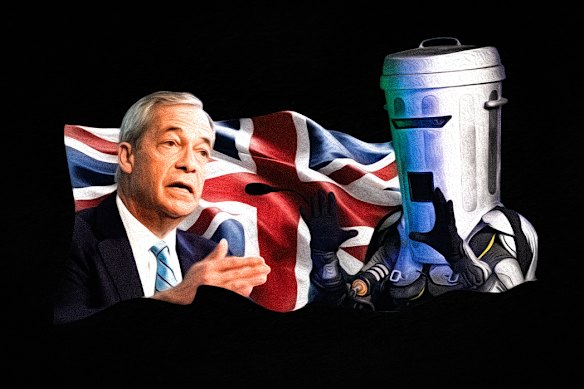
Reform UK Has a Chance for a “Victory That Will Last the Ages” and to Reboot Britain

Britain is entering one of the most unpredictable periods in its modern political history. The traditional boundaries between Labour, the Conservatives and smaller political parties are rapidly changing, while public confidence in the established political system continues to face serious pressure. In this turbulent environment, Reform UK has emerged as a political force with the potential to reshape the future of British politics.
The idea that Reform UK could achieve a “victory that will last the ages” and “reboot Britain” is undoubtedly ambitious. Yet the rise of the party shows that such language can no longer simply be dismissed as political exaggeration. Reform has moved from the margins of British politics into the centre of the national debate.
The crucial question is whether the party can transform growing public support into a sustainable governing movement.
From Protest Movement to Major Political Force
For years, Reform UK and its predecessors were largely viewed as protest parties. Their influence was significant, particularly on Brexit and immigration, but they were not generally regarded as realistic contenders for national government.
That perception has changed dramatically.
According to YouGov, by July 2026, 61% of Britons regarded Reform UK as one of the country’s major political parties, compared with just 19% two years earlier.
That transformation is politically important.
A protest party can succeed by identifying public anger and challenging the establishment. A governing party, however, must demonstrate that it has the people, policies and organisational structures necessary to run the country.
Reform is now attempting to make that transition.
Its challenge is therefore much greater than simply winning votes. It must convince millions of voters that it is capable of governing Britain responsibly.
What Does “Reboot Britain” Actually Mean?
The phrase “reboot Britain” appeals to a growing sense among some voters that the country’s problems are deeper than the failures of any one government.
Supporters of Reform argue that Britain has suffered from years of weak economic growth, high levels of immigration, pressure on public services, housing shortages, rising living costs and declining trust in politicians.
They believe that successive governments have attempted to manage these problems rather than fundamentally solve them.
Reform’s message is therefore deliberately radical.
The party argues that Britain needs a fundamental change in the way government operates, rather than another modest adjustment to the existing system.
Nigel Farage has repeatedly argued that Britain is “broken” and has called for major political change, presenting Reform as the movement capable of rebuilding the country.
This message resonates particularly strongly with voters who believe that the traditional parties have failed to listen to them.
For these voters, Reform represents not simply another political choice, but a rejection of the established political order.
Reform’s Appeal Goes Beyond Brexit
Brexit remains an important part of Reform’s political identity, but the party’s growing support cannot be explained by Brexit alone.
Immigration has become one of the central issues driving support for Reform. Research by YouGov in 2026 indicated that immigration remains particularly important to Reform voters.
This has allowed Reform to appeal to voters who may have previously supported the Conservatives, while also creating opportunities in traditionally Labour-supporting communities.
The underlying message is straightforward: Britain should have greater control over its borders, its laws and its political direction.
For voters who feel that governments have lost control over important national decisions, that message can be extremely powerful.
The challenge for Reform will be maintaining that support while expanding its appeal beyond its most committed supporters.
Local Election Success Provides a Foundation
One of the biggest differences between today’s Reform UK and earlier protest movements is its growing presence at the local level.
Reform has made significant gains in local government, giving the party an opportunity to develop an organisation capable of competing across the country.
The party says it won control of 14 councils in the 2026 local elections and now has more than 2,400 councillors.
This matters because political movements cannot survive indefinitely on national publicity alone.
To become a long-term political force, Reform needs councillors, activists, candidates, local organisers and experienced politicians.
Local government provides an opportunity to demonstrate whether Reform’s ideas can work in practice.
It also creates a testing ground for the party’s ability to manage budgets, public services and local institutions.
If Reform can demonstrate competent administration at the local level, it will strengthen its argument that it is ready for national government.
The Opportunity Is Real — But Victory Is Not Guaranteed
Despite its remarkable rise, Reform cannot assume that its success is inevitable.
Political fortunes can change extremely quickly.
A YouGov poll published in August 2026 showed Labour ahead of Reform, with Labour on 24% and Reform on 22%. It was the first time Labour had led Reform in that particular YouGov series for 18 months.
Other polling has also indicated that Labour’s position improved following Andy Burnham’s arrival as Prime Minister. Reuters reported that Labour had begun closing the gap with Reform after Burnham became prime minister in July.
This is an important warning.
Reform may have momentum, but momentum is not the same as electoral victory.
A government can recover. A political opponent can reinvent itself. A new leader can change the public mood.
Reform therefore has to maintain its support over an extended period while convincing undecided voters that it can offer more than opposition rhetoric.
Nigel Farage: Reform’s Greatest Strength and Its Greatest Risk
It is impossible to discuss Reform UK without discussing Nigel Farage.
Farage is the party’s most recognisable figure and one of the most effective political communicators in modern British politics.
His ability to dominate media coverage, connect with frustrated voters and frame complicated political issues in simple language has played a major role in Reform’s rise.
But that strength also creates a potential weakness.
A political party that depends heavily on one individual can become vulnerable if that individual loses popularity or credibility.
Farage’s victory in the Clacton by-election in August 2026 demonstrated that he remains an exceptionally powerful political figure. He won 63% of the vote in the contest, although the circumstances were unusual because the major parties did not contest the election.
The result demonstrated Farage’s continuing personal appeal, but it cannot automatically be interpreted as evidence that Reform can win a nationwide majority.
The party must eventually prove that its strength extends beyond Farage himself.
The Hardest Test: Turning Anger Into Government
This may be Reform’s greatest challenge.
It is relatively easy for an opposition movement to identify problems.
It is much harder for a government to solve them.
Once a party enters government, every promise has to be translated into legislation, budgets and practical decisions.
Reform’s proposals on welfare, taxation, immigration and government spending will therefore face intense scrutiny.
The party has proposed major changes to the welfare system with the objective of saving tens of billions of pounds, but such plans have generated debate over their economic and social consequences.
The question is no longer simply whether voters agree that the system needs reform.
They will want to know exactly what Reform would change, who would be affected and whether the proposed savings are realistic.
That is the difference between campaigning and governing.
Could Reform Really Change Britain?
Even if Reform fails to win an outright parliamentary majority, it could still fundamentally transform British politics.
The traditional two-party dominance of Labour and the Conservatives has already weakened.
YouGov has described a more fragmented British political landscape in which neither Labour nor the Conservatives can assume the level of dominance they once enjoyed.
That itself could be Reform’s greatest political achievement.
The party does not necessarily need to win hundreds of seats immediately to change the country.
If Reform forces Labour to take immigration more seriously, pushes the Conservatives further toward its policies, changes the national debate about government spending and challenges the established political consensus, its influence could be much larger than its parliamentary representation.
In that sense, Reform could lose an election while still winning the broader political argument.
That is a strategy Nigel Farage has pursued for many years.
A Historic Opportunity
Reform UK now possesses several advantages that its predecessors never enjoyed simultaneously.
It has a nationally recognised leader, a substantial voter base, growing local representation and a level of public recognition that places it firmly within Britain’s major political conversation.
But historic opportunities also create historic responsibilities.
If Reform genuinely wants to “reboot Britain”, it must overcome three major challenges.
First, it must maintain its support in a rapidly changing political environment.
Second, it must expand beyond its core electorate and convince voters who remain uncertain about its ability to govern.
Third, and most importantly, it must transform political protest into credible government.
That means producing detailed policies, credible financial plans and a competent team capable of running the machinery of the British state.
Without those things, Reform risks remaining a powerful protest movement rather than becoming a governing party.
The Battle for Britain’s Political Future
Britain’s political landscape is clearly changing.
For decades, Labour and the Conservatives dominated national politics. Today, voters have become more willing to consider alternatives, while dissatisfaction with the established parties has created space for new political movements.
Reform UK is the most powerful expression of that change.
Whether it becomes the party of government, however, remains uncertain.
The coming years will determine whether Reform’s rise represents a temporary political revolt or the beginning of a lasting realignment.
If Reform can combine its anti-establishment energy with credible economic policies, effective local government and a broader appeal to voters across Britain, it could become one of the most important political movements of the generation.
But if it fails to demonstrate that it can govern as effectively as it can campaign, its moment may eventually pass.
The difference between those two outcomes is enormous.
One would make Reform UK a historic force capable of reshaping Britain for decades.
The other would leave it remembered as the political movement that shook Westminster but never quite managed to take control of it.
For now, however, one fact is difficult to ignore: Reform UK has changed the political conversation in Britain, and the old political establishment can no longer assume that it will remain in control.
The real question is no longer whether Reform can disrupt British politics.
It already has.
The question is whether Nigel Farage and his party can turn that disruption into a lasting political revolution — and whether the British public will ultimately trust Reform UK not merely to challenge the system, but to rebuild the country.