

Nigel Farage Wins Clacton By-Election as Count Binface Takes More Than 9,000 Votes

Nigel Farage has won the Clacton by-election, returning to Parliament with a commanding majority — but the biggest surprise of the night was not the Reform UK leader.
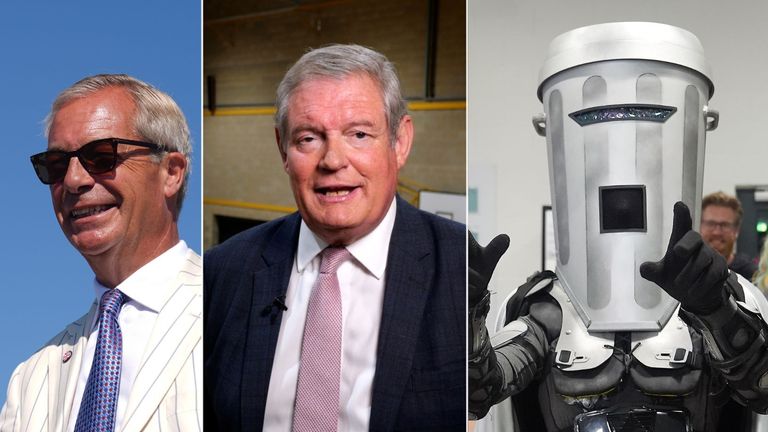
It was Count Binface.
Farage secured 22,239 votes, taking 63.34% of the vote and comfortably retaining the Essex constituency he first won at the 2024 general election. But his victory was accompanied by an extraordinary result from the satirical candidate Count Binface, who collected 9,455 votes, or 26.93%.
For Farage, the result was supposed to be a straightforward demonstration of public support.
Instead, it became one of the strangest parliamentary contests Britain has seen in years.
The ballot paper contained a record 34 candidates. The country’s major political parties — including Labour, the Conservatives, the Liberal Democrats and the Greens — chose not to contest the election, dismissing the contest as a political stunt after Farage resigned his seat and forced the by-election himself.
That decision left Farage facing an unusual collection of independents, fringe candidates and political satirists.
And yet one of them managed to attract more than one in four voters.
Farage Gets His Mandate
Farage had a clear objective when he triggered the by-election.
He wanted to return to Parliament with a fresh mandate from the people of Clacton.
His decision to resign came amid scrutiny over a £5 million gift from cryptocurrency billionaire Christopher Harborne and an investigation into whether the money should have been declared under parliamentary rules. Farage denied wrongdoing and argued that the by-election would allow voters to decide whether they wanted him as their MP.
The voters answered.
They chose Farage by a huge margin.
His 22,239 votes were more than twice the number received by Count Binface. The result means Farage will return to the House of Commons as the elected representative for Clacton and gives him an opportunity to argue that attempts to undermine his political career have failed.
But the result needs to be put into context.
Turnout was only around 44%, substantially below the 58.7% recorded in Clacton at the 2024 general election. Farage’s vote total was only slightly higher than the 21,225 votes he received in 2024, despite facing virtually no conventional mainstream opposition this time.
That makes the result less of a political earthquake than Farage might have hoped.
He won.
But he did not receive anything approaching universal support.
And the person who came second was not a Labour MP, Conservative MP or Liberal Democrat.
It was a man wearing a giant rubbish bin on his head.
Count Binface Steals the Spotlight
Count Binface is the political alter ego of comedian Jonathan Harvey, and his campaign has become a familiar feature of British elections.
But his performance in Clacton was on another level.
He received 9,455 votes — by far his strongest result in a parliamentary election. His previous performances had generally been measured in hundreds rather than thousands. In Clacton, however, he captured more than a quarter of all votes cast.
That cannot simply be dismissed as a joke.
Of course, the Count Binface campaign is deliberately humorous. His manifesto includes deliberately absurd policies, such as limiting the price of ice-cream cones and introducing bizarre punishments for people who use loudspeakers on public transport.
But satire can also be a form of protest.
In a by-election where the main parties deliberately stayed away, voters had very few conventional alternatives to Farage.
Some may have supported Binface because they genuinely liked his campaign.
Others may have been protesting against the unusual nature of the election.
And some may simply have wanted to send a message to Westminster.
Whatever the motivation, 9,455 votes is an extraordinary number.
It means that the second most popular candidate in Clacton was not even pretending to be a conventional politician.
That fact should make the major parties uncomfortable.
A Protest Vote Against the Political System?
There is a temptation to treat the result as political comedy.
That would be a mistake.
The Clacton election says something important about the relationship between voters and Britain’s political establishment.
The major parties decided that Farage’s decision to resign and trigger another election was not worthy of their participation. They effectively left him to fight against fringe and independent candidates.
But voters did not necessarily interpret the situation in the same way.
They still went to the polls.
And a significant number decided that Count Binface was a better option than Farage.
That does not mean 9,455 people genuinely believe Britain should be governed by a 5,900-year-old intergalactic space warrior.
It means the normal political rules were already breaking down.
When voters are presented with an election featuring 34 candidates, no major Labour or Conservative challenger and a Reform leader campaigning against what he calls the establishment, the contest becomes something different from a conventional parliamentary election.
It becomes a referendum on the political spectacle itself.
Farage’s Unusual Victory Speech
There was another extraordinary feature of the night.
Farage did not attend the official declaration of the result.
The Reform leader said he had been warned about a possible security threat and chose instead to hold his own event, dubbed “Farage Fest”, outside the constituency.
Essex police subsequently disputed the suggestion that Farage had been advised not to attend because of a credible threat, saying there had been no incidents and that security arrangements were in place.
That meant the winning candidate was absent when his own result was announced.
Count Binface, meanwhile, was there.
The contrast was almost too perfect.
The satirical candidate stood among the other candidates as the result was declared, while Farage celebrated his victory separately.
Binface even joked about the possibility of another Clacton election if parliamentary investigators eventually find against Farage.
The joke may have landed because there is a serious possibility behind it.
Farage’s parliamentary standards investigation has resumed following his victory.
The £5 Million Investigation Is Not Going Away
The by-election was triggered partly because Farage wanted to put the financial controversy behind him.
Instead, it has followed him back into Parliament.
The investigation concerns whether Farage should have declared the £5 million gift from Harborne.
Farage has denied wrongdoing and maintained that he did not believe the money needed to be registered under parliamentary rules. The investigation is not itself a finding of guilt.
But its timing is politically awkward.
Farage has just won an election designed to demonstrate that voters support him.
Within hours, Parliament’s standards watchdog resumed scrutiny.
His political opponents will argue that the victory does not settle the question of whether parliamentary rules were followed.
His supporters will argue that the voters have spoken and that the investigation represents establishment hostility towards Reform.
The truth will ultimately depend on the evidence and the findings of the parliamentary process.
But politically, the controversy is unlikely to disappear.
A Huge Win — But Not a Perfect One
Farage’s 63% share looks overwhelming.
And mathematically, it is.
But there are reasons to be cautious about describing the result as a national breakthrough.
The election was boycotted by the major parties.
Turnout was relatively low.
And Farage’s vote share was boosted by the absence of serious mainstream challengers.
The result therefore tells us something very important about Farage’s support in Clacton, but considerably less about his ability to win a general election across Britain.
That distinction matters.
Reform UK may be a powerful force nationally, but the Clacton by-election was an unusually favourable environment for Farage.
His challenge now is to convert this local victory into broader political momentum.
And that will be much harder.
What the Result Means for Reform
For Reform UK, Farage’s victory is nevertheless valuable.
The party can now point to another successful election result and argue that its leader remains firmly backed by voters.
It also puts Farage back at the centre of parliamentary politics at a time when Reform has been competing with Labour for attention.
The result gives him a platform.
It gives him credibility.
And it gives him another opportunity to attack the established parties from inside Parliament.
But Count Binface’s performance adds an important qualification.
Farage may have won the election, but he did not own the entire political conversation.
Almost 9,500 people chose the satirical candidate.
That is too large a protest vote to simply laugh away.
The Bigger Message
Perhaps the most interesting lesson from Clacton is not that Farage won.
Most observers expected him to win.
The real story is how voters behaved in an election that the mainstream political parties effectively abandoned.
They were offered Farage.
They were offered dozens of fringe candidates.
And thousands chose Count Binface.
That tells us something about political frustration.
People do not always protest by staying at home.
Sometimes they protest by voting for the candidate who makes fun of the system.
In that sense, Count Binface may have achieved something that conventional opposition parties failed to do.
He gave dissatisfied voters a way to express their dissatisfaction without voting for Farage.
That could become increasingly significant if mainstream parties continue to avoid difficult contests.
Farage Is Back — But the Questions Remain
Nigel Farage wanted Clacton to send a clear message.
It did.
He remains popular enough in the constituency to win by a huge margin.
He is returning to Parliament.
Reform UK has another reason to claim political momentum.
But the election also produced an unexpected warning.
A quarter of voters chose a satirical candidate.
Turnout was significantly lower than in the general election.
And Farage’s financial investigation has resumed almost immediately after his victory.
So this was not quite the clean political triumph that Reform might have imagined.
It was stranger than that.
Farage won decisively, but the political establishment stayed away.
Count Binface came second with almost 9,500 votes.
The winning candidate skipped the count.
And the parliamentary investigation he hoped to escape is now waiting for him when he returns to Westminster.
Clacton has therefore given Farage what he wanted: a new mandate.
But it has also given British politics something it did not expect.
A very serious warning wrapped in a giant silver rubbish bin.
Farage may have won the seat.
But Count Binface won the headline.
And perhaps that is the most revealing result of all.