
Nigel Farage Unveils Candidate to Take on Andy Burnham in Huge By-Election Announcement
Nigel Farage has made clear that his battle with Andy Burnham is far from over.
After Burnham’s dramatic return to Westminster through the Makerfield by-election and his subsequent arrival in Downing Street, Reform UK is already looking towards the next opportunity to challenge Labour.
The announcement of a Reform candidate for a key by-election is therefore much more than a routine selection.
For Farage, it is part of a wider strategy to demonstrate that Reform UK can take on Labour directly in constituencies that were once regarded as safe territory for the traditional parties.
It also provides an early test of whether the political momentum that carried Burnham into No 10 can survive a determined Reform challenge.
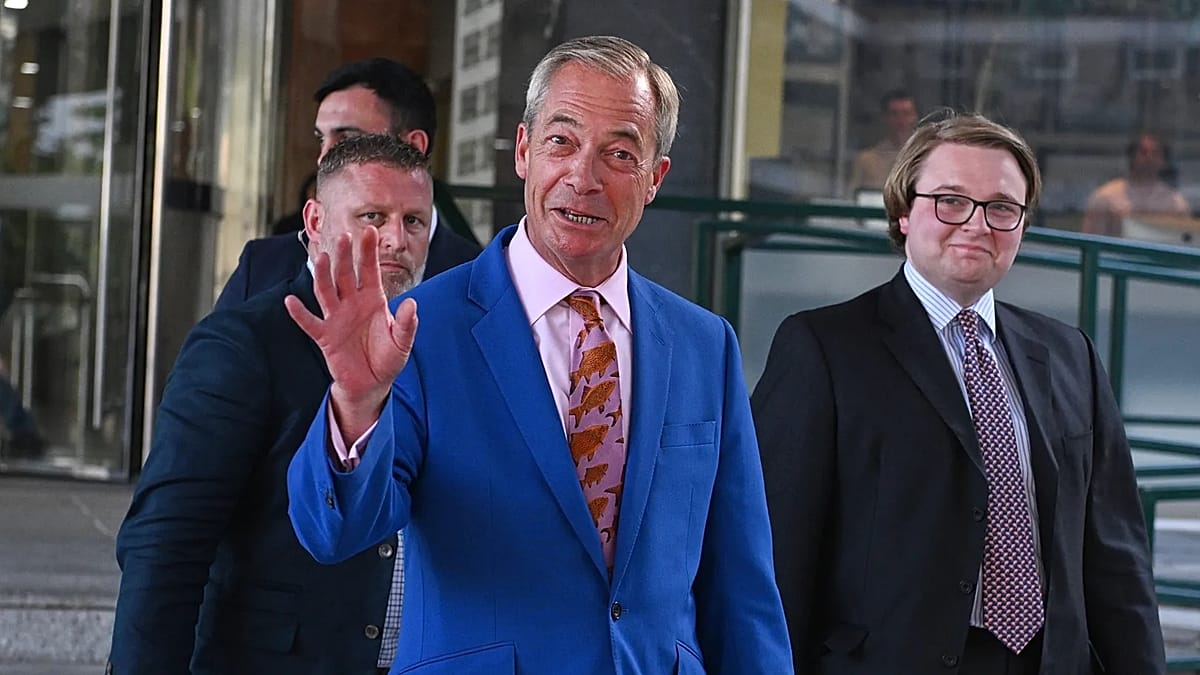
Farage wants to turn the tables
Farage has been openly critical of the circumstances surrounding Burnham’s rise to the premiership.
In July, the Reform leader described Burnham’s arrival in Downing Street as happening without a national mandate and demanded an immediate general election. Reform argued that the country should have been given the opportunity to decide whether it wanted Burnham as Prime Minister.
That argument has become a central part of Farage’s political message.
His position is straightforward: Burnham may have won Makerfield, but that does not mean Britain voted for a Burnham government.
Reform therefore sees every subsequent by-election as an opportunity to ask voters a similar question.
Do you want Labour—or do you want Reform?
That is a much more powerful question than simply asking voters whether they approve of the government.
Makerfield was a painful warning
The background to the latest announcement is particularly important.
Burnham won the Makerfield by-election by a huge margin, delivering Labour a major victory and securing the parliamentary platform that ultimately helped him become Prime Minister.
For Reform, the result was disappointing.
Farage subsequently admitted that he had expected his candidate to receive around 18,000 votes, but the party finished just short of 16,000. He also acknowledged that the result was disappointing.
There was another complication.
Reform believed some potential supporters had switched to Restore Britain, the rival political force competing for voters on the right.
Farage explicitly appealed to those voters after the result, arguing that Reform remained the main party capable of defeating the political establishment.
That makes the next contest even more significant.
Reform needs to prove that Makerfield was an isolated setback rather than evidence of a wider problem.
The candidate will face a very different Labour Party
The political circumstances have also changed dramatically since Makerfield.
When Burnham contested the seat, he was primarily seeking a route back into Parliament.
Now he is Prime Minister.
That changes the stakes completely.
A Labour candidate fighting a by-election can campaign against the local Conservative council, local issues or national government.
A Labour candidate campaigning under Burnham’s leadership can present the contest as a test of the new Prime Minister’s mandate.
That gives Labour an obvious advantage.
But it also gives Reform an opportunity.
Farage can argue that voters now have a chance to send a message directly to Burnham.
If Reform wins—or even significantly improves its performance—the party can claim that the new Prime Minister’s honeymoon period is already ending.
Reform’s strategy is becoming increasingly clear
The party’s recent behaviour suggests that Farage wants to contest politics on two levels.
At the national level, he is demanding a general election.
At the constituency level, Reform is building a network of candidates capable of fighting Labour seat by seat.
That is essential if Farage genuinely wants to become Prime Minister.
Reform cannot rely on national opinion polls alone.
Britain’s first-past-the-post electoral system means that votes must be converted into parliamentary constituencies.
A party can poll strongly nationwide and still fail to win enough seats to form a government.
Farage therefore needs Reform to demonstrate that it can win in different parts of England—not merely in its strongest coastal and former Conservative areas.
The Red Wall remains the prize
This is where Andy Burnham becomes particularly important.
Burnham has spent years cultivating an image as a politician capable of speaking to working-class voters in northern England.
That is exactly the demographic Reform wants to attract.
Farage’s political revolution depends partly on convincing former Labour voters that their traditional party no longer represents them.
Burnham’s strategy is almost the opposite.
He needs to persuade those same voters that Labour can recover its traditional working-class coalition.
That makes the battle between the two politicians unusually important.
It is not simply a personal rivalry.
It represents a fight over the future political identity of the Red Wall.
Reform has already demonstrated its potential
The party’s local-election performance earlier in 2026 showed that Reform can break through in areas where the traditional parties have dominated for generations.
In Barnsley, for example, Reform took control of the council after Labour suffered its worst local-election result there in more than half a century. Recent reporting suggests that Burnham’s arrival has nevertheless encouraged some voters who moved from Labour to Reform to reconsider their position.
That is exactly the dynamic Farage needs to prevent.
If Burnham can bring former Labour voters back into the fold, Reform’s national growth could slow considerably.
If Reform can keep those voters, Labour could face a serious threat across dozens of constituencies.
The next by-election could therefore provide an early indication of which strategy is working.
The Restore problem
Farage has another obstacle.
Reform is not the only party competing for voters on the right.
Restore Britain, associated with former Reform MP Rupert Lowe, has attempted to position itself as an even more uncompromising alternative on immigration, national sovereignty and the political establishment.
That creates a potentially devastating problem under Britain’s electoral system.
If Reform and Restore both stand in the same constituency, they can divide voters who might otherwise unite behind a single challenger to Labour.
Farage has already identified this problem.
Following the Makerfield result, he argued that several thousand voters who normally would have supported Reform instead backed Restore.
For Reform, candidate selection is therefore not merely about finding a popular individual.
It is also about ensuring that the party becomes the obvious home for anti-Labour voters.
Immigration will dominate the campaign
If Reform wants to defeat Labour, immigration is almost certain to be one of its central arguments.
The party has made border control one of the defining elements of its political identity.
Farage has repeatedly attacked successive governments over Channel crossings and has promised a much more aggressive approach to illegal migration.
Burnham, meanwhile, has attempted to demonstrate that Labour can be tough on border control without adopting Reform’s wider political programme.
That creates an increasingly sharp contrast.
Reform can argue that Labour is too cautious.
Labour can argue that Reform’s proposals are unrealistic.
The by-election candidate will therefore be required to defend not only local policies but the credibility of Farage’s wider national programme.
Welfare could become another battleground
Reform’s recently announced welfare plans could also feature prominently.
The party says its proposed reforms could save around £50 billion a year, including through major changes to disability benefits and restrictions on welfare entitlement for some foreign nationals.
That is potentially powerful politically.
Reform can tell voters that Labour has failed to control public spending and that the welfare system needs radical reform.
But there is a significant risk.
Many of the communities Reform hopes to win contain large numbers of people receiving benefits.
Recent analysis has highlighted the potentially difficult electoral consequences of Reform’s proposed changes to Personal Independence Payment and other support.
A Reform candidate therefore has to make a difficult argument:
The party wants to cut welfare spending while persuading voters who may personally depend on that spending that the reforms are in their interests.
That will not be easy.
Farage’s Clacton victory provides confidence—but not enough
Farage has at least one recent electoral victory to point towards.
After resigning his Clacton seat amid a parliamentary standards investigation, he fought and won a by-election to return to Parliament.
He secured 62.8% of the vote, while Count Binface received approximately 26.7%.
However, the circumstances were highly unusual.
The major political parties boycotted the contest, leaving Farage to face a field of 34 candidates, many of whom were independents or novelty candidates.
Consequently, the result confirmed Farage’s strength in Clacton but did not provide a reliable national test of Reform’s popularity.
The next serious by-election will be much more revealing.
If Reform can make significant gains against Labour in a competitive constituency, Farage will be able to argue that the party has recovered from Makerfield.
If it performs poorly, questions about its national momentum are likely to intensify.
Burnham cannot afford complacency
For Labour, the contest carries its own dangers.
Burnham currently enjoys a relatively strong personal position compared with several recent British prime ministers, although polling still shows significant uncertainty about whether voters believe he can govern for the entire country.
His early political honeymoon could therefore be tested by the result.
A Labour victory would allow Burnham to claim that his leadership is strengthening the party.
A Reform victory would give Farage a powerful narrative: the new Prime Minister is already losing support outside Labour’s traditional heartlands.
That is why candidate selection matters.
The person Farage has chosen will effectively become one of the first representatives of the new Reform strategy against the Burnham government.
A test bigger than one constituency
The coming by-election should not be viewed simply as a local contest.
It is becoming a test of three much bigger questions.
First: Can Reform recover from the disappointment of Makerfield?
Second: Can Farage prevent the right-wing vote from splitting between Reform and Restore?
Third: Can Burnham maintain the political momentum that carried him from Greater Manchester to Downing Street?
The answers could have consequences far beyond the constituency involved.
Farage’s ultimate objective is clear
The Reform leader has never hidden his ambition.
He does not simply want to win a handful of seats.
He wants to reshape British politics and eventually lead a government.
That means every by-election becomes part of a much larger campaign.
A strong result gives Reform evidence that it can challenge Labour.
A weak result gives Labour evidence that Burnham can hold the Red Wall.
The announcement of a new Reform candidate is therefore a message not just to local voters but to the entire country.
Farage is coming for Labour.
And this time, he wants to make sure that Makerfield is remembered as a warning rather than a turning point.
The political battle between Farage and Burnham is still in its early stages.
But with Reform determined to challenge Labour seat by seat, the next by-election could offer the clearest indication yet of whether Farage’s dream of reaching Downing Street is gathering momentum—or beginning to slip away.
Leave a Reply
You must be logged in to post a comment.