
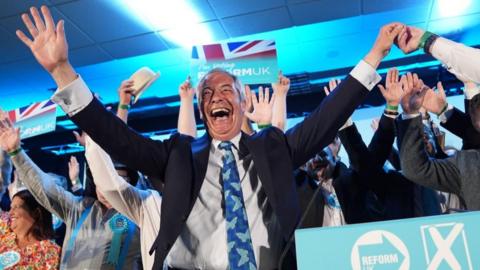
Nigel Farage Celebrates By-Election Win but Loses Seats to Labour and Lib Dems
Nigel Farage has every reason to celebrate after reclaiming his parliamentary seat in the Clacton by-election. The Reform UK leader won decisively, securing 22,239 votes, or around 63 per cent of the vote, and returning to Westminster after deliberately resigning his seat to force a fresh contest. Yet beneath the celebrations lies a much more complicated political picture. While Farage has strengthened his position in Clacton, Reform UK is facing setbacks elsewhere, while Labour and the Liberal Democrats are demonstrating that the battle for Britain’s political future is far from settled.
The Clacton result was never particularly likely to end in Farage’s defeat. The constituency had already elected him at the 2024 general election, and the major Westminster parties chose not to contest the by-election. Instead, Farage faced a record field of candidates, most of whom represented smaller parties or independents. His most surprising challenger was Count Binface, the satirical candidate played by comedian Jonathan Harvey, who received almost 27 per cent of the vote.
Farage nevertheless described the result as a major vindication. He had triggered the election after resigning amid scrutiny over an undeclared £5 million gift from cryptocurrency businessman Christopher Harborne. Farage argued that he wanted voters to give him a fresh mandate and framed the contest as a confrontation between himself and an establishment that he believes has repeatedly attempted to undermine him.

On the narrow question of whether he could win his seat again, the strategy worked.
But politics is rarely decided by one constituency.
The much more important question is whether Reform UK can translate Farage’s personal popularity in Clacton into a nationwide electoral breakthrough. And that is where the picture becomes considerably less comfortable for the Reform leader.
Farage’s party has recently suffered important setbacks outside its strongest territory. Labour’s victory in the Greater Manchester mayoral by-election was particularly significant. Bev Craig, the former leader of Manchester City Council, won approximately 47 per cent of first-preference votes before taking 66.3 per cent after second preferences were redistributed. Reform finished well behind.
That result matters because Greater Manchester had recently appeared to be fertile territory for Reform UK. The party had made significant gains in the region, and Farage had attempted to present Reform as a genuine alternative to Labour in northern communities.
Instead, Labour demonstrated that it could recover ground.
That is a warning Farage cannot simply ignore.
The Liberal Democrats also remain an important part of the equation. Their strength in many constituencies means that Reform cannot assume that dissatisfaction with Labour or the Conservatives will automatically translate into Reform votes. Britain’s electoral system rewards concentrated support, but it can punish parties whose vote is spread inefficiently across the country.
This is one of the central problems facing Reform UK.
A party can receive millions of votes without winning anything like a comparable number of parliamentary seats if its support is distributed in the wrong places. Conversely, Labour and the Liberal Democrats can benefit enormously from tactical voting and geographically concentrated support.
The result is a political battlefield far more complicated than the simple narrative of “Reform versus Labour.”
Farage’s greatest political achievement has been changing the national conversation. Immigration, national sovereignty, taxation, public spending and dissatisfaction with Westminster have all become central political issues partly because of the pressure created by his movement.
But influencing the debate is not the same as winning power.
To become a serious governing force, Reform needs candidates, organisation, money, local structures and policies capable of appealing to voters who do not instinctively support Farage.
Clacton demonstrates the strength of the existing Reform coalition. It does not prove that the coalition is large enough to carry the party into government.
Indeed, Farage’s 63 per cent result needs to be considered in context. The Conservatives, Labour and Liberal Democrats all declined to field candidates. That means the result was not a conventional contest between the country’s major political forces. Farage had an enormous structural advantage from the beginning.
The turnout was also substantially lower than at the 2024 general election, standing at roughly 44 per cent compared with nearly 59 per cent previously.
There is therefore a danger that Farage interprets a successful defence of a safe political base as proof of a much broader national mandate.
That would be a mistake.
The bigger challenge is what happens in constituencies where Reform faces a serious Labour, Conservative or Liberal Democrat candidate.
In such seats, Reform cannot depend on its opponents staying away.
It must persuade voters who have alternatives.
That requires Farage to answer a difficult question: what exactly does Reform UK offer beyond opposition?
Its strongest themes remain immigration, crime, national identity and dissatisfaction with established institutions. These issues clearly resonate with a substantial number of voters. But a party seeking national power also needs detailed and credible answers on the NHS, education, pensions, housing, energy, defence, taxation and economic growth.
This is where Labour may have an advantage.
Andy Burnham’s Labour government has begun attempting to rebuild support among voters who previously turned away from the party. Recent political analysis suggests that Labour has recovered momentum, while Reform’s national polling position has weakened from its earlier highs.
That does not mean Reform’s threat has disappeared.
Far from it.
Farage remains one of Britain’s most recognisable political figures. His ability to attract media attention is unmatched by most of his rivals, and his supporters remain highly motivated.
But the political environment has changed.
Six months ago, Reform could plausibly present itself as the unstoppable challenger to the established parties. Today, the picture is more fragmented. Labour has recovered some support. The Conservatives are attempting to rebuild. The Liberal Democrats continue to hold strategically important constituencies. And a new right-wing challenger, Restore Britain, threatens to divide the anti-establishment vote even further.
That fragmentation could become Farage’s biggest enemy.
If Reform, the Conservatives and other right-wing parties compete against each other in the same constituencies, Labour and the Liberal Democrats could benefit without needing to increase their own vote dramatically.
The same problem works in reverse.
If Labour and the Liberal Democrats divide anti-Conservative voters, Reform could win seats with relatively modest vote shares.
Britain’s next general election could therefore be decided not only by who voters support but by how efficiently each party’s support is distributed.
Farage understands this. That is why his party has repeatedly sought to establish itself as the principal challenger to Labour in working-class constituencies.
The recent setbacks show that this strategy is not guaranteed to succeed.
Greater Manchester is a particularly revealing example. Labour’s victory demonstrated that voters who had previously been attracted to Reform could return to Labour when presented with a different political message and a stronger local candidate.
For Farage, that should be a warning.
The Clacton victory proves that his core supporters remain loyal.
The Manchester result suggests that loyalty alone is not enough.
There is another cloud hanging over Farage’s political comeback: the parliamentary investigation into his financial affairs has resumed following his re-election. Farage denies wrongdoing and has argued that the investigation is politically motivated. However, the issue has not disappeared as a consequence of his by-election victory.
That could become increasingly important.
Farage attempted to use the by-election as a way of demonstrating that voters supported him despite the controversy. But winning a constituency does not determine whether parliamentary rules were breached. The investigation will continue independently of the electoral result.
If the controversy persists, it could prevent Reform from moving the national conversation towards its preferred subjects.
Instead of discussing immigration, taxation and public services, Farage could find himself repeatedly answering questions about his own conduct.
That is precisely the kind of political distraction he wanted the by-election to eliminate.
Nevertheless, it would be foolish for Labour, the Conservatives or the Liberal Democrats to celebrate Farage’s difficulties too early.
He has survived political setbacks before.
His political career has repeatedly demonstrated an extraordinary ability to recover from apparent defeat. He transformed UKIP from a fringe Eurosceptic organisation into a major political force, helped drive the Brexit campaign and eventually returned to Parliament after years of failed attempts.
Reform UK should therefore not be underestimated.
The real lesson from the Clacton by-election is that two things can be true simultaneously.
Farage won.
And Reform UK still has serious problems.
His personal political base remains remarkably strong, but his national path to power has become less straightforward. Labour’s recovery, Liberal Democrat strength and competition from other parties mean that the next general election could be much more difficult than the headlines surrounding Clacton suggest.
Farage’s supporters will point to the 63 per cent vote share and say that the result proves the Reform revolution is alive.
His opponents will point to the absence of major-party candidates, Count Binface’s extraordinary performance, lower turnout and Reform’s recent setbacks elsewhere.
Both interpretations contain part of the truth.
Clacton was a victory, but it was not a national election.
It demonstrated that Farage can mobilise his supporters. It did not demonstrate that Britain is ready to put Reform UK into government.
That distinction will become increasingly important over the coming months.
Farage now has to turn a symbolic victory into sustained political momentum. He must broaden his appeal, strengthen his party’s organisation and persuade voters that Reform is capable of governing rather than simply protesting.
Meanwhile, Labour and the Liberal Democrats will be looking for opportunities to exploit divisions on the right.
The next stage of Britain’s political battle is therefore likely to be much harder for Farage than Clacton.
He can celebrate his victory — and he certainly will.
But the wider political scoreboard tells a more complicated story.
Farage has won Clacton. The question is whether he can win Britain.