

‘Puffy-Eyed’ Rachel Reeves ‘Close to Tears’ in Awkward PMQs Clash
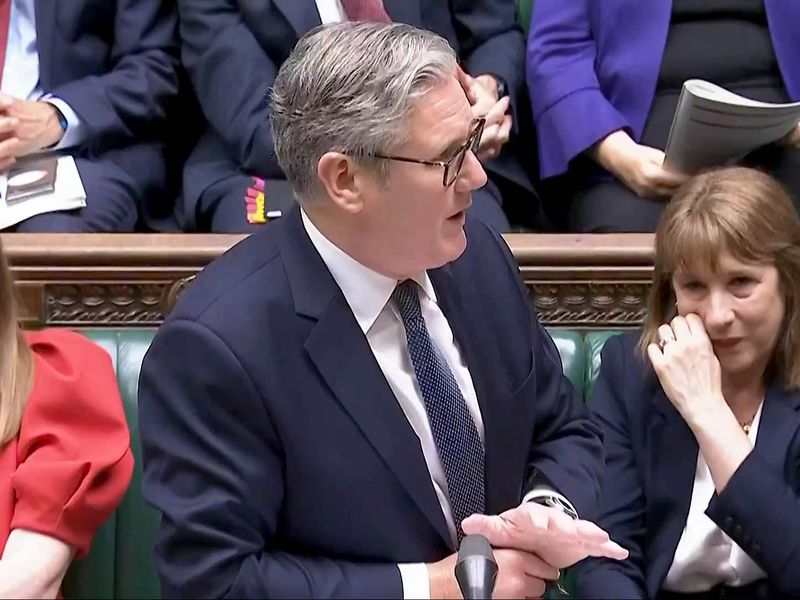
Rachel Reeves found herself at the centre of an intensely uncomfortable moment in the Commons as emotions appeared to get the better of her during Prime Minister’s Questions.
The former Chancellor was visibly emotional as Sir Keir Starmer faced his final PMQs before leaving Downing Street. Reeves was seen fighting back tears while Starmer delivered an emotional farewell to Parliament, creating one of the most striking images of his final appearance at the dispatch box.
For a politician who had spent two years attempting to project economic authority and political toughness, the sight was undeniably powerful.
But there was something more complicated happening beneath the surface.
Reeves was not simply watching another parliamentary debate.
She was watching the end of the government she had helped build.
And, perhaps even more painfully, she knew that her own political career at the Treasury was coming to an end.
A brutal few months for Reeves
Rachel Reeves had already endured an extraordinary period of political pressure.
She became Chancellor in July 2024, making history as Britain’s first woman to hold the position. But her tenure was repeatedly overshadowed by arguments over taxation, public spending, welfare reform, the economy and the government’s political direction.
Her most difficult personal moment came a year earlier, when she was seen crying during PMQs amid intense pressure over Labour’s welfare reforms.
Reeves later described that episode as the toughest moment she had experienced in the job. She acknowledged that seeing photographs of herself crying on the front pages of newspapers had been particularly difficult.
That history makes the latest images all the more striking.
For Reeves, the Commons had already become associated with one of the most difficult moments of her political career.
Now she was back in almost exactly the same setting, visibly emotional again.
The final PMQs was always going to be emotional
There was an obvious reason for the atmosphere.
Starmer was appearing at PMQs for the final time as Prime Minister and Labour leader.
His departure came after mounting political pressure and disappointing election results, with Andy Burnham preparing to take over as Labour leader and subsequently as Prime Minister.
The usual political theatre was therefore replaced, at least temporarily, by something much more personal.
MPs paid tribute to Starmer.
The Commons applauded.
There were jokes.
There were memories of his time in office.
And eventually Starmer turned towards his family in the gallery and delivered an emotional farewell.
Behind him sat Reeves.
The cameras caught her wiping away tears.
That image quickly became the defining picture of the afternoon.
But the awkwardness was impossible to miss
Politics is, after all, a theatre of control.
MPs are expected to remain composed even when facing fierce criticism.
Chancellors are expected to defend their budgets.
Prime ministers are expected to project authority.
And members of the Cabinet are expected to maintain a united front even when political relationships are under enormous pressure.
Reeves’s expression therefore attracted immediate attention.
Commentators described her as appearing close to tears, while political observers noted that she looked visibly emotional as Starmer spoke.
But it is important not to turn an emotional moment into something it was not.
There is no reliable evidence that Reeves was crying because of a new political crisis during this particular PMQs.
The circumstances were plainly emotional.
Starmer was leaving.
Reeves herself was also about to leave the Treasury.
The government she had served was being replaced.
Sometimes a politician’s face tells a story that has little to do with parliamentary strategy.
Reeves’s relationship with Starmer had been under intense scrutiny
The emotional image inevitably brought back memories of the tensions that had surrounded Reeves and Starmer throughout their time in government.
During the welfare controversy of 2025, Reeves was seen crying in the Commons while Starmer declined to guarantee her continued position as Chancellor when questioned by Kemi Badenoch.
Downing Street subsequently insisted that Reeves had the Prime Minister’s full support, while her spokesman said that a personal matter had affected her.
The incident became one of the defining images of Labour’s first year in government.
It was not simply about tears.
It was about uncertainty.
Was Reeves secure?
Was Starmer behind her?
Was the government losing control of its economic agenda?
Those questions helped fuel a political narrative that Reeves was increasingly vulnerable.
Yet she survived.
She remained Chancellor for another year.
And she continued to defend her economic record with remarkable determination.
She insisted the economy was moving in the right direction
Whatever criticisms were levelled against her, Reeves never abandoned the argument that her policies were producing results.
In Parliament during June, she pointed to lower interest rates, rising wages, increased investment and economic growth as evidence that Labour’s approach was working. She argued that borrowing had fallen as a share of GDP and contrasted her record with the Conservative governments that preceded Labour.
In her final Mansion House speech as Chancellor, Reeves also emphasised economic growth and productivity, arguing that Britain was beginning to see improvements after years of disappointing performance.
Her supporters therefore have a strong case that the emotional scenes should not obscure the substance of her time in office.
She was not simply a politician who struggled under pressure.
She was a Chancellor who made some of the most consequential economic decisions in modern British politics.
Those decisions will be debated for years.
The problem was always the political cost
Reeves’s economic strategy involved difficult choices.
Taxes rose.
Fiscal rules became central to government policy.
Public spending faced intense scrutiny.
And measures affecting pensioners, welfare recipients and working households generated considerable controversy.
Her defenders argued that these choices were necessary to repair Britain’s finances.
Her critics argued that Labour had increased the burden on ordinary people while failing to deliver the economic transformation promised during the election campaign.
That political argument never disappeared.
Indeed, it followed Reeves right up to the end.
Her final months were spent defending the economic record while the government struggled with declining political support.
By July 2026, the political pressure had become overwhelming.
Starmer resigned.
Burnham won the Labour leadership.
And Reeves left the Treasury.
The emotional PMQs was therefore not simply a farewell to Starmer.
It was also the end of Reeves’s chapter at the Treasury.
The image says something about political life
There is a tendency to treat politicians as though they are immune to ordinary emotions.
They are not.
They lose elections.
They face hostile headlines.
They experience personal attacks.
They work under extraordinary pressure.
And sometimes they simply reach the end of an exhausting political journey.
That is particularly relevant in Reeves’s case because she has already spoken publicly about how difficult it was to see herself portrayed as someone unable to cope after the 2025 crying incident.
The fact that she became emotional again does not necessarily indicate weakness.
It may simply indicate that the moment mattered to her.
And there is something deeply human about that.
Yet the political consequences remain
The problem is that politics rarely allows politicians to remain simply human.
Every facial expression becomes evidence.
Every tear becomes a headline.
Every hesitation becomes a political talking point.
That is exactly what happened to Reeves.
A moment of emotion became a symbol of a government under pressure.
Opponents could use it to reinforce their argument that Labour was divided and exhausted.
Supporters could interpret it as evidence of loyalty and personal commitment.
Neither interpretation necessarily tells the whole story.
The truth is probably much simpler.
Reeves was watching someone she had worked alongside leave office.
She knew her own time in the Treasury was ending.
And the Commons was saying goodbye to an era.
That would be enough to make almost anyone emotional.
Now Reeves has to defend her legacy from outside the Treasury
Her departure does not mean the debate over her record is finished.
Quite the opposite.
As Burnham’s government begins to make its own economic choices, Reeves’s legacy will become an increasingly important political reference point.
If the new government succeeds, Burnham and his ministers will claim they have moved beyond the limitations of the previous administration.
If the new government struggles, Reeves’s supporters may argue that she had been right to be cautious.
Either way, the former Chancellor will remain part of the story.
She has left behind an economy that is neither the disaster described by some opponents nor the unqualified success claimed by some supporters.
There are positive indicators.
There are serious weaknesses.
There are difficult fiscal choices.
And there is a great deal of unfinished business.
The tears were only one moment
It would be easy to reduce Reeves’s final PMQs appearance to a photograph.
“Puffy-eyed.”
“Close to tears.”
“Emotional.”
Those descriptions may capture what viewers saw, but they do not capture the political story behind it.
Rachel Reeves spent two extraordinary years as Chancellor.
She became the first woman to hold the office.
She introduced major tax and spending measures.
She endured political crises.
She faced criticism from opposition parties and, at times, pressure from her own side.
She survived one of the most damaging moments of her career.
And eventually she watched the government that appointed her come to an end.
When the tears appeared in the Commons, they were therefore not necessarily evidence of a politician falling apart.
They may have been the final release after two years of enormous pressure.
The cameras will remember the tears.
History, however, will judge the decisions.
And that judgment has only just begun.