

NORTHERN IRELAND ON EDGE: Streets Fill With Protesters After Belfast Attack
Northern Ireland was shaken by some of the most serious anti-immigration unrest seen in the region in recent years after a violent knife attack in Belfast became the trigger for protests, rioting and attacks on ethnic minority communities. What began as a shocking criminal incident rapidly developed into a much wider confrontation over immigration, asylum, policing and national identity.
The events have left Northern Ireland facing difficult questions about social cohesion and public order. They have also revived painful memories of the region’s history, where political and communal divisions once produced years of violence. Although the current unrest is fundamentally different from the Troubles, images of burning homes, roadblocks, masked crowds and families fleeing their neighbourhoods have inevitably caused concern.
At the centre of the crisis was an attack in north Belfast on the evening of 8 June 2026. Police responded to reports of a serious stabbing on Kinnaird Avenue shortly after 10.30pm. The victim, Stephen Ogilvie, suffered catastrophic injuries and required extensive hospital treatment. His family later appealed for calm after the attack became the catalyst for anti-immigration violence.
The attack was recorded and footage quickly spread across social media. Within hours, the incident had become the subject of intense online speculation. The identity and immigration background of the alleged attacker became a major focus of discussion, while unverified claims circulated rapidly.
According to reports, the suspect was initially described online as being from Somalia before police information established that he was from Sudan. He had arrived in Northern Ireland from the Republic of Ireland after making an asylum claim. The allegation that an asylum seeker was responsible for such a serious attack provided an immediate focus for activists already campaigning against immigration.
But what happened next went far beyond a conventional political protest.
On 9 June, crowds gathered in several areas of Belfast and elsewhere in Northern Ireland. Some protesters initially presented their demonstrations as expressions of anger about crime, immigration and the government’s asylum policies. As the evening progressed, however, violence escalated.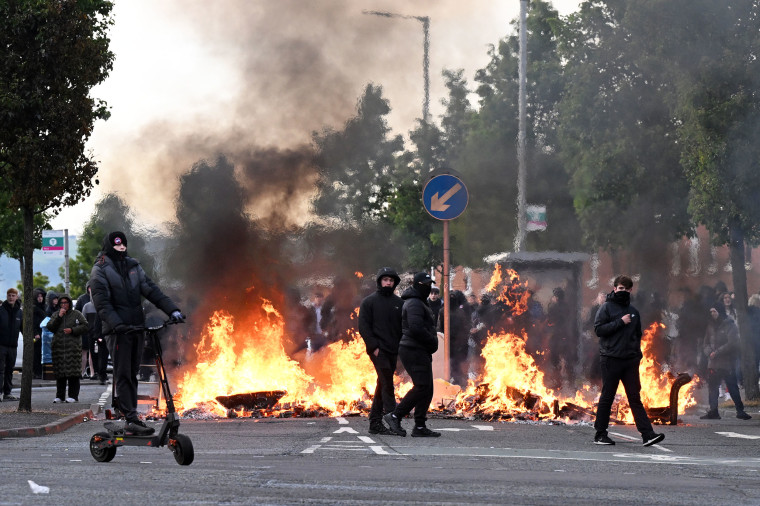
Roadblocks were erected, vehicles were attacked and fires were started. Properties believed to be occupied by migrants or ethnic minority families were targeted. Businesses were damaged or burned, while police officers came under attack. The Police Service of Northern Ireland subsequently launched a major investigation into the disorder.
The distinction between protest and riot became increasingly clear.
Northern Ireland’s Executive said people had every right to protest peacefully but condemned the violence, intimidation and destruction that followed. Ministers warned that the disorder was causing fear in communities and putting innocent lives at risk.
The statement was significant because it reflected a broad political consensus: whatever people’s views on immigration, violence against homes, businesses or police officers could not be accepted as legitimate political protest.
For many residents, the most frightening aspect was the apparent targeting of people because of their ethnicity or perceived nationality.
Reports described families from Romania, Ukraine, Sudan and other countries leaving their homes after properties were attacked. In some areas, minority-owned businesses were targeted and vehicles were set alight. A Syrian supermarket was among the businesses reported to have been burned during the disorder.
These incidents transformed the political meaning of the protests.
A debate about immigration policy had become a question of personal safety.
People who had nothing to do with the original attack suddenly found themselves being treated as representatives of a much wider political problem. For families living in Belfast, the threat was no longer simply something they could watch on television. It was happening outside their homes.
The Police Service of Northern Ireland responded with public-order resources, and water cannon were deployed during subsequent clashes. Police also made arrests and began releasing images of people they wanted to identify. By 12 June, the PSNI said 21 suspects had been identified, 19 arrests had been made and 12 people had been charged and remanded in custody.
The scale of the police response demonstrated the seriousness of the situation.
Northern Ireland has considerable experience with public disorder, but the nature of this unrest presented a different challenge. Rather than being primarily organised around the traditional constitutional divide between unionism and nationalism, the violence was strongly connected to hostility towards migrants and ethnic minorities.
That does not mean Northern Ireland’s old political divisions have disappeared.
The region remains deeply shaped by questions surrounding British and Irish identity. But the emergence of anti-immigration politics has added another layer to an already complicated political landscape.
In recent years, Northern Ireland has experienced several episodes of anti-immigrant disorder. The 2024 riots in Belfast followed unrest elsewhere in the United Kingdom after the Southport murders, while Ballymena experienced serious violence in 2025 following allegations involving two Roma teenagers. The 2026 Belfast violence therefore did not emerge from an entirely empty political landscape.
Instead, it occurred after months and years of growing arguments about immigration.
That background is important.
Northern Ireland has historically had lower levels of immigration than many parts of Great Britain. Yet concerns about asylum accommodation, housing, public services and demographic change have increasingly entered local political debate.
For some residents, immigration has become a symbol of wider frustration with government.
They may be worried about the availability of affordable housing. They may believe that asylum accommodation is placing pressure on public resources. They may object to government decisions about migration or believe that immigration levels are too high.
Those concerns should be capable of being discussed democratically.
But the Belfast unrest demonstrated the danger of allowing political frustration to become collective blame.
An asylum seeker accused of a crime must face the justice system as an individual. If convicted, he can be punished according to the law. If immigration consequences apply, they can be determined through the appropriate legal procedures.
That does not make every asylum seeker responsible.
It certainly does not make every immigrant responsible.
This distinction became especially important after lists of addresses allegedly belonging to immigrants or immigration-related organisations began circulating online. Police warned that such material could put innocent people at risk.
The spread of these lists demonstrated how quickly online activity can translate into physical danger.
A social media post can begin with an accusation, become a rumour and eventually turn into a target. Once an address is published to thousands of people, the occupants may have little ability to protect themselves.
The same pattern has appeared in other episodes of British unrest.
Social media allows images and claims to spread at extraordinary speed. A violent incident can be transformed into a political narrative before investigators have established the full facts.
That creates a serious challenge for democratic societies.
People understandably want answers immediately after a shocking crime. But investigations often take time. Early information may be incomplete or incorrect. When anger fills the gap between the incident and the facts, misinformation can become extremely powerful.
The Belfast case illustrates this danger vividly.
The attack itself was real and horrific. The victim suffered life-changing injuries. His family had every reason to feel devastated and angry.
But the suffering of one victim cannot provide justification for attacking unrelated families.
Indeed, the victim’s own family publicly appealed for calm and condemned the violence against immigrants.
That appeal carries an important moral message.
Justice for a victim does not mean revenge against an entire community.
The distinction between those two ideas is one of the most important principles in a functioning legal system.
Northern Ireland’s history makes this especially significant.
During the Troubles, people were frequently judged according to their perceived community identity. Religion, neighbourhood and political allegiance could determine whether someone was viewed as a friend or enemy.
Communities were divided, homes were attacked and families were sometimes forced to leave areas because of their identity.
Modern Northern Ireland has worked for decades to move away from that model.
The Good Friday Agreement did not eliminate every disagreement, but it created a political framework in which conflict could increasingly be managed through democratic institutions rather than violence.
The recent unrest is not a return to the Troubles. The political circumstances are very different, and there is no evidence that Northern Ireland has returned to the sustained armed conflict of the past.
Yet there is an uncomfortable similarity in the underlying mechanism: people being treated as members of a group rather than as individuals.
This is why the violence has caused such alarm.
It is one thing to oppose immigration policy. It is another to decide that a person deserves intimidation because of where they were born.
It is one thing to demand stronger border controls. It is another to burn someone’s home.
It is one thing to criticise the asylum system. It is another to attack a family that happens to live in accommodation associated with asylum seekers.
The difference between political protest and communal persecution must remain clear.
There is also a legitimate debate about whether governments have done enough to address public concerns about immigration.
If people believe asylum accommodation is affecting local communities, authorities should explain the numbers, costs and arrangements involved. If housing is under pressure, politicians should address the underlying shortage. If criminal suspects have no right to remain in the United Kingdom, the government should explain how removal procedures work.
Silencing these questions would be counterproductive.
People are more likely to lose trust in institutions when they believe legitimate concerns are being ignored.
At the same time, politicians and community leaders have a responsibility to ensure that concerns are not transformed into hatred.
The Northern Ireland Executive’s condemnation of the disorder reflected this balance. It acknowledged that people were shocked and angry about the original attack while insisting that the criminal justice process must be allowed to operate.
That principle should remain central.
The government must investigate the original attack.
The police must identify those responsible for the subsequent disorder.
The courts must determine guilt and punishment.
And politicians must debate immigration through democratic means.
These are separate processes, and confusing them can damage all of them.
The crisis also raises questions about policing.
The PSNI has faced difficult resource pressures while dealing with an increasingly complex public-order environment. Officers had to protect themselves, prevent further attacks and attempt to safeguard communities under threat.
At the same time, the police faced criticism over whether they had done enough to anticipate the possibility of violence.
The experience of previous summers should have provided warning signs. Reports have indicated that anti-immigrant hostility and online mobilisation had been increasing before the June violence. The later investigation by the Guardian described the unrest as part of a broader pattern that had developed over several years.
This raises a crucial question for Northern Ireland’s authorities: can future unrest be prevented rather than simply contained?
Prevention will require more than additional police officers.
It will require monitoring threats of violence, challenging misinformation, protecting vulnerable communities and maintaining communication with local residents.
It will also require political leadership.
If people believe that their concerns about immigration are being ignored, extremist groups can attempt to exploit that frustration. But if governments respond to every act of violence by abandoning lawful policy, they risk allowing mobs to dictate political decisions.
Neither extreme is sustainable.
The events in Belfast therefore offer a warning to the entire United Kingdom.
Immigration has become one of the country’s most divisive political subjects. The question is no longer simply how many people should be admitted, but what kind of society Britain wants to become and how it maintains social cohesion while immigration levels change.
Those debates will continue.
There will be arguments about asylum, borders, housing, integration and national identity. Some people will demand much tougher immigration controls. Others will emphasise Britain’s humanitarian obligations.
Both sides can participate in that debate.
What cannot be accepted is the idea that political disagreement gives people permission to attack their neighbours.
Northern Ireland has already learned the enormous cost of allowing communal divisions to become violent.
The lesson from Belfast should therefore be clear.
A horrific crime must be investigated. Victims must receive justice. Immigration policy must be debated honestly. Governments must listen to public concerns. But innocent people must not be collectively punished for the actions of an individual.
The streets of Belfast became a powerful symbol of how quickly fear can turn into anger, and how quickly anger can become violence.
The challenge now is to ensure that the violence does not become a permanent feature of Northern Ireland’s political life.
Northern Ireland has spent decades building peace. Its future cannot be secured by turning neighbours against one another again.
The answer to a violent crime is justice—not revenge.
And the answer to a difficult political debate is democracy—not the mob.