

Northern Ireland Rocked by Unrest as Belfast Attack Ignites Furious Reaction
Northern Ireland was plunged into serious unrest in June 2026 after a brutal knife attack in Belfast triggered angry demonstrations that quickly developed into riots, arson and attacks against members of ethnic minority communities. What began as a shocking criminal incident rapidly became a wider confrontation over immigration, border controls, misinformation and identity, exposing tensions that had been building in parts of Northern Ireland for months.
The violence was particularly disturbing because of Northern Ireland’s history. For decades, the region experienced sectarian conflict during the Troubles, when political disagreement and questions of national identity were accompanied by bombings, shootings and communal violence. Although the Good Friday Agreement transformed Northern Ireland’s political landscape, memories of those years remain powerful. The sight of homes and businesses being attacked once again generated fears that old patterns of communal intimidation could return in a different form.
The immediate trigger was a knife attack in north Belfast on June 8. A man was seriously injured in the incident, and video footage of the attack circulated rapidly online. Police subsequently arrested a 30-year-old Sudanese man, who was charged with attempted murder and other offences. The Police Service of Northern Ireland said there was no evidence that the attack was terror-related.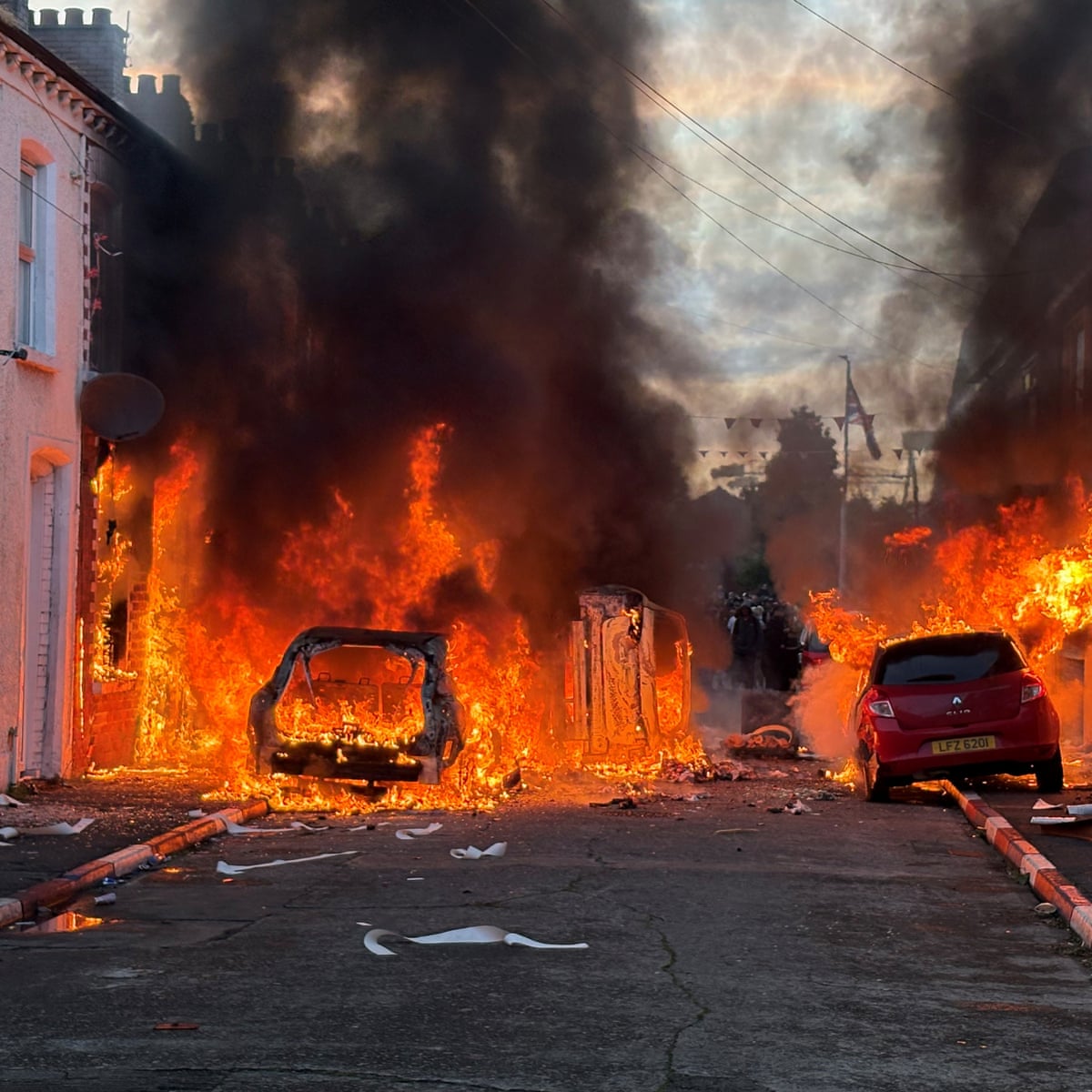
The suspect’s immigration background soon became a central focus of public discussion. Police said he had arrived in Belfast from Dublin in 2023 after claiming asylum. The revelation generated immediate anger among anti-immigration activists and some politicians, who argued that the case demonstrated weaknesses in Britain’s immigration and border-control system.
But the reaction quickly went far beyond a debate about immigration policy.
Protests were followed by serious disorder in Belfast and surrounding areas. Masked groups attacked police officers, vehicles and buildings. Fires were started, including fires at properties believed to house immigrants. Police used water cannon and plastic bullets in an effort to control the violence, while officers from Great Britain were brought in to reinforce the PSNI. At least a dozen police officers were injured during the unrest.
Perhaps the most disturbing feature was that some attacks appeared to target people because of their perceived nationality or ethnicity rather than because they had any connection with the original crime.
Reports emerged of families being driven from their homes after properties were attacked. Businesses owned by ethnic minority residents were also damaged or burned. A list of addresses believed to belong to immigrants circulated online, increasing fear among communities across Belfast. The Police Service of Northern Ireland warned that the circulation of such information was reckless and deeply distressing for residents.
This transformed the unrest from a protest about one criminal investigation into something much broader.
For many residents from ethnic minority backgrounds, the message was terrifying. They were suddenly being treated as representatives of an immigration debate that had nothing to do with their individual behaviour. Families who had lived peacefully in Belfast for years found themselves worrying that their homes could become targets simply because someone believed they were immigrants.
That is one of the central dangers of communal unrest: individual responsibility disappears and collective blame takes its place.
A person accused of a crime can be investigated, prosecuted and, if convicted, punished according to the law. But when anger is redirected towards an entire ethnic or migrant community, innocent people become targets. The distinction between justice and revenge is then lost.
Northern Ireland’s political leaders responded by condemning the violence.
Northern Ireland Secretary Hilary Benn described the attacks as racist thuggery, while First Minister Michelle O’Neill condemned the scenes of families being forced from their homes. Political leaders from across the region called for calm and insisted that people should not be collectively blamed for the actions of one individual.
The PSNI also warned people not to be manipulated by voices online encouraging hatred and disorder. The police response reflected a growing recognition that social media had become a major factor in modern public-order emergencies.
Within hours of the attack, unverified claims, inflammatory videos and emotionally charged posts were circulating across social media platforms. Some material encouraged people to attend protests, while other posts identified alleged immigrant addresses. The speed at which such information spread made it extremely difficult for authorities and journalists to correct false claims before they influenced behaviour.
This is not an entirely new phenomenon.
Britain experienced similar problems during the disorder that followed the Southport stabbing in 2024. False information about the identity and religion of the attacker circulated online and contributed to violent anti-immigrant demonstrations. Northern Ireland’s 2026 unrest demonstrated how quickly a shocking crime can again become the centre of an online information war.
The consequences can be devastating.
A photograph, video or claim can be shared thousands of times before anyone verifies it. A rumour about someone’s nationality can suddenly become accepted as fact. An angry post can encourage people to gather in the street. Once crowds assemble, individuals can become emboldened by the behaviour of others.
The result is a dangerous feedback loop: fear creates anger, anger creates demonstrations, demonstrations create confrontation and confrontation generates more images that can be used to fuel further anger.
The Belfast unrest also reopened an extremely sensitive question about the border between Northern Ireland and the Republic of Ireland.
Northern Ireland is part of the United Kingdom, while the Republic of Ireland is a separate sovereign state and member of the European Union. Yet people can move across the land border without routine immigration checkpoints. The arrangement is deeply connected to the Good Friday Agreement and the political settlement that ended decades of conflict.
The fact that the suspect had travelled from the Republic of Ireland to Northern Ireland therefore became politically significant.
Critics of the existing immigration system argued that the open border created a potential route through which people could enter the UK after arriving in Ireland. Supporters of the current arrangements counter that the Common Travel Area between Britain and Ireland predates modern immigration disputes and is a fundamental feature of relations between the two countries.
The controversy illustrates the difficulty of combining immigration enforcement with the political realities of the island of Ireland.
Any attempt to impose conventional border controls could have consequences extending far beyond immigration. Northern Ireland’s peace settlement was built partly around the ability of people to move freely between communities and across the Irish border.
That is why the Belfast attack quickly became much more than a local crime story.
It became a test of Britain’s immigration system, the Irish border arrangements and Northern Ireland’s fragile social cohesion.
However, it is important to distinguish legitimate political questions from racial hostility.
There is nothing inherently illegitimate about debating immigration levels. Governments have the right to determine immigration policy, decide who qualifies for asylum and establish procedures for removing people who have no legal right to remain.
Citizens also have the right to criticise those policies.
But opposition to immigration policy does not justify attacking immigrants, burning homes or threatening families. Those actions are crimes in their own right.
The distinction is particularly important because Northern Ireland has a diverse population that has grown significantly over recent decades. Immigrants and ethnic minority residents work in hospitals, schools, shops, construction, transport, hospitality and many other sectors. Some have lived in Northern Ireland for decades; others are second-generation British citizens.
Treating all of these people as responsible for the actions of one suspect is therefore both unjust and socially destructive.
The violence also created an uncomfortable historical parallel.
During the Troubles, “burning out” families from their homes was a notorious form of intimidation. People could be forced to leave neighbourhoods because of their religion or political identity. Communities were divided by fear, and homes became symbols of territorial control.
To see families again being driven from properties because they were perceived to be outsiders was therefore particularly disturbing.
Northern Ireland’s post-conflict society has spent decades attempting to build a different future. The principle that people should be able to live safely regardless of their religious, ethnic or political identity is central to that future.
The Belfast unrest demonstrated how fragile that progress can become when anger is allowed to turn into collective punishment.
There is also a wider political lesson.
Immigration has become one of the most controversial issues in British politics. Concerns about asylum applications, small-boat crossings, housing shortages and pressure on public services have helped fuel support for parties demanding much tougher policies.
Politicians therefore face a difficult responsibility.
They must be able to discuss genuine public concerns without encouraging people to believe that an entire community is responsible for crime or social problems. Strong language may attract attention and energise supporters, but it can also contribute to an atmosphere in which vulnerable groups become targets.
Social media makes that responsibility even greater.
Ofcom warned platforms about potential legal consequences if their services were used to incite violence or spread hatred in connection with the Belfast unrest. Technology Secretary Liz Kendall also called for urgent discussions with major platforms, including X, over their responsibilities under Britain’s Online Safety Act.
The debate over social media is likely to become increasingly important.
Traditional news organisations have editorial standards, legal responsibilities and professional processes for verifying information. Social media platforms operate very differently. A dramatic video can become globally visible within minutes, regardless of whether the accompanying description is accurate.
That does not mean social media itself causes violence. The underlying grievances may exist independently. But online networks can dramatically accelerate the spread of rumours, anger and mobilisation.
In Belfast, that acceleration was particularly visible.
The original attack was horrific and deserved a full criminal investigation. The victim’s suffering should remain at the centre of the story. His family has subsequently provided updates on his recovery, saying that he was expected to leave hospital and begin rehabilitation after suffering devastating injuries, including serious damage to his eyesight.
But the victim’s tragedy should not be used as a justification for attacking unrelated people.
The proper response to a violent crime is investigation, prosecution and justice.
If the suspect is convicted, the courts can impose the appropriate punishment. If immigration law requires further action after the criminal process, that can be considered through lawful procedures. What cannot be justified is replacing the justice system with mob punishment.
That principle matters not only for immigrants but for everyone.
Once a society accepts the idea that a person’s ethnicity or nationality makes them collectively responsible for an individual’s crime, no community is completely safe from becoming the next target.
Northern Ireland knows this lesson better than almost anywhere else in the United Kingdom.
The region’s history demonstrates what can happen when political identity becomes so powerful that individuals are judged primarily by the group to which they belong.
The 2026 Belfast unrest is not a return to the Troubles. The circumstances are very different, and there is no evidence that Northern Ireland has returned to the organised paramilitary conflict of the past. But the images of burning buildings, masked crowds and terrified families inevitably evoke memories of a period when communal intimidation was a central feature of everyday life.
That is why the response matters so much.
Authorities must protect communities, investigate crimes and maintain public order. Politicians must address legitimate concerns about immigration while rejecting racial scapegoating. Social media companies must take seriously the spread of material that encourages violence. And communities themselves must resist the temptation to allow anger over one crime to become hatred towards thousands of innocent people.
The Belfast attack has revealed genuine anxieties about immigration and border control. Those anxieties cannot simply be dismissed.
But neither can the violence be excused as an understandable expression of political frustration.
Northern Ireland has spent decades trying to replace conflict with politics and law. The challenge now is to ensure that new disputes over immigration do not recreate the same patterns of fear and communal division under a different name.
The strongest response to the Belfast attack is therefore not collective revenge.
It is justice for the victim, accountability for the perpetrator, protection for innocent communities and an honest political debate about immigration.
Northern Ireland’s future will not be secured by burning people out of their homes. It will be secured by ensuring that every person—regardless of nationality, religion or background—is protected by the same law.
That is the real test emerging from the Belfast unrest: whether a society with such a difficult history can confront a new source of tension without allowing fear and anger to tear its communities apart again.