
Reform Is on Fire – The Civil War Now Raging Inside Nigel Farage’s Party
Reform UK has enjoyed a remarkable rise in British politics, but the party is now facing a serious internal crisis as rival personalities, competing political strategies and questions about leadership threaten to undermine its momentum.
The latest turmoil has centred on the suspension of Tim Montgomerie, the founder of ConservativeHome and a prominent Reform supporter who joined the party after leaving the Conservatives. Montgomerie was suspended after publicly criticising Nigel Farage and Reform’s home affairs spokesman Zia Yusuf. He has vowed to challenge the decision, turning the dispute into a wider argument about whether Reform can tolerate dissent within its own ranks.
The row is particularly damaging because it comes at a moment when Reform should be celebrating. Farage recently secured a decisive victory in the Clacton by-election, returning to Parliament with 22,239 votes. The result gave Reform another opportunity to demonstrate that its electoral appeal extends beyond opinion polls and social-media attention.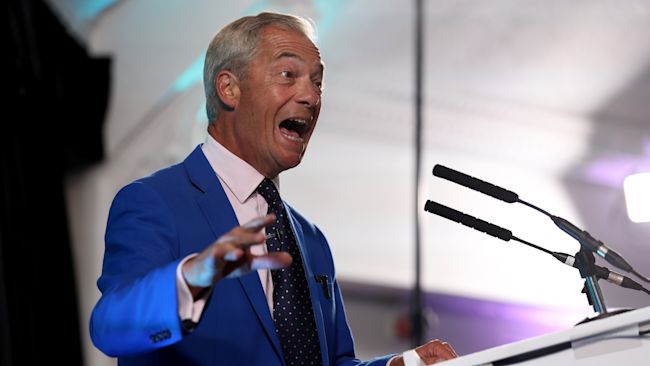
Yet behind the scenes, the party appears increasingly divided.
The central problem is that Reform is no longer simply a protest movement. Its growing support means voters and political commentators are beginning to ask whether it could eventually become a serious party of government. That creates pressures that are very different from those faced by a small insurgent organisation.
A protest party can thrive on provocative personalities and uncompromising rhetoric. A potential governing party needs discipline, credible policies, experienced politicians and mechanisms for resolving disagreements.
Reform is now being forced to confront that transition.
At the heart of the dispute is Farage himself. His political personality dominates Reform in much the same way that it dominated the UK Independence Party and the Brexit Party. A recent analysis of the party described tensions between long-standing loyalists and newer arrivals, between those who want Reform to remain an insurgent movement and those who want to turn it into a professional governing organisation.
That division is becoming increasingly visible.
Montgomerie’s criticism was significant precisely because he was not an obvious political enemy. He had joined Reform and broadly supported its objectives. His concerns focused on Farage’s leadership style, party structures and the behaviour of other senior figures.
His suspension has consequently raised a difficult question: if someone broadly supportive of the party can be removed for publicly criticising its leadership, how much room is there for internal disagreement?
Reform deputy leader Richard Tice has defended the decision. He argued that disagreements should generally be dealt with privately and insisted that the party remains open to debate. From the leadership’s perspective, this is a reasonable argument: political parties cannot operate effectively if every disagreement immediately becomes a public confrontation.
But critics see something more troubling.
They argue that the incident demonstrates the dangers of a political organisation built around one dominant leader. If Farage’s authority becomes too closely intertwined with the party itself, disagreements with Farage can easily become disagreements with Reform.
That can create a culture in which ambitious politicians compete not only over policy but also over their relationship with the leader.
Zia Yusuf has emerged as one of the most controversial figures in this environment. As Reform’s home affairs spokesman, he has adopted an unusually combative political style, particularly on immigration. His supporters see that approach as evidence of determination. Critics argue that his rhetoric could make it more difficult for Reform to attract moderate voters.
The question facing Farage is whether Yusuf’s confrontational style helps or harms the party’s long-term ambitions.
There is a strategic argument in favour of it. Reform’s existing supporters are attracted to politicians who appear willing to say things that traditional parties avoid. Aggressive rhetoric can strengthen the impression that Reform is genuinely different from Labour and the Conservatives.
But there is also an obvious danger.
If Reform wants to win enough seats to influence or form a government, it will eventually need support from voters who may agree with its concerns about immigration but dislike extreme rhetoric or political infighting.
This is the fundamental contradiction now facing the party.
Reform’s success depends on being different from the political establishment. Its future success may depend on becoming more like a conventional political organisation.
Farage has already begun addressing this challenge by building a broader team of prominent politicians. Figures such as Robert Jenrick and Suella Braverman have brought Conservative experience and credibility, while Tice and Yusuf occupy different positions within the party’s leadership.
But bringing experienced politicians into Reform creates another problem: competing personalities.
The more powerful figures Reform contains, the more difficult it becomes for Farage to maintain absolute control.
This is not necessarily unusual in a growing political party. However, Reform’s history makes the situation especially sensitive.
The party has already experienced a major rupture with Rupert Lowe, a former Reform MP who was suspended following a bitter dispute with the leadership and subsequently established Restore Britain. Lowe has since offered an “olive branch” to Farage, suggesting that cooperation between the two movements could eventually be possible. Instead, the proposal quickly developed into another round of recriminations.
Restore creates a particularly serious strategic problem for Reform.
If the British right becomes divided between Reform and Restore, both parties could end up competing for essentially the same voters. Under Britain’s electoral system, that could be extremely damaging.
A divided right could allow Labour or the Conservatives to win seats even where a majority of voters support right-wing policies.
Farage therefore has a strong incentive to maintain unity.
The problem is that unity cannot simply be imposed.
If politicians feel that they cannot criticise the leadership, tensions can build beneath the surface. If criticism is allowed to become public, opponents can portray the party as chaotic.
The Montgomerie dispute demonstrates exactly this dilemma.
The party wants to appear disciplined, but disciplining a prominent supporter has itself become a major story.
Meanwhile, Farage’s own political position has faced additional scrutiny. His recent return to Parliament followed a Clacton by-election in which he won comfortably, but the campaign was overshadowed by questions surrounding a £5 million gift from cryptocurrency businessman Christopher Harborne and concerns about financial disclosure. Farage has denied that the money was linked to his political activities, while parliamentary scrutiny has continued.
These controversies create additional pressure at exactly the moment when Reform needs to look stable.
The party’s opponents are eager to exploit every sign of disorder.
Labour can argue that Reform is not ready to govern. The Conservatives can portray Farage’s movement as an unreliable alternative to the established right. And Restore Britain provides a direct challenge from another direction.
Yet it would be a mistake to conclude that Reform is necessarily collapsing.
The party remains electorally significant. Farage’s Clacton victory demonstrated that he retains considerable support, while recent polling has placed Reform ahead of the Conservatives.
The internal conflict may therefore be better understood as a symptom of success.
A party with little chance of winning power does not need to resolve questions about governing competence. A party that believes it could become Britain’s largest political force must answer them.
That means Reform must decide what kind of organisation it wants to be.
Does it remain a populist movement centred around Farage, with a small group of loyal figures and highly provocative campaigning?
Or does it become a broader conservative-populist party capable of attracting millions of voters who want political change but also expect competence and stability?
The answer could determine Britain’s political future.
Farage’s personal appeal remains one of Reform’s greatest strengths. He is an experienced campaigner with a remarkable ability to generate media attention and connect with voters who distrust Westminster.
But personal leadership also creates vulnerability.
If Reform becomes too dependent on Farage, what happens when he makes a political mistake? What happens if his popularity declines? And what happens when younger or more ambitious politicians begin demanding greater influence?
These questions are becoming increasingly important as the party expands.
The tension between Farage and his colleagues is also connected to a deeper ideological question.
Some Reform figures appear focused primarily on immigration and cultural issues. Others are increasingly emphasising economic policy, business, public services and government reform. The party has recently promoted proposals designed to attract business support, including changes to data-protection rules, tax measures and reforms aimed at encouraging investment.
That broader policy agenda suggests that Reform is trying to become more than an anti-immigration movement.
But broadening the party’s platform creates the possibility of new disagreements.
What should Reform prioritise: immigration, tax cuts, public-service reform, defence, housing or economic growth?
How radical should its policies be?
How aggressively should its politicians communicate?
And how much should Reform compromise in order to win power?
These questions cannot be answered simply by Farage making another speech.
They require a functioning political organisation.
That is why the current infighting matters.
The dispute with Montgomerie may eventually be resolved, and Reform could emerge stronger. The party could decide that disagreements are normal and establish clearer rules for internal debate.
Alternatively, the episode could become another step in a pattern of internal conflict.
If prominent figures continue to leave or be suspended, Reform risks repeating the history of previous Farage-led political movements. UKIP and the Brexit Party both experienced intense internal disputes as they grew in prominence.
The danger is that Reform could win the political argument against its opponents but lose the organisational battle against itself.
Farage knows that the opportunity before him is unusually large.
Labour is attempting to establish itself under Andy Burnham, while the Conservatives are struggling to rebuild their position. Reform has an opening to become the dominant force on Britain’s political right.
But that opening will not remain available forever.
The longer Reform spends fighting internally, the more opportunity its rivals have to recover.
The challenge is therefore not simply keeping the party together. It is deciding what Reform should become.
The suspension of Tim Montgomerie has brought that question into sharp focus. His supporters see the episode as evidence that the party leadership is intolerant of criticism. Reform’s leadership sees it as an attempt to maintain discipline and prevent internal disagreements from damaging the organisation.
Both arguments contain some truth.
A successful political party needs unity, but it also needs honest internal debate.
It needs a strong leader, but it also needs institutions capable of surviving that leader.
It needs a distinctive identity, but it must eventually persuade people beyond its traditional base.
Reform has not yet demonstrated that it can achieve all three.
For now, the party remains politically powerful but organisationally unsettled. Farage has the electoral momentum, but he also has an increasingly complicated team around him. Yusuf’s confrontational style, Montgomerie’s suspension, Lowe’s rival party and continuing questions about Reform’s internal structure have created a turbulent political environment.
The irony is that Reform’s greatest danger may come precisely because it is becoming more successful.
When a political movement is small, disagreements can be ignored. When it starts looking like a potential government, every disagreement becomes a question about competence.
Nigel Farage now has to prove that Reform can survive the pressures of success.
If he can impose discipline while allowing genuine debate, the current crisis may ultimately strengthen the party. If he responds to every challenge by tightening control, he risks driving away talented figures and creating new rivals.
The next stage of Reform’s rise will therefore not be determined only by opinion polls or election results.
It will be determined by whether Nigel Farage can turn a movement built around his personality into a political party capable of functioning beyond it.
That is the real civil war now raging inside Reform UK.
And its outcome could decide whether Farage’s party becomes the next great force in British politics—or another insurgent movement undone by its own internal divisions.