
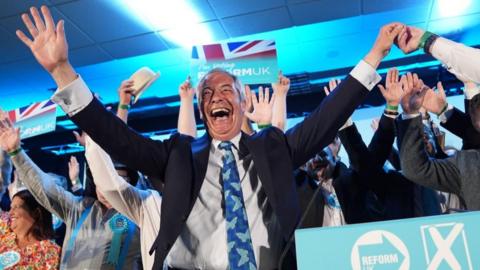
Nigel Farage Celebrates By-Election Win but Loses Seats to Labour and Lib Dems
Nigel Farage has every reason to celebrate after securing a major by-election victory for Reform UK. The result provides the Reform leader with another opportunity to claim that his party is transforming British politics and challenging the traditional dominance of Labour and the Conservatives.
Yet beneath the celebration lies a more complicated political picture.
While Reform UK can point to an important victory, the wider electoral landscape contains several warning signs. The party has also lost council seats to Labour and the Liberal Democrats, demonstrating that Farage’s momentum is not as unstoppable as some of his supporters might believe.
This contrast could prove crucial for Reform as it attempts to turn its growing popularity into a realistic prospect of forming a national government.
The by-election victory is undoubtedly significant. Reform has demonstrated that it can win elections in areas where established parties have traditionally dominated. For Farage personally, such victories reinforce his argument that British politics is undergoing a fundamental realignment.
He has spent years predicting that voters would eventually abandon the Conservative Party in large numbers. That prediction has increasingly become reality. Reform has attracted millions of voters who are dissatisfied with the Conservatives, Labour and what they see as an unresponsive political establishment.
The party’s local election successes have also demonstrated the depth of this support. Reform made dramatic gains across England in recent elections, taking control of several councils and winning hundreds of seats.
However, electoral politics is rarely straightforward.
A party can achieve a spectacular victory in one constituency while struggling elsewhere. This is particularly true in Britain’s first-past-the-post system, where local political circumstances can have an enormous influence on individual results.
That is precisely why Reform’s losses to Labour and the Liberal Democrats should not be ignored.
For Labour, taking seats from Reform provides valuable evidence that Farage’s party can be challenged. The government can argue that Reform’s support is not permanent and that voters who are dissatisfied with Labour may nevertheless choose another alternative rather than backing Farage.
The Liberal Democrats have a different opportunity.
Their traditional strength has often come from targeting particular constituencies and exploiting dissatisfaction with larger parties. They can present themselves as a moderate alternative to both Labour and Reform, particularly in areas where voters are uncomfortable with political polarisation.
This creates a difficult environment for Farage.
Reform needs to convince voters that it is the most effective vehicle for change. But if voters have several alternatives, the party cannot assume that dissatisfaction automatically translates into Reform support.
The problem becomes even greater when considering the Conservative Party.
The Conservatives have suffered heavily from the rise of Reform, but they remain a major national organisation with considerable resources and an established electoral base. If the Conservatives can rebuild their reputation, they could potentially win back some of the voters who moved to Farage.
Reform could therefore find itself squeezed from several directions.
Labour can appeal to voters who prioritise public services and economic security. The Liberal Democrats can attract moderate and tactical voters. The Conservatives can attempt to recover economically conservative voters. Reform must compete against all three while maintaining its distinctive identity.
Farage’s response has been to broaden the party’s policy platform.
For years, immigration and Brexit dominated Reform’s political message. Those issues remain central, but the party increasingly wants to demonstrate that it has credible answers on taxation, business, housing, healthcare and public services.
This is essential if Reform genuinely wants to govern.
A protest party can survive by highlighting problems. A governing party must explain how it intends to solve them.
That difference is now becoming increasingly important.
Reform’s economic policies, for example, have attracted attention because the party wants to combine lower taxes with higher economic growth and reduced regulation. Supporters argue that Britain needs a major change in economic direction. Critics question whether Reform’s promises can be funded without significant reductions in public spending or additional borrowing.
These questions will become more difficult as the party becomes more electorally successful.
The same applies to healthcare.
Voters may agree with Reform’s criticism of the NHS, but they will eventually want to know how the party would reduce waiting lists, recruit staff and improve services. Housing presents a similar challenge. Reform can promise more affordable homes, but building them requires land, planning reform, infrastructure and substantial investment.
This is where the difference between campaigning and governing becomes clear.
Farage has proven that he can identify voter frustration. His next challenge is proving that Reform has the competence to address the underlying causes.
The recent by-election victory helps him because it gives Reform another example of electoral success. It allows Farage to tell supporters that their votes can produce concrete results.
But the council losses to Labour and the Liberal Democrats complicate that message.
They suggest that Reform’s electoral coalition is not yet secure.
Some Reform voters may be highly committed and unlikely to change their minds. Others may be voting for the party primarily as a protest against Labour or the Conservatives. These less committed voters could move elsewhere if political circumstances change.
That is why Farage needs to understand not only why people vote for Reform, but also why some voters choose not to.
The losses to Labour and the Liberal Democrats provide important clues.
Labour may be benefiting from voters who want stronger public services but are concerned about Reform’s more confrontational approach. The Liberal Democrats may be attracting people who want political change but prefer a less polarised alternative.
Reform therefore faces a strategic dilemma.
Should it become more moderate in order to attract centrist voters, or should it remain uncompromising in order to protect its core support?
Moving towards the centre could make Reform more acceptable to a wider electorate. But it could also weaken the very identity that made the party successful.
Remaining firmly on the right could preserve Farage’s strongest supporters but limit Reform’s ability to expand beyond its existing coalition.
This is arguably the most important political decision facing Farage.
His personal popularity also presents both an advantage and a risk.
Farage is one of Britain’s best-known political figures. He can attract media attention, communicate directly with voters and dominate political debates. His supporters see him as an authentic outsider who has challenged the establishment for decades.
But a party that relies too heavily on one individual can become vulnerable.
If Reform’s fortunes rise and fall entirely with Farage’s personal popularity, the organisation may struggle to develop a broader leadership team. A national governing party requires experienced politicians who can manage departments, develop policy and defend decisions under intense scrutiny.
Recent controversies within Reform have therefore been particularly significant.
Internal disagreements can damage a party more severely once voters begin to consider it a potential government. People may tolerate instability in a protest movement, but they are much less forgiving when deciding who should control the country.
Farage must therefore demonstrate that Reform can remain disciplined while expanding.
The council losses also demonstrate the importance of local organisation.
National popularity does not automatically translate into thousands of successful local candidates. Labour and the Liberal Democrats have decades of experience building local political networks. Reform is still developing this infrastructure.
If the party wants to win a large number of parliamentary seats, it will need strong local organisations, credible candidates and campaigners capable of maintaining support between elections.
The by-election victory is therefore important, but it should be placed within the larger picture.
Reform has clearly established itself as a serious political force. It can win elections and has demonstrated that its support extends well beyond a narrow protest vote.
At the same time, it is not yet invincible.
The fact that Labour and the Liberal Democrats can take seats from Reform demonstrates that voters remain open to persuasion. Political loyalties are fluid, and the next election could look very different from the previous one.
For Labour, this provides a reason for confidence.
Prime Minister Andy Burnham’s government is under pressure on many fronts, including the economy, public services, housing and immigration. But if Labour can demonstrate tangible improvements in living standards and regain the confidence of working-class voters, it may be able to limit Reform’s expansion.
The Liberal Democrats also have an opportunity to exploit the growing fragmentation of British politics.
Their strategy of targeting specific constituencies could become particularly effective if voters increasingly engage in tactical voting. In a fragmented political system, a party does not necessarily need to dominate nationally to win a substantial number of seats.
That creates a complicated electoral map for Farage.
He cannot simply focus on national polling. He must understand where Reform’s support is strongest, where it is vulnerable and which parties are best positioned to challenge it in individual constituencies.
This is one reason why by-election results can be both encouraging and misleading.
A strong result in one constituency can demonstrate potential, but it does not necessarily predict what will happen elsewhere.
Farage knows this. His political career has been built around understanding the geography of British political dissatisfaction. He understands that winning national influence requires converting broad support into specific electoral victories.
The latest results therefore offer both good news and a warning.
The good news is that Reform remains capable of winning important contests and attracting substantial support. The warning is that Labour and the Liberal Democrats can still defeat the party, while the Conservatives remain a potential threat if they recover.
The next phase will be about consolidation.
Farage needs to turn enthusiasm into organisation. He needs to broaden Reform’s policy programme without abandoning its core supporters. He needs to present himself not merely as the leader of an anti-establishment movement but as a potential Prime Minister capable of running a modern state.
That will be a much harder task than winning a by-election.
Ultimately, the latest results reveal a British electorate that is increasingly unpredictable. Voters are willing to abandon traditional loyalties, but they are also willing to switch between alternatives.
Farage can celebrate his victory, and he should. It is evidence that Reform remains a powerful force.
But the losses to Labour and the Liberal Democrats should serve as a reminder that no victory is permanent.
Reform has opened the door to a new political era, but walking through that door will require more than slogans and successful campaigns. It will require organisation, credible policies, disciplined leadership and the ability to persuade voters who do not automatically share Farage’s worldview.
The by-election victory may strengthen his position today.
The council losses show why he cannot afford to become complacent tomorrow.
:::{“fallbackMarkdown”:””,”reference”:{“matched_text”:” “,”prefix”:null,”start_idx”:12349,”end_idx”:12349,”safe_urls”:[],”refs”:[],”alt”:””,”prompt_text”:null,”type”:”sources_footnote”,”sources”:[],”has_images”:false},”showLoginRequiredCard”:false}