
PMQs Showdown: Andy Burnham Refuses to Cut Benefits to Fund Defence as Kemi Badenoch Turns Up the Pressure
The latest Prime Minister’s Questions produced one of the clearest political dividing lines yet between Andy Burnham and Kemi Badenoch.
With Britain’s defence spending under growing pressure and international security concerns dominating Westminster, the Conservative leader attempted to force the Prime Minister into answering a deceptively simple question: if Britain needs to spend substantially more on defence, where will the money come from?
Burnham’s answer was equally direct.
He rejected the idea that Britain should pay for greater national security by making large cuts to social security.
The exchange revealed a fundamental disagreement over the priorities of government.
Badenoch argued that Britain faces serious threats that cannot wait for long-term plans. Burnham argued that national security and social security should not be treated as competing objectives.
The confrontation is likely to continue well beyond the chamber of the House of Commons.
Badenoch Puts Defence at the Centre of PMQs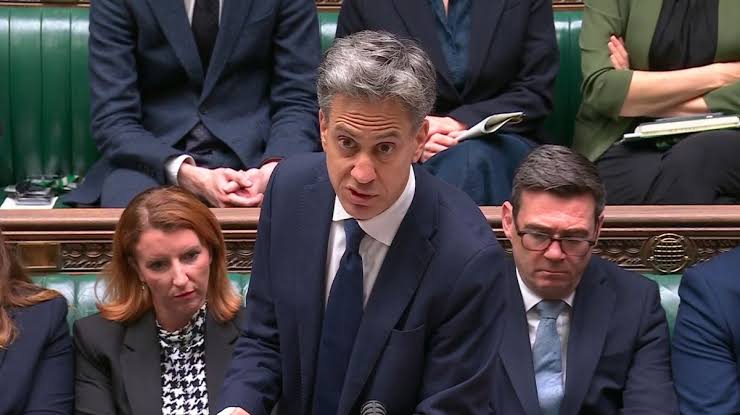
Kemi Badenoch entered the session determined to return to an issue she had already raised with Burnham during previous PMQs: Britain’s future defence budget.
The Conservative leader questioned why the government was not moving more quickly towards the NATO spending target.
The government has committed to spending 3.5 per cent of GDP on defence and national security by 2035, while the Prime Minister has said that a timetable for reaching 3 per cent will be set out later.
For Badenoch, that timetable is not fast enough.
She argued that Britain faces threats now rather than in a decade.
Her concerns included Russia, tensions around the Falkland Islands and the wider deterioration of Britain’s security environment.
Her argument was built around urgency.
If the government believes the security situation has changed, she asked, why should the country wait years before significantly increasing defence spending?
The Welfare Question
The most contentious part of the exchange concerned welfare.
Badenoch has argued that the government should find money for defence by reducing welfare spending.
Her proposed approach includes changes to housing benefits and the restoration of the two-child benefit cap. She has argued that such measures could help close what Conservatives describe as a funding gap for defence.
The Conservative position is therefore based on a particular spending choice.
If government spending must increase on defence, money has to come from somewhere.
Badenoch’s argument is that welfare spending has grown too much and should be reduced to free resources for national security.
Burnham rejected that approach.
He described the proposed reductions to housing support as “crude cuts” and argued that taking billions of pounds out of housing benefit could result in large numbers of people losing secure accommodation.
The Prime Minister also argued that the government’s approach to housing could eventually reduce welfare expenditure by increasing the supply of social housing.
That creates a very different philosophy.
Rather than immediately cutting benefits, Burnham says the government should address the structural reasons why welfare spending is high.
“National Security Cannot Come at the Expense of Social Security”
The most memorable moment of the exchange came when Burnham made his central argument.
He said that while his government would do everything necessary to protect national security, it could not come at the expense of social security.
That statement immediately became the focus of the political reaction.
Badenoch interpreted it as evidence that Burnham was putting welfare before defence.
She subsequently accused the government of being too dependent on welfare spending and argued that defending the country must sometimes take priority over benefits.
Burnham’s position is different.
He does not reject increased defence spending.
Instead, he rejects the idea that a large reduction in welfare is the necessary mechanism for paying for it.
That distinction is central to understanding the dispute.
Burnham’s Defence Commitment
It would be inaccurate to portray Burnham’s position as opposition to higher defence spending.
The Prime Minister has repeatedly said that his government is committed to Britain’s NATO obligations.
He has backed the target of reaching 3.5 per cent of GDP on defence and security by 2035 and has said that the government will establish a route towards that goal.
His argument is about how Britain gets there.
Burnham says the government has a fully funded defence investment plan and that the Chancellor was appointed partly because of his commitment to defence.
He has also called for cross-party cooperation rather than political point-scoring.
That approach contrasts sharply with Badenoch’s more confrontational strategy.
For the Conservative leader, the government needs to provide a clear answer about where the money will come from.
For Burnham, the priority is to establish a sustainable economic and fiscal framework rather than making rapid spending cuts simply to satisfy a political deadline.
The £4 Billion Dispute
At the centre of the argument is a proposed reduction of roughly £4 billion in housing benefit.
Badenoch argues that reducing housing-related welfare spending could provide money for defence.
Burnham says such a policy could have serious consequences for households and potentially create additional homelessness.
The disagreement illustrates two different ways of looking at public expenditure.
One approach begins with the size of the defence requirement and asks which existing budgets can be reduced.
The other begins with the consequences of those reductions and asks whether the proposed savings are socially and economically sustainable.
Neither side disputes that defence requires significant additional resources.
The disagreement is over which sacrifices, if any, should be made to provide them.
Why the Debate Has Become So Difficult
Britain is facing a difficult fiscal environment.
The government has promised increased defence spending while also facing pressure over public services, welfare, taxation and the cost of living.
At the same time, borrowing costs have risen and inflation remains a concern.
Burnham acknowledged this week that his first Budget will be challenging, while insisting that his government will make difficult decisions to maintain economic stability.
That makes the defence debate particularly important.
There is little evidence that the government can simply spend substantially more without making choices elsewhere.
The choices could involve taxation, borrowing, economic growth, reductions in other areas of public expenditure, or some combination of all four.
The government therefore has to explain not only how much it wants to spend on defence, but how that spending will fit into the wider public finances.
Badenoch’s Political Challenge
For Badenoch, defence provides an opportunity to challenge Burnham on an issue where Conservatives traditionally seek to emphasise their commitment to national security.
Her argument is straightforward.
If Britain faces a more dangerous international environment, defence spending should rise quickly.
If there is not enough money available, the government should identify spending that can be reduced.
Welfare is one of the areas she has chosen.
She has also criticised the government for what she regards as excessive taxation and insufficient attention to wealth creation.
Her broader message is that Britain cannot protect itself militarily while allowing other areas of government spending to expand without restraint.
That argument is likely to remain a major part of Conservative attacks on the government.
Burnham’s Counterargument
Burnham is attempting to construct a different narrative.
Rather than presenting welfare and defence as opposing priorities, he argues that a secure country also needs strong communities.
People need housing.
They need employment.
They need functioning public services.
And they need an economy capable of generating the tax revenues necessary to support both defence and social programmes.
His government has therefore focused on economic growth as part of the answer.
During the PMQs exchange, Burnham argued that Labour could reduce welfare costs by helping more young people into employment and by increasing the supply of social housing.
The idea is that structural reform could eventually reduce spending without imposing immediate and severe cuts on vulnerable households.
Whether that strategy can generate savings quickly enough to meet defence commitments is one of the questions the government will have to answer.
The NATO Clock
Perhaps the most important unresolved issue is timing.
The government has committed to 3.5 per cent of GDP by 2035.
But Badenoch wants greater clarity about the route to 3 per cent.
The Prime Minister has said that a date for reaching 3 per cent will be announced as part of future spending decisions.
For the opposition, this leaves room for criticism.
For the government, committing to a specific figure without knowing the full economic circumstances could be risky.
The disagreement therefore goes beyond ideology.
It is also about fiscal planning.
A government can announce a spending target relatively easily.
The difficult part is building a credible long-term plan to pay for it.
A Much Bigger Argument Than Welfare
The PMQs clash has revealed something broader about Britain’s political debate.
The country is increasingly being asked to decide how much it is willing to spend on national security.
That question is becoming more urgent as European security conditions change and governments across NATO reconsider their defence capabilities.
But greater defence spending inevitably creates choices elsewhere.
If taxes do not rise and borrowing does not increase significantly, spending elsewhere may have to be reduced.
The political argument is therefore unlikely to disappear.
The Conservatives are likely to continue pressing the government over welfare and the timetable for defence spending.
Labour will continue arguing that national security cannot be separated from social stability.
Both sides are attempting to define what “security” means.
For Badenoch, security begins with military capability.
For Burnham, military strength is only one part of national resilience.
What Happens Next?
The immediate answer will come through the government’s future spending decisions.
Burnham has promised that his government will meet its NATO commitments.
But the precise route remains under development.
The Chancellor will also face difficult decisions in the upcoming Budget as the government attempts to balance defence spending with economic stability and domestic priorities.
That means the PMQs argument is unlikely to remain theoretical.
Eventually, the government will have to publish numbers.
It will have to show how much money is going to defence, how quickly that spending will rise and how the additional cost will be financed.
At that point, the political debate will become even sharper.
The Real Test for Burnham
For Burnham, the challenge is now to demonstrate that his promise of stronger defence can coexist with his refusal to pursue major welfare cuts.
He has clearly rejected the Conservatives’ proposed approach.
But rejecting one funding mechanism does not eliminate the underlying financial problem.
The government still needs to find a sustainable way to increase defence spending.
For Badenoch, the challenge is equally significant.
She has identified welfare reductions as one potential source of funding, but she will have to convince voters that the consequences of those reductions are acceptable.
The debate therefore comes down to competing priorities rather than a simple argument about whether Britain should spend more on defence.
Almost everyone involved accepts that the security environment has changed.
The real disagreement is over what Britain should sacrifice, reform or invest in to respond to that change.
A Political Fault Line That Is Only Getting Bigger
The Burnham-Badenoch clash at PMQs may prove to be an early sign of one of the defining political arguments of the coming years.
How much should Britain spend on defence?
How quickly should it reach its NATO targets?
And who should pay for the increase?
Badenoch says welfare spending must be confronted.
Burnham says national security cannot be achieved by weakening social security.
Between those two positions lies a difficult set of economic choices.
As the government prepares its future spending plans, voters will have the opportunity to judge those choices for themselves.
For now, one thing is clear.
The argument over Britain’s defence budget is no longer simply about military strategy.
It is becoming a fundamental debate about the role of government, the future of the welfare state and what Britain is prepared to spend to protect itself in a more uncertain world.