

Officials had hoped the one-in-one-out deal would impact Channel crossings (Image: Getty)
Shabana Mahmood is scrambling to save the one-in-one-out migrant deal with France which has “floundered”, Border Force officers believe. French Interior Minister Laurent Nunez has told the Home Secretary that Paris does not want to renew the removals scheme when the trial ends in October.
It is potentially a huge blow for the Home Office, as it was becoming increasingly integral to removing the biggest cohorts of Channel migrants from the UK. And frontline officers believe Emmanuel Macron’s Government “won” because Britain has taken in more people than it has removed.
Get the latest politics news – straight from our team in Westminster and more
Invalid email
You agree you are 18 or over. We use your sign-up to provide content in ways you’ve consented to and to improve our understanding of you. This may include adverts from us and third parties based on our knowledge of you. You can unsubscribe at any time. More Info.
Now insiders believe Mr Nunez’s preferred plan – for Andy Burnham to strike up a deal with the EU – will fail because of political chaos within the bloc.
A Border Force source told the Daily Express: “The idea of an EU-wide migrant distribution scheme has been floated before. It’s been batted about for 10 years.
“And it’s never succeeded because countries cannot agree how many they’re going to take.”
Asked if the agreement had impacted Channel migrant crossings at all, the official said: “No.
“If it has, it is absolutely minimal. It is true that the numbers coming by small boat are down. And that’s a great statistic for the government who like to parrot it a lot.
“What they don’t tie that to is the number of irregular migrants arriving through another route. So, our lorry drops.
“We certainly saw people come back. We knew we’d removed them under the “one in, one out”, and a week later they were back.
“The French weren’t doing anything with them, which, in fairness, they never said they would.
“The whole scheme just floundered.”
Britain has returned some 1,400 Channel migrants to France, which has sent a similar number of legitimate asylum seekers to the UK.
At this point, officials had been expecting to remove 200 migrants a week.
The officer said Labour had ignored warnings that human rights challenges and modern slavery claims would ground the majority of deportation flights.
They said: “They were always going to be the problem.
“The issue with this was refoulement. Nobody considered the asylum claim. We would simply have refouled them to France, and France would not have necessarily considered it themselves.”
Negotiations are underway between Britain and France on whether to renew the “one in, one out” deal, which is set to expire on Oct 1.

Shabana Mahmood and Laurent Nunez are struggling to agree a new deal (Image: Getty)
Ms Mahmood wants to make the arrangement permanent and increase the number of migrants being returned as a deterrent to further crossings.
But Mr Nunez has seemingly already ruled out the proposal.
And he wants Britain to negotiate a returns agreement with the EU. Such a proposal would see Labour accept more migrants from across Europe, in exchange for removing small boat arrivals.
Paris is said to have withdrawn support for the plan because immigration officials in France are struggling to deport those being returned from the UK.
Former Border Force Director General Tony Smith said: “France’s decision to end the one-in-one-out deal in favour of an EU wide deal on returns is destined to fail.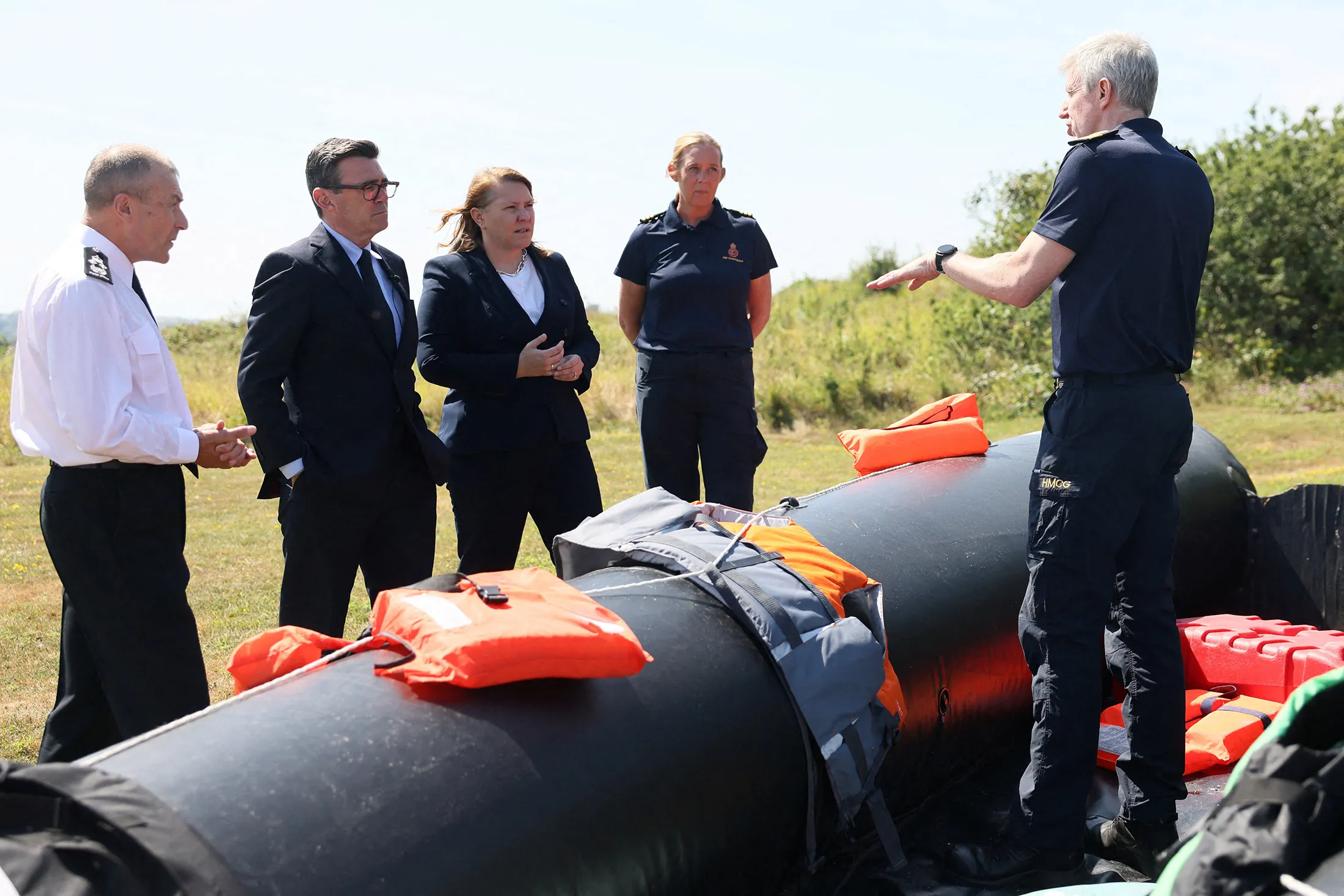
“I worked on various iterations of the Dublin Convention and although we were able to get some returns to Greece and Italy in the early days we never returned anybody to France because we couldn’t prove the migrants had entered the EU there.
“Up until Brexit, we ended up taking in more migrants than we ever returned under Dublin, which has now been replaced by the EU asylum pact.
“That is already struggling with some countries (like Poland and Hungary) who would prefer to pay fines rather than take migrants back from other EU countries.
“Although a safe third country returns deal with France for all boat arrivals offers our best chance of stopping the boats it’s clear that the current French government aren’t interested in it.
“The one-in-one-out deal might have worked if we returned everyone, and so wouldn’t have to take any in, but the numbers have been so small that there is no deterrent to others.
“Extra French patrols in and around Dunkirk and Calais have helped to reduce numbers but the smugglers won’t give up – they will just adapt their tactics to bring people over in bigger boats from further afield.
“Any new deal with the EU will inevitably just see us taking in more asylum seekers from other EU countries and won’t stop others from coming by boat anyway.”
On June 15, Mr Nuñez told a French parliamentary inquiry: “For our part, we want to move away from this bilateral relationship with the UK.
“We consider that France should not have to carry it alone, and that it would be better to integrate it into an agreement between the EU and UK.
“So I have already clearly told my counterpart that this pilot agreement, which we signed in August 2025, was not intended to be renewed beyond October 1, 2026.”
Asked whether an EU replacement could be ready by then, he added: “There is an action plan, there is interest, but it would be naive of me to tell you there will be a mechanism to bridge the gap.”
Andy Burnham and the Future of the UK-France Migrant Deal
The United Kingdom’s attempt to reduce small-boat crossings across the English Channel has become one of the most difficult political and practical challenges facing the government. Prime Minister Andy Burnham has placed cooperation with France at the centre of his strategy, particularly through the “one in, one out” arrangement under which some migrants arriving in Britain by small boats can be returned to France while an equivalent number of people are admitted through legal routes. However, the future of this arrangement has become uncertain. A recent report citing a Border Force source claimed that the scheme had “floundered” and had made little difference to crossings. These claims have created a new political challenge for Burnham’s government, although other evidence indicates that French enforcement and wider UK-France cooperation have contributed to a substantial reduction in small-boat crossings.
The “one in, one out” arrangement was originally established as a pilot scheme between Britain and France. The principle was straightforward: migrants who crossed the Channel illegally in small boats could, subject to the relevant legal processes, be returned to France, while an equivalent number of asylum seekers could travel legally from France to Britain. The British government presented the scheme as a way of creating a safe and legal alternative to dangerous Channel journeys while increasing the consequences for people attempting to cross illegally.
The wider UK-France strategy goes beyond the returns mechanism. In April 2026, Britain and France agreed a new package designed to increase cooperation against people-smuggling networks. The agreement included additional French personnel, technology and intelligence resources. The British government said that cooperation since the 2024 election had prevented more than 42,000 illegal crossings and contributed to the arrest of hundreds of smugglers.
There is evidence that French enforcement activity has increased. In August, the British government reported that French units had prevented 185 small-boat crossing events between 27 April and 2 August. Officials said this represented 61% of the crossing events during that period. The government also reported that French authorities had seized boats, engines and life jackets and arrested suspected smugglers.
The number of people successfully crossing the Channel has also fallen compared with the previous year. According to analysis published by The Guardian, 12,469 people had crossed by small boat between January and mid-July 2026, compared with 21,690 during the equivalent period in 2025. That represented a decline of approximately 43%. However, the same analysis warned that the reduction could not be attributed to a single policy and that smugglers had adapted their methods.
This distinction is important because it complicates the criticism made by the Border Force source cited in the recent report. The source claimed that the “one in, one out” arrangement had had little or no effect on the number of crossings. The source also argued that some migrants returned to France subsequently attempted to come back to Britain. These are significant operational observations, but they represent the assessment of an individual source rather than an independently established conclusion about the entire government strategy.
The source also raised concerns about the practical difficulties involved in returning migrants. Some cases can involve asylum claims, human-rights considerations and modern-slavery claims, all of which can affect whether removal is legally possible. The source argued that these legal complications had been underestimated when the scheme was designed.
Such concerns illustrate why immigration policy cannot be evaluated simply by counting boats. A policy can reduce crossings while still creating significant administrative costs. Conversely, a policy can achieve some operational objectives without eliminating the underlying reasons why people attempt dangerous journeys. The success or failure of the arrangement therefore depends on what objective is being measured.
Another problem concerns the scale of the returns. According to the recent reporting, approximately 1,400 migrants had been returned to France under the arrangement, with a similar number of asylum seekers travelling legally to Britain. The original expectation was that the mechanism would operate on a larger scale. If only a relatively small proportion of Channel arrivals can be returned, its deterrent effect may be limited.
The French government has also raised concerns about the future of the arrangement. French Interior Minister Laurent Nuñez has reportedly told British officials that France wants to move away from the bilateral system and instead develop a wider agreement between the United Kingdom and the European Union. He has previously said the report was sceptical about this approach. Former Border Force director general Tony Smith argued that an EU-wide returns arrangement would face major political and administrative difficulties because EU member states have different interests and may that the pilot was not intended to continue beyond 1 October 2026.
This creates a significant problem for Burnham because the effectiveness of the agreement depends on cooperation from France. Britain cannot unilaterally return migrants to France without French agreement and appropriate legal arrangements. If Paris decides that the bilateral system should end, the British government will have to find another mechanism for dealing with Channel arrivals.
One possible alternative would be an agreement involving the wider European Union. However, the Border Force source quoted in the report was sceptical about this approach. Former Border Force director general Tony Smith argued that an EU-wide returns arrangement would face major political and administrative difficulties because EU member states have different interests and may disagree about how many migrants they should accept.
This criticism reflects a broader challenge created by Brexit. Before Britain left has produced no results. French authorities have increased patrols and intervention operations, and British officials have attributed part of the reduction in crossings to disruption of smuggling networks in northern France. In August, a senior British Border Security Command official explicitly rejected claims that French officers were simply allowing boats to depart. He said French officers had been working to disrupt launches the EU, the country participated in European arrangements governing asylum and returns. The UK’s departure changed the legal framework for cooperation with European countries. Any new agreement must therefore be negotiated separately with France or through a new UK-EU framework.
At the same time, it would be misleading to conclude that the UK-France cooperation has produced no results. French authorities have increased patrols and intervention operations, and British officials have attributed part of the reduction in crossings to disruption of smuggling networks in northern France. In August, a senior British Border Security Command official explicitly rejected claims that French officers were simply allowing boats to depart. He said French officers had been working to disrupt launches, arrest smugglers and seize equipment.
The evidence therefore presents a mixed picture. The overall number of crossings has fallen substantially compared with 2025, and French enforcement has increased. However, smugglers have adapted by launching boats from different parts of the French and Belgian coast and using larger vessels. Some crossings have also involved serious emergencies. In August, French and British rescue teams saved 157 people after a migrant boat caught fire in the Channel.
This adaptation by smuggling networks demonstrates the limitations of enforcement alone. Criminal organisations have financial incentives to continue operating, and they can change routes and methods when particular launch sites become harder to use. Larger boats can also create new safety risks because more people are placed on vessels that may be unstable or unsuitable for crossing the Channel.
Burnham has therefore argued for a broader strategy. During his meeting with French President Emmanuel Macron, his government announced additional resources for French police, including a specialist team intended to seize equipment and arrest smugglers. The number of French officers working on small-boat crossings was expected to rise to nearly 1,050.
Burnham has also supported the idea of safe and legal routes. The argument is that people who have legitimate reasons to seek asylum should have an alternative to paying criminal smugglers and risking their lives in small boats. Supporters of this approach argue that reducing the market for smugglers requires both enforcement and legal alternatives.
However, safe routes also present difficult policy questions. The government has to determine who qualifies, how many people can be admitted and how applications can be’s comments raise legitimate questions about whether the returns mechanism has operated at the scale originally intended and whether it has significantly deterred crossings. Nevertheless, the broader evidence does not support the simple conclusion that the entire UK-France strategy has failed. Crossings have fallen, French intervention has increased, and cooperation between the two governments has disrupted some smuggling activity. processed. If the legal routes are too limited, they may have little effect on people who remain determined to cross illegally. If they are expanded substantially, the government may face political opposition from voters concerned about immigration levels.
The controversy surrounding Burnham’s France deal therefore reflects a much larger disagreement about how Britain should manage irregular migration. One approach prioritises stronger enforcement, deterrence and removals. Another emphasises legal routes, international cooperation and addressing the reasons people seek asylum. In practice, governments often attempt to combine elements of both approaches.
The criticism from the Border Force source should consequently be understood in this wider context. The source’s comments raise legitimate questions about whether the returns mechanism has operated at the scale originally intended and whether it has significantly deterred crossings. Nevertheless, the broader evidence does not support the simple conclusion that the entire UK-France strategy has failed. Crossings have fallen, French intervention has increased, and cooperation between the two governments has disrupted some smuggling activity.
The immediate challenge for Burnham is the approaching expiry of the current returns arrangement. If France does not agree to renew it, Britain will need either a replacement bilateral agreement or a new framework involving the EU. The government must also consider whether the existing scheme provides sufficient value relative to its financial and administrative costs. Recent reporting said that the cost of returning an individual under the arrangement was approximately £56,000, although the Home Secretary argued that this was comparable to the cost of accommodating a migrant in a hotel for a year.
Ultimately, the debate is not simply about whether Burnham has suffered a political “blow”. It is about whether a particular policy mechanism can achieve several objectives simultaneously: reducing dangerous crossings, disrupting smuggling gangs, providing legal routes for genuine asylum seekers and maintaining public confidence in border control.
In conclusion, the future of Andy Burnham’s France migrant deal is uncertain. A Border Force source has criticised the “one in, one out” arrangement and claimed that its effect on Channel crossings has been minimal. France has also indicated that it may prefer an EU-wide arrangement rather than renewing the existing bilateral scheme.
However, other evidence shows that wider UK-France cooperation has coincided with a substantial reduction in small-boat crossings and increased French enforcement against smugglers.
The available evidence therefore points to a mixed assessment rather than a simple success or failure. Burnham’s government faces the practical task of deciding whether to preserve the current arrangement, renegotiate it, or replace it with a broader European framework. Whatever option is chosen, its effectiveness will ultimately depend on the ability of Britain and its European partners to combine enforcement, legal cooperation and safe alternatives while addressing the criminal networks that profit from dangerous Channel crossings.