
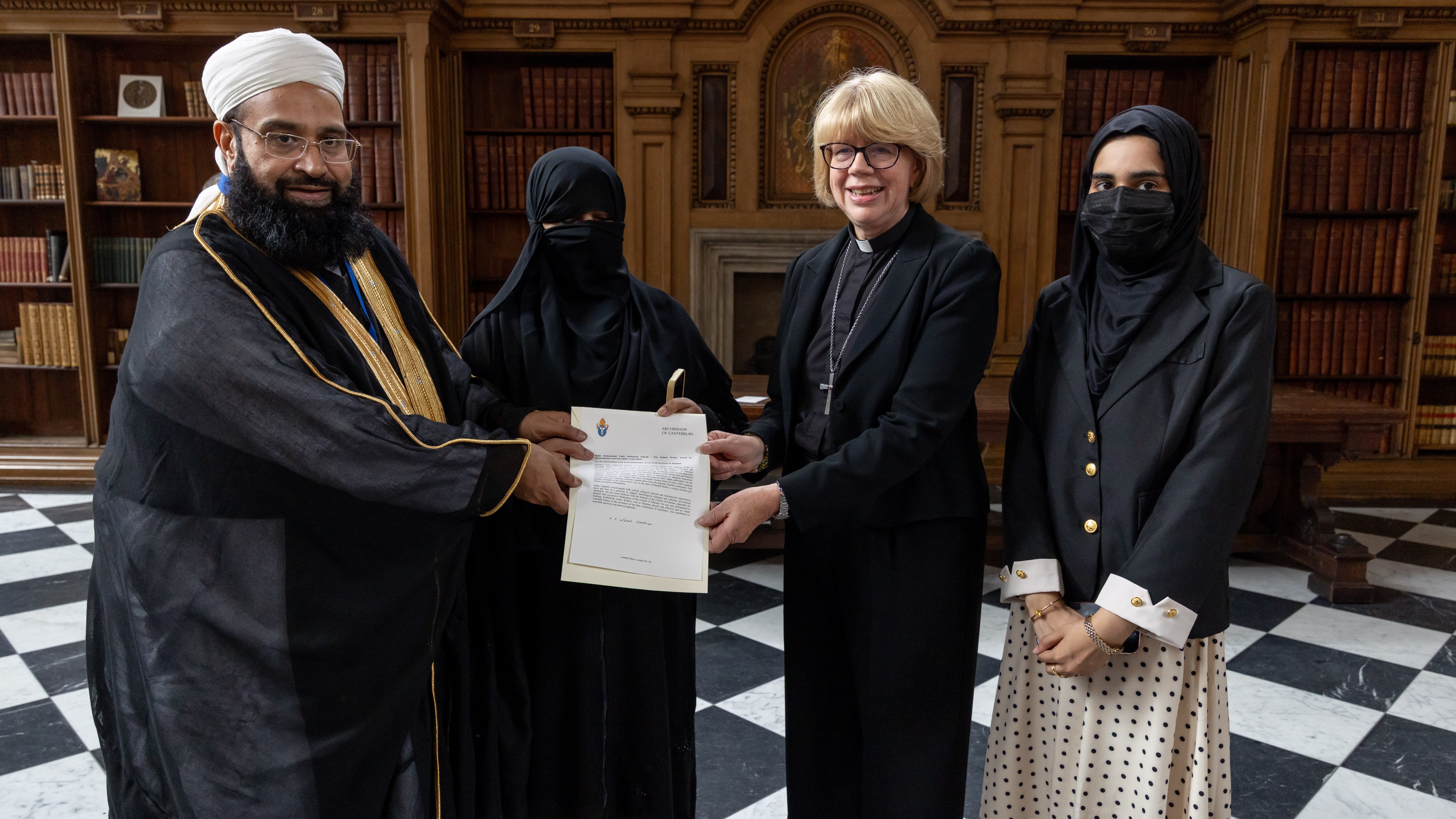
Nigel Farage erupted at the Archbishop of Canterbury in a row over her giving an award to a Muslim cleric who praised Osama bin Laden. Hafiz Muhammad Tahir Mehmood Ashrafi received the honour for reconciliation and interfaith cooperation last week on the anniversary of 9/11.
But Dame Sarah Mullally was forced to withdraw the award following a backlash after it emerged he praised the mastermind of the terror attacks in comments made in 2007. Speaking on his GB News show, the Reform UK leader said: “Every time we get a new Archbishop I think it must get better, it doesn’t, it gets worse.”
Get the latest politics news – straight from our team in Westminster and more
Invalid email
You agree you are 18 or over. We use your sign-up to provide content in ways you’ve consented to and to improve our understanding of you. This may include adverts from us and third parties based on our knowledge of you. You can unsubscribe at any time. More Info.

Reform UK leader Nigel Farage (Image: GB NEWS)
Mr Farage added: “Why oh why is the Archbishop of Canterbury giving an award to a man who praised Osama bin Laden just a few years after the Twin Towers?”
Mr Ashrafi, the chairman of the Pakistan Ulema Council which is a group of Islamic scholars, received the award “for his outstanding work as an ambassador of interfaith harmony in Pakistan”.
But the honour sparked a backlash after past comments emerged that he made about Bin Laden.

Speaking after The Satanic Versus author Sir Salman Rushdie was knighted in 2007, Mr Ashrafi said: “We are pleased to award the title of Saifullah [sword of God] to Osama bin Laden after the British government’s decision to bestow the title of ‘Sir’ on blasphemer Rushdie. This is the highest title for a Muslim warrior.
“If a blasphemer can be given the title ‘Sir’ by the West despite the fact he’s hurt the feelings of Muslims, then a mujahid who has been fighting for Islam against the Russians, Americans and British must be given the lofty title of Islam, Saifullah.”
Lambeth Palace said in a statement yesterday that the award had been withdrawn.
It said: “The award was given for Imam Ashrafi’s longstanding support for religious minorities in Pakistan, particularly the Christian community – support that is valued by many Christians in Pakistan including its Anglican Church.
“It is a longstanding principle of interfaith dialogue and co-operation that we must engage with one another across deeply-held differences, and that remains the case.
“However, previous comments made by Imam Ashrafi have come to light that have led Lambeth Palace to reconsider this award and we can now confirm today that the award has been withdrawn. We have contacted Imam Ashrafi to make him aware of this decision.”
A spokesman for Mr Ashrafi and his council said his remarks had been taken “out of context”.
He said: “Our position against terrorism, extremism, suicide attacks and the killing of innocent people is clear and unequivocal. We have consistently worked for peace, moderation and interfaith harmony.”
Nigel Farage Loses It at Archbishop of Canterbury After Row Over Award to Muslim Cleric
Nigel Farage has launched a sharp attack on the Archbishop of Canterbury after an award given to a prominent Muslim cleric was withdrawn following the emergence of controversial comments about Osama bin Laden.
The Reform UK leader criticised Dame Sarah Mullally after Hafiz Muhammad Tahir Mehmood Ashrafi was presented with the Hubert Walter Award for Reconciliation and Interfaith Cooperation at Lambeth Palace last week.
The award was subsequently withdrawn after previous remarks made by Ashrafi came to light.
Speaking on his GB News programme, Farage questioned how the honour had been approved in the first place.
“Every time we get a new Archbishop I think it must get better, it doesn’t, it gets worse,” he said, according to reports of his broadcast. He also questioned why the Archbishop had given an award to someone who had previously praised bin Laden.
The controversy has now placed the Archbishop’s office under intense scrutiny over the vetting of recipients of high-profile interfaith awards.
Why was the award given?
Ashrafi was presented with the Hubert Walter Award after being recognised for what Lambeth Palace described as his longstanding support for religious minorities in Pakistan, particularly the Christian community.
The Archbishop’s office said that this work was valued by many Christians in Pakistan, including members of the Anglican Church.
The award was intended to recognise reconciliation and cooperation between religious communities.
The ceremony took place at Lambeth Palace last week, on the anniversary of the September 11 terrorist attacks.
An official photograph showed Ashrafi receiving the award, with the original description stating that he was being recognised for his work as an ambassador of interfaith harmony in Pakistan.
The timing subsequently became a major focus of criticism.
The comments that changed everything
The controversy centres on comments Ashrafi made in 2007 following the decision by the British government to grant Salman Rushdie a knighthood.
Rushdie, author of The Satanic Verses, had long been a controversial figure among some Muslim communities because of the book.
According to reporting on the remarks, Ashrafi said he would support giving bin Laden the title “Saifullah”, meaning “Sword of God”, in response to the honour given to Rushdie.
At the time, bin Laden was already internationally associated with al-Qaeda and the September 11 attacks, which killed almost 3,000 people.
Those comments resurfaced after Ashrafi received the Lambeth Palace award.
Their emergence triggered calls for the Archbishop’s office to explain how such a prominent honour could have been awarded without the historical remarks being identified during the vetting process.
Lambeth Palace reverses the decision
The Archbishop’s office has now acted.
In a statement issued on 17 September, Lambeth Palace confirmed that the award had been withdrawn.
It said that the honour had originally been awarded because of Ashrafi’s work supporting religious minorities and interfaith cooperation in Pakistan.
However, the Palace said that “previous comments” had subsequently come to light and had led it to reconsider the decision.
The statement added that Ashrafi had been contacted about the withdrawal.
Lambeth Palace also stressed that interfaith dialogue remains an important principle, saying that engagement across deeply held differences continues to be necessary.
That qualification is significant.
The withdrawal of the award does not mean the Archbishop’s office has abandoned engagement with Muslim religious leaders. Rather, the dispute concerns whether this particular individual was an appropriate recipient of a specific honour.
Farage’s reaction
Farage nevertheless used the episode to launch a broader criticism of the Church of England’s leadership.
His comments reflected a long-running argument within British politics about the way institutions approach multiculturalism, religious dialogue and controversial religious figures.
For Reform UK, the episode also fits into wider concerns the party has repeatedly raised about immigration, integration and what it describes as the failure of established institutions to confront extremist views.
Farage’s criticism was particularly direct because the award had been presented by the Archbishop herself.
He questioned why someone with a history of comments praising bin Laden could have been considered suitable for an award associated with reconciliation and interfaith cooperation.
The question of due diligence is now central to the controversy.
Ashrafi’s defence
Ashrafi’s representatives have rejected the interpretation that his 2007 remarks amounted to support for terrorism.
A spokesman said the comments had been taken out of context and argued that Ashrafi’s wider record should also be considered.
His representatives said his position against terrorism, extremism, suicide attacks and the killing of innocent people was clear.
They also pointed to his work promoting peace, moderation and interfaith harmony.
Ashrafi himself has reportedly explained that his 2007 comments were made in the context of the controversy surrounding Rushdie’s knighthood.
He said the comparison was intended to illustrate what he regarded at the time as the offence caused to Muslims by the British decision.
That explanation does not erase the controversy surrounding the language used, but it provides important context when assessing what he intended by the remarks.
Why the anniversary mattered
The timing of the award has made the controversy particularly sensitive.
The presentation took place on the anniversary of the September 11 attacks.
Sky News reported that Ashrafi received the award on the 25th anniversary of 9/11.
That coincidence has intensified criticism from those who believe the historical comments should have been identified before the ceremony.
The National Secular Society also criticised the decision, arguing that the award demonstrated serious shortcomings in the vetting process. Its chief executive Stephen Evans welcomed the withdrawal.
The criticism therefore extends beyond Farage and Reform UK.
A wider debate over interfaith engagement
The dispute raises a broader question about how institutions should conduct interfaith engagement.
Supporters of dialogue argue that religious and political leaders must be willing to engage with people from different traditions, including those with whom they have profound disagreements.
Lambeth Palace explicitly defended that principle in its statement.
But engagement and endorsement are not necessarily the same thing.
An institution can engage with a religious figure without agreeing with every statement that person has previously made. At the same time, awards carry symbolic significance, meaning the decision to honour someone inevitably attracts scrutiny over their public record.
That is why the controversy has moved beyond a dispute about one historical comment.
It has become a question about the standards used to decide who receives an official honour.
Pressure on the Archbishop
For Dame Sarah Mullally, the episode represents an early challenge to her leadership.
She became the first woman to serve as Archbishop of Canterbury, taking up the position at a time when the Church of England is already facing debates over its role in modern Britain.
The controversy will inevitably raise questions about whether the award process was sufficiently thorough.
Lambeth Palace has not suggested that the award was deliberately given despite knowledge of Ashrafi’s historical comments. Instead, its statement says those comments “came to light” only afterwards.
That distinction matters.
The available evidence does not establish that the Archbishop personally knew about the remarks before the ceremony.
What it does establish is that the award was subsequently reconsidered and withdrawn once the historical comments became known.
What happens next?
The immediate dispute may now shift from the award itself to the process that produced it.
The Archbishop’s office has reversed the decision, while Ashrafi’s representatives have defended his wider record.
Farage, meanwhile, has used the episode to question the judgement of the Church of England’s leadership and the standards applied to public honours.
The incident is unlikely to end the debate over interfaith cooperation.
Instead, it illustrates the difficult balance faced by institutions attempting to promote dialogue between religious communities while also ensuring that people receiving official recognition have been properly scrutinised.
For Reform UK, the controversy provides another opportunity to challenge what Farage regards as failures by Britain’s established institutions.
For Lambeth Palace, the withdrawal of the award is an attempt to draw a line under a decision that generated substantial criticism.
And for Ashrafi, the episode has placed historical remarks made almost two decades ago back at the centre of public attention.
The key fact is that the award has now been withdrawn.
The more difficult question is why those remarks were not identified before the honour was presented.
That is likely to remain the central issue as scrutiny of the Archbishop’s decision continues.