

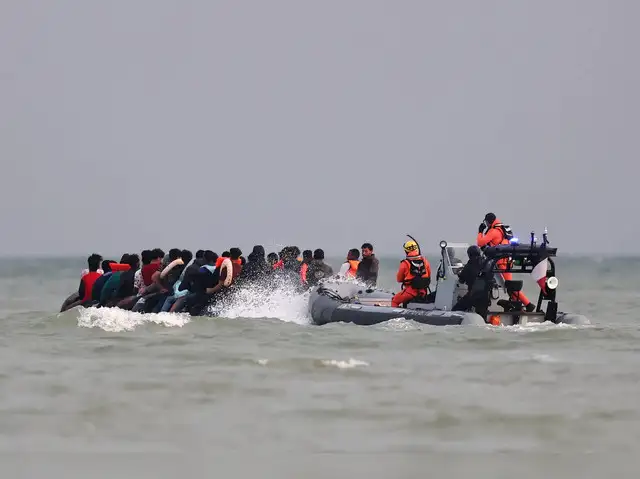
Channel Tensions Rise Over Reported Plan by Anti-Immigration Activists to Confront Migrant Boats
Reports that anti-immigration activists are considering taking their own vessels to sea to disrupt migrant dinghies have sparked fears of a dangerous maritime clash in the English Channel.
Fears of a dangerous confrontation in the English Channel are growing following reports that anti-immigration activists are considering taking their own vessel to sea to disrupt or confront migrant dinghies travelling toward Britain.
The reported plan has immediately intensified an already bitter national debate over irregular migration, border enforcement, and the limits of political protest.
Supporters of tougher immigration controls may view the proposal as a dramatic response to years of frustration over small-boat crossings.
Critics, however, warn that civilian attempts to intervene in one of the world’s busiest shipping routes could put migrants, protesters, and professional rescue crews in serious peril.
What Is Known About the Reported Maritime Plan?
Important details remain unclear regarding the reported initiative.
Authorities and journalists have not yet verified precisely which individuals would participate, what type of vessel they intend to use, or what specific tactics they mean by “stopping” migrant boats.
Those uncertainties matter immensely.
There is a vast legal and practical difference between sailing into the Channel to stage a symbolic protest, observing migrant boats from a safe distance, and physically attempting to block, board, tow, or redirect a crowded inflatable dinghy.
The latter possibilities would raise severe legal, humanitarian, and maritime safety questions.
Until now, the vast majority of anti-immigration protest activity has taken place firmly on land—outside accommodation facilities, near ports, or in town centers.
Taking that campaign directly onto the waters of the Channel would represent a significant and volatile escalation.
Why the English Channel Is an Extremely Dangerous Environment
The appeal to activists is easy to understand in the context of ongoing political debates.
Images of small boats crossing from northern France have become a defining symbol of Britain’s immigration argument.
For campaigners who believe successive governments have failed to secure the border, travelling into the Channel can be framed as direct action.
However, the sea operates under entirely different rules than a demonstration outside Parliament.
A street protest can usually be separated, managed, or contained by police forces.
At sea, a single miscalculation can cost lives within minutes.
The English Channel is an exceptionally challenging maritime environment.
Large commercial container ships routinely pass through its narrow shipping lanes, weather conditions can deteriorate rapidly, and powerful currents make small inflatable boats inherently unstable.
Many migrants attempting the crossing possess limited maritime experience and lack adequate safety equipment.
Adding another civilian vessel deliberately attempting to interfere with their journey could create catastrophic, unpredictable consequences.
If activists approach a migrant dinghy too closely, passengers might panic, shift weight to one side, or alter course suddenly, destabilizing the vessel and risking punctures or drownings.
The Legal and Humanitarian Questions
The proposal also forces a confrontation with fundamental legal principles.
If protesters intend merely to sail in international or British waters while displaying political banners, their actions would raise one set of regulatory issues.
If they intend to physically interfere with another vessel, the situation becomes a criminal and operational emergency.
Private citizens do not acquire law-enforcement powers simply because they believe the government is failing to enforce immigration rules effectively.
Border enforcement at sea requires trained authorities operating under strict legal powers, safety protocols, and international maritime law.
Furthermore, a vital humanitarian principle dictates that anyone facing imminent danger at sea must not be placed at greater risk.
Whether a migrant’s eventual asylum claim is accepted or rejected by the legal system, that determination cannot safely be resolved through an unregulated confrontation between political activists and passengers on an inflatable boat.
Risks to the Protesters Themselves
The physical danger would not be limited to migrants crossing the Channel.
Activist groups taking an unsuitable vessel into busy commercial waters could easily find themselves in distress and requiring emergency rescue.
Operating safely at sea demands professional knowledge of navigation, marine communications, weather forecasting, and collision regulations.
A protest boat surrounded by commercial cargo traffic, Border Force cutters, lifeboats, and small migrant craft would place an intolerable burden on rescue organizations already dedicated to preserving life at sea.
This dynamic introduces an obvious irony.
A mission intended to protest the societal costs of irregular migration could easily end with British emergency services spending public resources rescuing the protesters themselves.
Why Activists Believe Direct Action Is Necessary
The political frustration driving such proposals cannot be dismissed as a minor fringe phenomenon.
Public dissatisfaction over persistent small-boat crossings remains high across Britain.
Governments have repeatedly pledged to reduce irregular migration, dismantle people-smuggling networks, and strengthen bilateral cooperation with France.
Yet boats continue to arrive on British shores.
For some campaigners, each successful crossing is viewed as definitive proof that conventional state policy has failed.
They argue that Britain possesses a border in theory but lacks the political will to enforce it in practice.
From that perspective, direct action is seen as political theatre designed to expose government weakness and demand immediate change.
Even if activists never physically intercept a single boat, the visual impact of their vessel operating in the Channel could generate substantial online attention, which may be a primary objective.
A Major Test for Authorities
If the reported plan develops into an actual attempt to launch a protest vessel, British authorities will face a delicate operational balancing act.
Citizens retain fundamental rights to political expression and peaceful assembly.
Preventive state action requires a solid legal basis rather than mere disagreement with the protesters’ political views.
Simultaneously, maritime and law-enforcement agencies have a statutory duty to protect navigation, maintain public order, and prevent criminal acts.
Officials will need to assess what organizers genuinely intend to do, distinguishing between symbolic demonstrations and unlawful physical obstructions.
What happens next as tensions rise around Channel crossings?
Channel Tensions Rise Over Reported Anti-Immigration Boat Plans
Tensions between Britain and France over migration across the English Channel have intensified following Reform UK’s proposal to deploy the Royal Navy to intercept migrant boats and return passengers to France.
The plan, presented by Reform UK as “Operation Fortress”, would represent a significant change in Britain’s approach to small-boat crossings if the party were to form a government.
Reform UK leader Nigel Farage has argued that the policy could bring the crossings to an end rapidly. The party says naval vessels would intercept boats attempting to travel from France to Britain and escort them back towards French territory.
France, however, has rejected the proposal.
French officials have argued that a unilateral British attempt to return boats would infringe French sovereignty and could conflict with international law. The disagreement has therefore developed into something larger than an argument about immigration policy. It has become a dispute over maritime jurisdiction, international cooperation and the limits of unilateral action.
Reform UK’s Operation Fortress
Reform UK unveiled Operation Fortress in August as part of its broader immigration policy.
The party said that, if elected, it would use the Royal Navy to intercept small boats crossing the Channel and return migrants to France or Belgium.
Farage described the proposal as potentially the largest British military operation in the Channel since the Second World War.
The party’s stated objective is straightforward: to make the crossing route no longer viable for people attempting to reach Britain through unauthorised journeys.
Reform has also presented the plan as a humanitarian measure, arguing that preventing boats from completing the dangerous journey could reduce the risk of deaths in the Channel.
ITV News reported that Reform insists its proposal is compatible with international law and that naval intervention would be intended both to prevent crossings and protect lives.
However, the central practical question is what happens when a British vessel intercepts a boat carrying asylum seekers.
The answer is not determined solely by British policy.
It also involves France.
The French Objection
France’s response has been direct.
The French government has said that Britain cannot simply enter French territorial waters, intercept boats and return passengers to French ports without French agreement.
The BBC reported that French authorities described the Reform proposal as a violation of French sovereignty and international law.
This creates an immediate operational problem.
The Channel is an international waterway, but it is also divided into territorial waters belonging to different states.
A British naval vessel operating close to the French coast would therefore have to take account of French jurisdiction.
If France refuses to accept people returned by British authorities, the British government would face a difficult question: where could those people legally be disembarked?
Reform has indicated that it would proceed despite French objections.
A spokesperson for the party said Britain would stand up for its interests regardless of the French government’s position.
That position illustrates the fundamental difference between the two governments.
Reform’s proposal prioritises unilateral enforcement.
France insists that cooperation and sovereignty must remain central.
Why the Channel Is So Difficult to Control
The English Channel is one of the world’s busiest maritime areas.
Commercial ferries, cargo vessels, fishing boats, pleasure craft and rescue services operate alongside small migrant boats.
Any military operation would therefore need to account for maritime safety as well as immigration enforcement.
Small inflatable boats can be difficult to detect and may change direction quickly.
They can also be dangerously overcrowded.
This creates another complication.
An operation designed to prevent crossings must avoid creating additional risks for passengers already at sea.
The British government has traditionally relied on cooperation with French authorities to disrupt crossings before boats leave the French coast.
That approach involves French police patrols, surveillance, arrests of suspected smugglers and the seizure of boats and equipment.
The UK also provides financial support for French enforcement efforts.
Existing UK-France Cooperation
Britain and France already have an extensive system of cooperation over Channel migration.
The House of Commons Library says the two countries have signed several agreements covering border controls, including the Treaty of Le Touquet and the Sandhurst Treaty.
In April 2026, Britain and France agreed a new three-year funding arrangement worth £662 million to support efforts against unauthorised migration.
The government says the cooperation is producing results.
According to the Home Office, French police units prevented 185 small-boat crossing events between 27 April and 2 August 2026.
The government said this represented 61 per cent of all recorded small-boat events during that period.
These figures are important because they show that Britain is already pursuing an approach based on intervention before boats leave France.
The dispute with Reform is therefore partly about whether that strategy should be replaced or supplemented by direct British naval intervention.
The “One-In, One-Out” Experiment
Another element of UK-France cooperation has been the “one-in, one-out” pilot scheme.
Introduced in August 2025, the arrangement allows Britain to return some people who arrive by small boat to France while accepting an equivalent number of migrants from France who have not attempted an unauthorised crossing.
According to the House of Commons Library, 377 people had been returned to France and 380 had arrived in Britain under the scheme by early March 2026.
The scheme was designed partly around deterrence.
The government’s argument was that people considering the Channel journey would know that arriving in Britain did not necessarily mean being allowed to remain.
However, the relatively small number of people covered by the pilot has led commentators to question how much influence it can have on the overall scale of crossings.
Reports also indicated that the arrangement was expected to end in October 2026 unless extended.
That uncertainty has added another layer to the debate.
The Politics of “Stopping the Boats”
Immigration has become one of the most politically contested issues in Britain.
For Reform UK, stopping small boats is a central part of its political programme.
Farage has repeatedly argued that successive governments have failed to establish sufficient control over Britain’s borders.
The party therefore presents Operation Fortress as a clear alternative to existing policy.
The language is deliberately uncompromising.
The objective is not simply to reduce crossings.
It is to stop them.
The government’s approach is different.
Ministers have combined enforcement with negotiations with France, action against smuggling gangs and changes to the asylum system.
The Home Office says the government is strengthening enforcement while developing new safe and legal routes for refugees.
The disagreement is therefore partly philosophical.
Reform emphasises deterrence and border enforcement.
The government emphasises international cooperation and a combination of enforcement and legal routes.
The Humanitarian Dimension
The Channel crossings also have a serious humanitarian dimension.
The journeys are dangerous.
Boats can be overcrowded, poorly equipped and vulnerable to changing weather and sea conditions.
The deaths of people attempting to cross have repeatedly triggered calls for stronger action.
Reform argues that preventing departures would reduce those dangers.
Critics of aggressive interception policies, however, argue that simply making one route more difficult does not necessarily eliminate people’s reasons for attempting to reach Britain.
The Refugee Council has argued that some people resort to smugglers because they lack viable legal alternatives, particularly when separated from family members or fleeing conflict and persecution.
This creates a difficult policy question.
Can enforcement reduce dangerous crossings without simply pushing people towards different and potentially more dangerous routes?
There is no simple answer.
The Question of International Law
The legal dimension could become one of the biggest obstacles to Operation Fortress.
Reform argues that humanitarian intervention in the Channel would be lawful.
French authorities have taken the opposite position regarding unilateral British returns.
The difference matters because international maritime law contains rules governing rescue, territorial waters and the treatment of people intercepted at sea.
A naval operation would therefore require detailed legal protocols.
British authorities would need to determine what powers naval personnel had when intercepting a boat.
They would also need to establish where passengers could safely be taken.
If France refused to accept returned passengers, the practical purpose of the operation could become difficult to achieve.
That is why critics have questioned whether the proposal could operate in the way Reform describes without French cooperation.
Military Questions
There are also military considerations.
The Royal Navy is primarily designed for national defence and maritime security rather than large-scale immigration processing first three months of the new UK-France enforcement arrangement, while broader reporting indicates that the number of people arriving by small boat in naval interception, stronger French cooperation, expanded legal routes, tougher action against smugglers, or.
Intercepting a boat is one task.
Safely taking potentially hundreds of passengers aboard naval vessels is another.
Personnel would need specialist training and equipment.
There could also be medical requirements.
If an intercepted boat were in distress, naval crews might have obligations to rescue people regardless of their immigration status.
That means an operation intended to prevent arrivals could quickly become a maritime rescue operation.
The distinction between enforcement and rescue could therefore become blurred.
A New Political Partnership in France
The debate has taken another turn following an agreement between Reform UK and France’s National Rally.
In September, Nigel Farage and National Rally leader Jordan Bardella signed a memorandum of understanding aimed at stopping small-boat crossings.
The agreement envisages returning asylum seekers who arrive in Britain from France, with France then repatriating them to their countries of origin.
It also proposes cooperation over the costs of border security.
This is significant because it shows that Reform is not abandoning the idea of cooperation entirely.
Instead, the party is proposing cooperation with a future French government that shares its approach to migration.
Bardella said a National Rally government would work to prevent France from being used as a route for irregular migration to Britain.
The agreement is political rather than an existing government-to-government treaty.
Its practical effect would therefore depend on the outcome of future elections in both countries and the willingness of governments to implement the proposed arrangements.
The Government’s Alternative
The British government has continued to pursue cooperation with the French authorities.
The Home Office says French enforcement operations have prevented hundreds of crossing attempts and disrupted smuggling activity.
The government also says it is working to expand safe and legal routes for refugees while tightening the asylum system.
This approach reflects an attempt to deal with both sides of the problem.
First, reduce the number of people making unauthorised journeys.
Second, provide alternative routes for people who have legitimate claims to protection.
The effectiveness of each part of that strategy will remain subject to political debate.
Rising Pressure Along the Coast
The political argument is also being felt locally.
In September 2026, hundreds of masked anti-immigration protesters blocked roads around Dover, severely disrupting access to the UK’s busiest ferry port.
The demonstration included chants demanding an end to small-boat crossings and resulted in significant disruption to travellers and freight traffic.
The incident demonstrates how the Channel issue has moved beyond Westminster.
For communities around Dover and the Kent coast, migration is connected to policing, traffic, local services and the operation of one of Britain’s most important international transport hubs.
At the same time, the government has stressed the importance of maintaining public order and avoiding confrontational protests that disrupt ordinary residents and businesses.
A Dispute With Wider Consequences
The argument over Reform UK’s boat policy is therefore about much more than whether the Royal Navy should patrol the Channel.
It raises questions about Britain’s relationship with France.
It raises questions about the interpretation of international law.
It raises questions about the appropriate role of the military.
And it raises questions about how a democratic government should balance border enforcement with humanitarian responsibilities.
Reform UK has proposed a highly interventionist model based on interception and return.
The French government has objected to unilateral returns on sovereignty and legal grounds.
The British government is pursuing a different strategy based on cooperation with France, enforcement against smuggling networks and changes to the asylum system.
Meanwhile, the number of attempted crossings has fluctuated.
The Home Office reported that French authorities prevented 185 crossing events during the first three months of the new UK-France enforcement arrangement, while broader reporting indicates that the number of people arriving by small boat in 2026 has fallen compared with the previous year.
What Happens Next?
The future of the Channel dispute will depend heavily on political developments in both Britain and France.
If Reform UK were to enter government, Operation Fortress could become a major test of Britain’s relationship with Paris.
If France continued to oppose unilateral returns, negotiations would be unavoidable.
The alternative would be a prolonged dispute over maritime jurisdiction and the treatment of people intercepted at sea.
For now, the Channel remains a shared European security and humanitarian challenge.
Britain wants fewer unauthorised arrivals.
France wants to protect its sovereignty and manage migration on its own territory.
Migrants and asylum seekers continue to face dangerous journeys.
And political parties in both countries are using the issue to argue for fundamentally different approaches to border control.
The reported anti-immigration boat plans have therefore intensified tensions across the Channel, but they have also exposed the central reality of the problem: Britain cannot easily reshape the Channel migration system through unilateral action alone.
Whether future governments choose naval interception, stronger French cooperation, expanded legal routes, tougher action against smugglers, or a combination of these approaches, the practical and legal relationship between London and Paris will remain crucial.