
Robert Jenrick has vowed that Reform UK will “defuse the benefits bomb set to bankrupt Britain”, in his first speech since being named as Nigel Farage’s “shadow chancellor”. Dubbing the UK’s soaring welfare bill an “economic and moral disaster”, he pledged to stop foreigners receiving handouts and prevent claimants getting cash for “spurious” mental health reasons.
Mr Jenrick also confirmed the party had performed a U-turn over plans to end the two-child benefit cap, and would retain current rules that restrict the amount of Universal Credit paid to larger families. Labour is to scrap the cap, handing 570,000 households in Great Britain an average of £5,400 each in extra benefit payments. Mr Farage previously indicated Reform would either follow suit or remove the cap for working families.
But in a speech in London’s financial district, Mr Jenrick declared: “A Reform government will restore the cap in full. We are the party of alarm clock Britain – a party for workers and not welfare.”
Get the latest politics news – straight from our team in Westminster and more
Invalid email
You agree you are 18 or over. We use your sign-up to provide content in ways you’ve consented to and to improve our understanding of you. This may include adverts from us and third parties based on our knowledge of you. You can unsubscribe at any time. More Info.

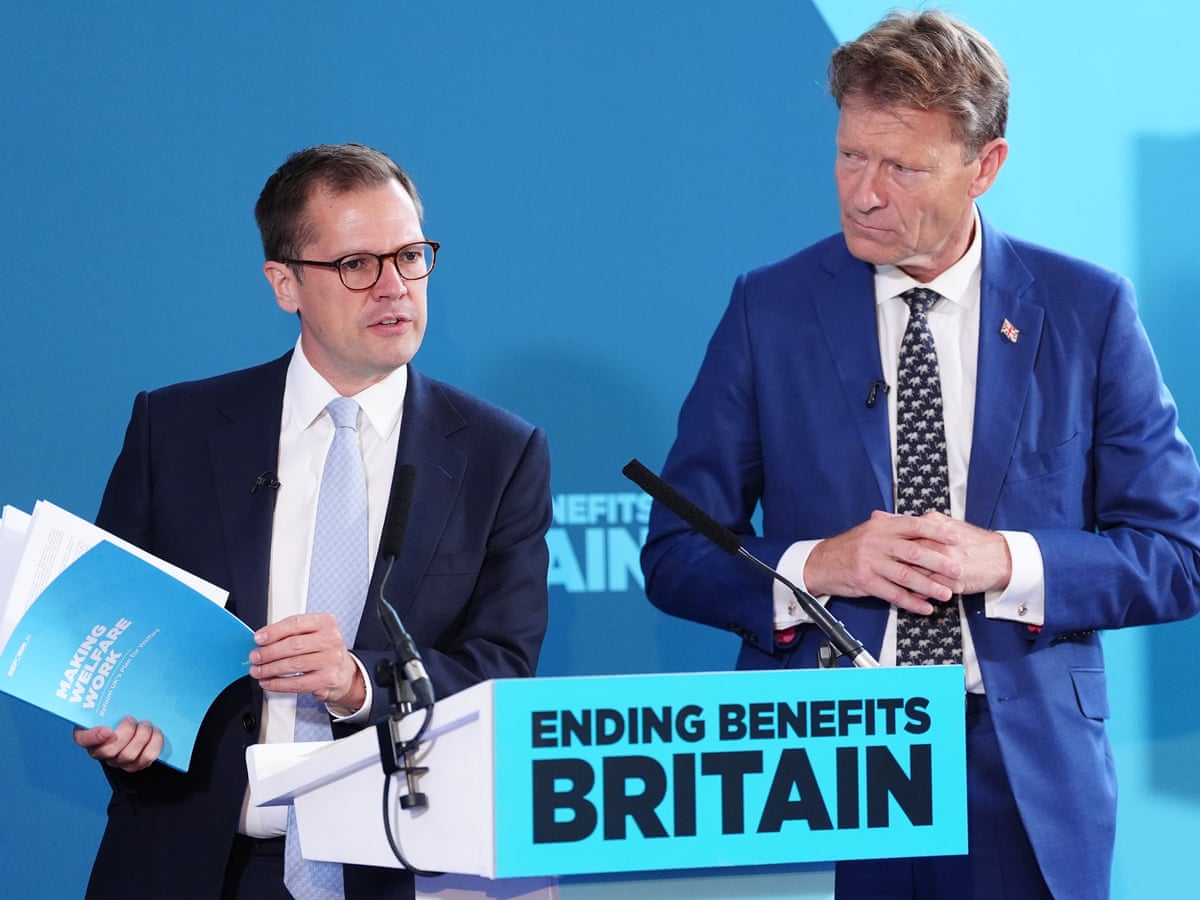
Nigel Farage and Robert Jenrick hold a press conference in London (Image: Getty)
Labour branded the announcement “cruel” and highlighted predictions that ending the cap would mean 450,000 fewer children in relative poverty.
It also appeared that Mr Farage had been reluctant to accept the U-turn, as he told journalists after the speech: “My attempt at being pro-family has failed.”
Mr Jenrick refused to commit a Reform government to maintaining the pensions triple lock, saying an announcement on the state pension would be made at a later date, but dropped a heavy hint that the policy or something very similar will remain.
Questioned by the Express, the former Conservative cabinet minister said: “We’re going to be saying more about this in the coming days, but I’ve always been a supporter of the triple lock.
“It’s incredibly important that we provide dignity and security to older people on fixed incomes in the last decades of their life – particularly at a time like this, where there are such challenging circumstances with the cost of living.
“So I don’t think your readers will be disappointed, but we’ll say more in the coming weeks.”
Mr Jenrick was named as Reform’s “shadow chancellor” this week, alongside home affairs spokesman Zia Yusuf, education spokesman Suella Braverman and business spokesman Richard Tice, who would also serve as deputy prime minister in a Reform government.
The appointments are designed to end a perception that Reform is a “one-man band”, as Mr Farage put it, and demonstrate the party has the experience required to run the country.
In a lengthy speech, Mr Jenrick set out plans to stop “net zero” policies influencing economic decisions, force UK employers to train British staff rather than importing foreign workers, and “ruthlessly” crack down on scammers and shoplifters.
But the speech was also designed to reassure financial markets by pledging that a Reform government would follow “strict fiscal rules” and introduce tax cuts only when the nation can afford it.
Mr Jenrick dubbed Reform “reassuring revolutionaries” and promised no “wild spending splurges alongside big tax cuts”.
He said: “We will instil a fiscal discipline that has been sorely missing, spending only what we can afford and never saddling future generations with the bill for our profligacy.”
The MP added: “I give you my word that a Reform government will never play fast and loose with your savings.”
*** Ensure our latest politics headlines always appear at the top of your Google Search by making us a Preferred Source. Click here to activate or add us as Preferred Source in your Google search settings. ***
Plans to slash the welfare bill include restricting benefits to UK nationals, and ensuring people can only claim sickness benefits for mental health conditions if they have a medical diagnosis.
Mr Jenrick said: “On current course, one in eight people are set to claim disability benefits in four years’ time – that’s almost nine million people.
“The number claiming disability benefits for an attention disorder has more than doubled since Covid. We all know a significant number of these claims are spurious.
“And that we’re just giving up on over half a million young people, discarded as ‘unfit to work’. So our benefits system is broken.”
He vowed: “We will stop those with mild anxiety, depression, and similar conditions from claiming disability benefits and instead encourage them into the dignity of work.
“We will reinstate in-person assessments and require clinical diagnoses to weed out those who are choosing a life on benefits.”
He added: “And we’ll make sure only British nationals can claim benefits in the first place.”
Conservatives pointed out that Mr Farage and Mr Jenrick, who defected from the Tories in January, had previously been staunch critics of each other.
Kevin Hollinrake, chairman of the Conservative Party, said: “One week Nigel Farage says Robert Jenrick is a fraud, next week he’s Reform’s economic guru. You cannot trust a word he says.
“Reform’s economic policy changes by the week. Just two weeks ago, Rob Jenrick voted to lift the two-child benefit cap. Today, he claims he would reinstate it. They make even Keir Starmer look consistent.”
He added: “Reform is a one-man band. The only view that counts is Nigel Farage’s, and he wants more welfare.”
Labour chairwoman Anna Turley said: “Robert Jenrick has united the Right behind a cruel child poverty pact that would see nearly half a million kids pushed into poverty.
“Farage’s party is stuffed full of former failed Tories who are now hell-bent on continuing their damaging legacy, with working people and their children set to pay the price.”
Reform Benefits Bombshell Revealed by Robert Jenrick – Plan to Stop Handouts for Foreign Nationals
Robert Jenrick has unveiled one of Reform UK’s most significant welfare proposals, with the party saying it would prevent foreign nationals from claiming most taxpayer-funded benefits under a Reform government.
The announcement, made as part of a wider welfare reform programme, would represent a major change to Britain’s benefits system. Reform UK says the measures could save tens of billions of pounds each year, while critics argue that the proposals could affect vulnerable people who live and work legally in Britain.
Jenrick, Reform UK’s finance spokesman, has presented the policy as a question of fairness to British taxpayers. He argues that people who have not contributed sufficiently to the British tax system should not be entitled to receive the same level of welfare support as British citizens.
The proposal has immediately generated controversy because it would extend beyond recent Reform pledges to restrict Universal Credit. The latest plan would cover a much broader range of benefits.
According to ITV News, Reform says its proposed restrictions on foreign nationals could save around £21 billion annually by the fifth year of the policy.
A Much Broader Welfare Restriction
Reform UK has previously called for foreign nationals to be prevented from claiming Universal Credit. The latest proposal goes considerably further.
Under the plan, foreign nationals could be excluded from a wide range of benefits and publicly funded support, including Universal Credit, housing benefit, pension credit, Jobseeker’s Allowance, child benefit, free childcare and certain disability benefits.
The party has included the proposal within a much larger programme that it says could reduce welfare spending by more than £50 billion a year.
The figures are ambitious. BBC Verify reported that the UK government is expected to spend around £353 billion on welfare in the relevant financial year, with almost half going towards the state pension. Reform’s proposed £50 billion reduction would therefore represent approximately a quarter of welfare spending outside the state pension.
That scale explains why the proposals have attracted such intense political attention.
Jenrick’s Argument
Jenrick has framed the issue around the obligations of taxpayers.
He has argued that British workers should not be expected to finance benefits for people from overseas who have not made comparable contributions to the British economy.
Reform says its approach would create a system in which welfare support is more closely connected to citizenship and contribution.
The party describes the current arrangements as unfair and says the British taxpayer should come first.
This argument forms part of Reform’s wider political programme on immigration. The party has consistently argued that immigration levels should be reduced and that access to public services should be more tightly connected to a person’s status in Britain.
The welfare announcement therefore represents not an isolated policy but another component of Reform’s broader approach to immigration, taxation and public spending.
Who Would Be Affected?
One of the most important details is that the proposal would not simply target newly arrived migrants.
Reform’s plan would also affect some people who have lived in Britain for many years.
According to reporting on the proposal, it would include EU citizens who have settled status in the United Kingdom. This is particularly significant because millions of EU citizens obtained long-term residence rights following the UK’s departure from the European Union.
The government has previously explained that benefit eligibility for foreign nationals depends on immigration status and other requirements. Many migrants enter Britain with a “No Recourse to Public Funds” condition, meaning they cannot normally access most taxpayer-funded benefits. People who later obtain settled status can become eligible subject to the rules governing individual benefits.
Reform’s proposal would therefore alter the position of some people who currently have lawful access to welfare.
That is one of the reasons the policy could have significant legal and diplomatic implications.
The European Union Question
The proposal involving EU citizens presents a particularly complicated problem.
Under the arrangements established following Brexit, millions of EU citizens living in Britain have settled or pre-settled status and associated rights.
BBC Verify reported that approximately 4.5 million EU citizens have long-term settlement rights in Britain, while around one million UK citizens living in the EU have comparable rights.
Reform has indicated that it would seek to renegotiate the arrangements underpinning these rights.
That could potentially create a difficult diplomatic process between Britain and the European Union.
Any attempt to remove existing benefit rights from people with settled status would therefore involve more than simply changing domestic welfare regulations. It could raise questions about reciprocal arrangements affecting British citizens living elsewhere in Europe.
This is one of the biggest practical challenges facing the proposal.
Reform’s £50 Billion Target
The restrictions on foreign nationals form only one part of Reform’s wider welfare strategy.
The party has said it wants to save more than £50 billion a year by 2030.
Another major component concerns health and disability benefits, particularly Personal Independence Payment, or PIP.
Reform has proposed replacing the current system with a new Disability Needs Assessment and says people with the most severe disabilities would remain protected.
The party estimates that reforms to health and disability benefits could generate around £21 billion in savings. A further approximately £21 billion is attributed to restricting benefits for foreign nationals.
Reform has also discussed measures involving benefit fraud and the uprating of benefits.
Taken together, these proposals represent a major restructuring of the welfare system rather than a small adjustment to individual payments.
Questions Over the Savings
The size of Reform’s projected savings has prompted scrutiny.
BBC Verify reported that analysts have questioned how easily the proposed savings could actually be delivered. The Institute for Fiscal Studies, for example, said there was relatively little detail available on important aspects of Reform’s proposals.
The question is not simply whether fewer people would receive benefits.
Governments must also consider how changes affect employment, taxation, housing, healthcare and local government spending.
For example, if a person loses financial support but remains unable to work because of a serious disability, some of the costs could potentially appear elsewhere in the public sector.
This does not necessarily mean Reform’s proposed savings are impossible. It means that the headline figure depends on how the policy would operate in practice and how people and institutions respond.
A Dispute Over Universal Credit Figures
The debate has also produced controversy over statistics.
Reform initially claimed that Department for Work and Pensions data showed the share of Universal Credit paid to foreign nationals had risen to 15.5% in January 2026.
Full Fact subsequently reported that this was incorrect. The 15.5% figure represented the proportion of Universal Credit claimants who were not British or Irish citizens, rather than the proportion of Universal Credit expenditure paid to foreign nationals. Full Fact also noted that the proportion had been falling since 2024.
This distinction is important.
The number of claimants and the amount of money spent are not the same measurement. A percentage of recipients cannot automatically be presented as a percentage of total expenditure.
Reform corrected the relevant part of its welfare document after the issue was raised.
The episode illustrates why statistics are particularly important when governments and opposition parties propose major changes to public spending.
Critics Raise Concerns
The proposals have faced strong criticism from political opponents and campaign groups.
Critics argue that the policy could affect people who are legally resident in Britain, including individuals who have worked, paid taxes and established families in the country.
The Guardian reported criticism from disability campaigners and others who argued that the broader welfare programme could place additional pressure on vulnerable people.
There are also concerns about the potential effect on people with disabilities.
Reform maintains that people with the most severe disabilities would remain protected, but critics have questioned how eligibility would be determined and whether the proposed savings could be achieved without reducing support for people with substantial needs.
These disagreements reflect fundamentally different approaches to welfare.
Reform emphasises reducing government spending, encouraging employment and prioritising taxpayers.
Its opponents emphasise social protection and argue that welfare should remain available to people who meet established eligibility requirements, regardless of nationality where the law currently permits access.
A Major Political Divide
The controversy surrounding Jenrick’s announcement demonstrates a much wider political divide over the future of Britain’s welfare state.
At one end of the argument is the principle that access to taxpayer-funded support should be closely connected to citizenship and contribution.
At the other is the argument that lawful residents who meet the established conditions should receive support according to need and the rules applying to their immigration status.
Neither position can be understood simply through the phrase “handouts for foreigners”.
The existing system already distinguishes between different immigration statuses. Many migrants are subject to restrictions on access to public funds, while others who obtain settled status can qualify for benefits under the relevant rules.
Reform is proposing to change that balance.
What Happens Next?
The biggest question is whether the proposals could actually be implemented in the form described.
A Reform government would need to translate the announcements into legislation and regulations. Changes affecting EU citizens with settled status could additionally require negotiations with European governments and institutions.
The financial assumptions would also need to be tested against actual behaviour.
If large numbers of foreign nationals became British citizens, for example, the potential savings could be lower than Reform currently estimates. BBC Verify identified this as one of the complications surrounding the proposal.
There would also be questions about administrative costs, appeals, enforcement and the effect on families with different citizenship statuses.
These details could ultimately determine the real financial impact.
Conclusion
Robert Jenrick’s welfare announcement represents a major element of Reform UK’s economic and immigration agenda.
The party says it would prevent foreign nationals from accessing most benefits and claims that the measure could save approximately £21 billion a year by its fifth year. It forms part of a wider plan targeting more than £50 billion in annual welfare savings.
The proposal would go significantly beyond simply restricting Universal Credit. It could affect housing support, pension credit, child benefit, childcare and disability-related payments, including for some EU citizens with settled status.
Supporters see the policy as a way of prioritising British taxpayers and reducing welfare expenditure. Critics warn that it could affect lawful residents and vulnerable households and raise difficult legal and diplomatic questions.
The debate will ultimately depend on the precise legislation, eligibility rules and financial calculations that would accompany the proposals.
For now, Jenrick’s announcement has made one thing clear: welfare reform is becoming a central part of Reform UK’s political programme, and the question of who should have access to Britain’s benefits system is likely to remain one of the country’s most contentious political issues.