

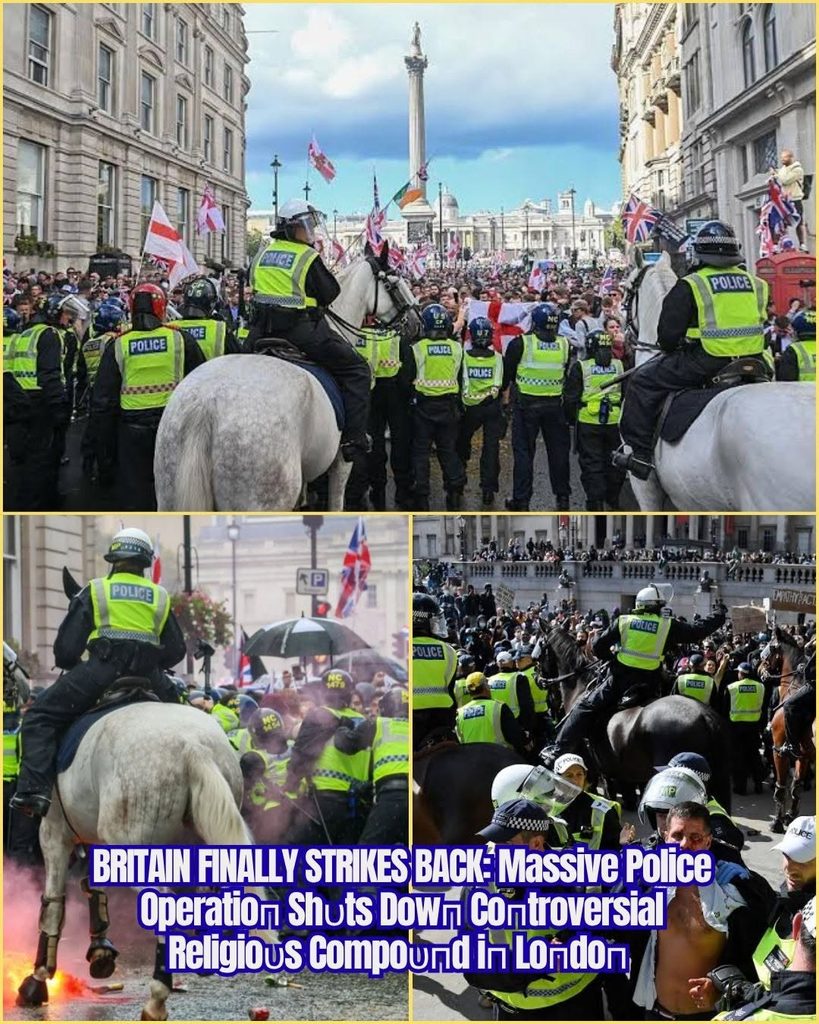
Britain woke up this morning to scenes many people described as “unbelievable” after dramatic footage emerged showing hundreds of police officers storming a heavily guarded compound linked to a controversial religious organization in London.
The operation, which reportedly began before sunrise, has instantly become one of the most talked-about stories in the country.
Videos showing armed officers, flashing emergency lights, barricaded entrances, and crowds gathering outside the compound spread across social media within minutes, triggering intense national debate.
For some, the raid represented long-overdue action.
For others, it raised troubling questions about extremism, security, freedom of belief, and how authorities allowed tensions surrounding the group to escalate for so many years.
But regardless of political opinion, one thing became clear very quickly:
The entire country was watching.
According to early reports circulating online, the compound had been the subject of growing concern for years.
Critics claimed the organization operated in near secrecy, with allegations involving intimidation, isolation practices, and connections to extremist rhetoric repeatedly discussed across forums, local communities, and activist circles.
Authorities had reportedly monitored the location for an extended period before finally launching the coordinated operation involving multiple law enforcement divisions.
Witnesses described the atmosphere as chaotic and surreal.
Residents living near the area said they were awakened by loud sirens and helicopters hovering overhead before seeing streets rapidly blocked off by police vehicles.
“I looked outside and saw officers everywhere,” one local resident reportedly said. “It felt like something out of a movie.”
Another witness described seeing dozens of officers entering the property while crowds began gathering behind police barriers filming the scene on their phones.
Within hours, clips from the raid flooded TikTok, X, Facebook, and Instagram.
Some videos appeared to show heavily equipped officers moving through gates while smoke and shouting could be heard in the background.
Hashtags connected to London, extremism, and the compound quickly surged to the top of trending lists across the UK.
The public response was immediate — and deeply divided.
Thousands praised the authorities for finally taking decisive action after years of controversy surrounding the group.
“This should have happened years ago,” one viral comment read.
Another person wrote:
“Britain cannot keep ignoring extremism hiding in plain sight.”
Supporters of the operation argued that the government had spent too long hesitating out of fear of political backlash or accusations of discrimination.
Many insisted the raid represented a turning point in how Britain responds to organizations accused of spreading dangerous ideologies.
Others, however, expressed concern over the scale and tone of the operation itself.
Civil rights advocates and some political commentators questioned whether authorities had released enough verified information to justify the dramatic response.
Several warned against allowing public fear and social media outrage to replace due process or careful investigation.
“This is exactly the kind of situation where facts matter more than emotion,” one legal analyst said during a televised discussion.
Still, public attention intensified even further after unconfirmed reports claimed investigators had discovered disturbing materials inside sections of the compound.
Although authorities had not publicly verified many of the online claims at the time, speculation exploded across the internet.
That speculation fueled even greater anger.
People across Britain began debating not only the specific operation, but the wider issue of rising extremism and public trust in institutions.
Some accused leaders of ignoring warnings for years.
Others blamed political divisions, online radicalization, and fear of public backlash for preventing earlier intervention.
One thing many people seemed to agree on was that the raid symbolized something larger than a single police operation.
To supporters, it represented frustration boiling over after years of perceived inaction.
“This isn’t just about one compound,” one commentator explained online.
“It’s about whether Britain still believes in enforcing its laws equally and protecting public safety.”
The emotional intensity surrounding the story only grew as more footage emerged throughout the day.
Images showing officers carrying evidence boxes, securing entrances, and escorting individuals away from the area continued spreading rapidly online.
Meanwhile, crowds gathered outside the police perimeter holding signs, filming livestreams, and arguing openly about what the raid meant for the country moving forward.
Political leaders were also quickly pulled into the controversy.
Several MPs reportedly demanded full transparency from law enforcement regarding the investigation, while others publicly defended the operation as necessary and overdue.
News channels dedicated hours of nonstop coverage to analyzing every new detail and viral video clip.
International media soon picked up the story as well, turning what began as a local operation into a global headline.
But beyond the political debate, many ordinary citizens described feeling something deeper:
Exhaustion.
Fear.
Frustration.
And uncertainty about what Britain is becoming.
“This country feels more divided than ever,” one London resident said during an interview outside the scene.
“People are angry, suspicious, and constantly fighting online.
This raid just brought all of that tension into the open.”
As investigations continue, authorities are expected to release additional information regarding arrests, evidence, and the reasons behind the operation.
Officials have urged the public not to spread misinformation while facts are still being verified.
Even so, the images from London have already left a lasting impression on millions of people watching around the world.
The sight of hundreds of officers storming a controversial compound in the heart of Britain’s capital has become more than just a news story.
It has become a symbol of a country wrestling with questions about security, identity, extremism, and how far governments should go when public pressure reaches a breaking point.
And whether people support the operation or fear its implications, one reality is impossible to ignore:
Britain is talking about little else tonight.
Britain Faces Questions After Claims of Major Police Operation at Controversial London Religious Compound
Reports of a major police operation at a controversial religious compound in London would inevitably attract public attention, raising questions about law enforcement, religious freedom, public safety and the responsibilities of the authorities. However, the headline alone does not establish which organisation was involved, what action officers took or whether anyone was arrested. Those details require reliable confirmation before conclusions can be drawn.
A Police Operation Under Public Scrutiny
A large police presence at a religious site can quickly become a major public issue, particularly when concerns have previously been raised about the activities taking place there. Residents may seek reassurance that complaints are being investigated, while members of the religious community may want to know why officers have attended and whether their rights are being respected.
The scale of an operation does not, by itself, establish that wrongdoing has occurred. Police deployments can involve a range of circumstances, including searches conducted under legal authority, investigations into alleged offences, public-order concerns or efforts to protect people who may be at risk.
For that reason, the key questions are straightforward: What prompted the operation? Which legal powers were used? Were any arrests made? And have the police explained what investigators are seeking to establish?
Without confirmed answers, dramatic descriptions of a compound being “shut down” should be treated cautiously. An operation at a property is not necessarily the same as its permanent closure, and the presence of police does not establish the guilt of the people associated with the site.
Public Safety and the Rule of Law
When allegations emerge about a particular institution, the public has a legitimate interest in knowing whether authorities have responded appropriately. If credible evidence points to criminal conduct, investigators should be able to pursue it regardless of the organisation involved or the beliefs held by its members.
The same principle applies to every community. Religious identity should not provide immunity from the law, but neither should religious affiliation make an organisation or its members automatically suspicious.
A fair investigation must focus on evidence, identifiable conduct and the legal standards that apply. If offences have occurred, those responsible should face the appropriate legal process. If allegations prove unfounded, that outcome should also be recognised.
This distinction matters because unverified claims can spread rapidly online, sometimes turning an unclear incident into a story about an entire religious group. Such generalisations can place innocent people at risk and make it harder for investigators to establish the facts.
What Does It Mean to Shut Down a Religious Compound?
The phrase “shut down” can describe several different situations, and the distinction is important. Police might search a property, temporarily restrict access, remove people from a particular area or execute a warrant as part of an ongoing investigation. A permanent closure may require separate legal steps and an identifiable legal basis.
Any confirmed closure would therefore need to be understood in context. Was the property closed by its owners, restricted by the police, or subject to a court order? Were residents or visitors asked to leave? Was the action temporary or permanent?
These details would help establish the significance of the incident far more clearly than dramatic descriptions alone.
The public should also be able to distinguish between an investigation and a finding of wrongdoing. Investigators gather evidence; prosecutors determine whether a case should proceed; and courts decide disputed criminal allegations through the legal process. Each stage serves a different purpose.
Religious Freedom and Accountability
Britain’s approach to religious freedom rests on the principle that people should generally be able to practise their faith, assemble peacefully and organise their communities within the law. These protections are important in a society where people follow different religions and hold different beliefs.
Those protections do not place anyone above the law. Where there is evidence of abuse, exploitation, threats or other criminal activity, the authorities have a responsibility to investigate. Equally, any restrictions
imposed on a religious institution should have a proper legal basis and be proportionate to the circumstances.
Maintaining that balance is essential. An investigation should not be presented as proof that a faith itself is dangerous, nor should appeals to religious freedom prevent legitimate scrutiny of specific conduct.
Public confidence depends on the authorities explaining what they can disclose, protecting the integrity of investigations and applying the law consistently.
The Questions That Still Need Answers
If a major operation has taken place at a London religious compound, several details would help the public understand what happened.
First, the Metropolitan Police or the relevant force should clarify the location and nature of the operation, subject to any restrictions required by an active investigation. Second, any arrests, charges or court proceedings should be reported accurately, with a clear distinction between suspicion and proven wrongdoing. Third, authorities should explain whether the site remains open and whether any restrictions are temporary.
Independent reporting would also help establish whether the operation followed earlier complaints, formed part of a longer investigation or concerned a separate incident. Statements from the organisation involved and affected local residents could provide additional context, although each account would need to be assessed alongside the available evidence.
Until such information is confirmed, claims about the reasons for the operation or its consequences should not be treated as established fact.
Accountability Must Be Based on Evidence
A significant police operation can become a defining moment for a local community, especially when it concerns a religious institution that has attracted controversy. Yet the lasting significance of any such event depends on what the evidence establishes, not on the strength of the headline.
The public deserves effective policing, transparent explanations where possible and confidence that serious allegations will be investigated. People connected with the site also deserve due process and protection from collective blame.
If authorities have uncovered criminal activity, a thorough investigation and appropriate legal proceedings should establish responsibility. If the facts point to a different explanation, that should be made clear as well.
The central issue is not whether a headline sounds like a dramatic confrontation between Britain and a religious group. It is whether the authorities acted lawfully, what the investigation has established and what happens next.
Until reliable details are available, the reported operation should be approached with caution. Facts, evidence and due process—not speculation—must determine the story.
BREAKING: Reform UK win first seat in Salford with by-election victorys
Reform UK has made political history in Salford after securing its first-ever council seat in the city, delivering a major blow to Labour in an area that has traditionally been considered one of the party’s strongest strongholds. The dramatic by-election victory has sent an unmistakable message across Greater Manchester, raising fresh questions about Labour’s declining popularity and the growing influence of Nigel Farage’s political movement.
The result came after a closely contested election in the Barton and Winton ward, where Reform UK candidate Michael Felse narrowly defeated Labour candidate Catherine Goodyer. Following a tense count and recount, Felse emerged victorious with 676 votes, compared with Labour’s 643.
Although the winning margin was just 33 votes, the political significance of the result extends far beyond the numbers.
For Reform UK, this represents an important breakthrough in a city where Labour has enjoyed decades of electoral dominance. The party has repeatedly attempted to establish itself as a serious alternative to the traditional political establishment, and winning a seat in Salford provides an important opportunity to demonstrate that its appeal is not restricted to areas where it already enjoys strong support.
For Labour, however, the result represents an uncomfortable warning.
Salford has long been associated with the Labour movement, with generations of voters supporting the party because of its traditional connections with working-class communities, trade unions and local public services.
But political loyalties are changing.
Increasing numbers of voters appear willing to reconsider their traditional party preferences, particularly when they believe that politicians have failed to address the problems affecting their neighbourhoods.
During his campaign, Felse highlighted issues including litter, potholes and concerns about local investment. He argued that residents wanted their everyday problems addressed rather than simply hearing promises about large development projects.
His message appeared to resonate with enough voters to deliver a historic victory.
Speaking after the result, Felse expressed his delight at becoming Salford’s first Reform UK councillor. He thanked the people who supported him and suggested that his election could be the beginning of a much larger political breakthrough.
He also indicated that he expected to be joined by additional Reform representatives following the wider local elections scheduled for May.
That prediction reflected the party’s growing confidence.
Under Nigel Farage, Reform UK has increasingly positioned itself as a political movement capable of challenging both Labour and the Conservatives. Its message has focused heavily on immigration, economic pressures, public services and dissatisfaction with established political leadership.
The Salford result gives that strategy an important local dimension.
Rather than relying exclusively on national opinion polls or high-profile television appearances, Reform can now point to an actual electoral victory in a traditionally Labour-controlled area.
The circumstances surrounding the by-election have also attracted considerable attention.
The vote was organised following the death of David Lancaster, a Labour councillor who had represented the area for decades and was recognised as England’s longest-serving councillor.
The decision to hold a separate by-election shortly before the wider local elections generated controversy.
Reform members used a provision under the Local Government Act 1972 to trigger an earlier election after the required requests were submitted by two local electors.
Labour representatives criticised the decision, arguing that the election could have been held alongside the scheduled May contests, potentially avoiding additional costs for the local authority.
The controversy did little to diminish the significance of the result for Reform.
The party had successfully identified an opportunity to compete for a seat earlier than expected, and its candidate ultimately defeated Labour in a closely fought contest.
The final figures demonstrated just how competitive the election had become.
Michael Felse received 676 votes, while Catherine Goodyer secured 643. The Green Party finished third with 363 votes, followed by the Conservatives on 118, the Liberal Democrats on 94 and Your Party on 44.
Turnout stood at 17.82 per cent, reflecting the limited participation that can accompany local by-elections.
Nevertheless, the result was an important political development.
For Nigel Farage, victories such as this help reinforce his argument that Reform UK is becoming a genuine challenger to Britain’s established political parties.
The party has frequently argued that Labour and the Conservatives have lost touch with ordinary voters. Its supporters believe that decades of political promises have failed to deliver meaningful improvements in living standards, local infrastructure and public services.
The Salford result provides Reform with an opportunity to take that argument directly into Labour territory.
It also creates a difficult situation for Labour politicians.
The party cannot simply dismiss the defeat as an isolated local event. Even though the winning margin was narrow and turnout was relatively low, losing a historically Labour seat to Reform sends a message that deserves serious consideration.
Voters may be expressing dissatisfaction with local leadership, national government policies or both.
The challenge for Labour is understanding which issues influenced the result and how the party can rebuild confidence among communities that previously supported it.
Immigration, the cost of living, housing and pressure on public services remain important subjects in British political debate. Reform has attempted to use these issues to attract voters who feel that established parties have not delivered sufficient change.
Labour, meanwhile, faces the difficult task of defending its record while demonstrating that it has a credible plan for improving everyday life.
The Conservative Party also has reasons to pay attention.
Reform’s continued expansion threatens to divide the traditional right-wing vote, potentially making it harder for the Conservatives to recover support in areas where they once hoped to challenge Labour.
If Reform continues winning local contests, the pressure on Conservative politicians to reconsider their strategy could intensify.
However, the Salford victory should not be interpreted as proof that Reform can automatically take control of the entire council.
One by-election involves a single ward, and the result does not establish the political preferences of every resident across the city.
The wider May election would provide a much clearer indication of whether Reform could transform its breakthrough into a sustained electoral presence.
Indeed, subsequent local election results demonstrated that the party could make substantial gains across Salford, winning 14 council seats while Labour retained overall control with 34. The wider result confirmed that Reform had become a significant force in the city, even though Labour later won the Barton and Winton ward in the May contest.
For Reform, the longer-term objective is therefore not simply to celebrate one historic victory.
It must demonstrate that its councillors can deliver practical improvements and maintain the confidence of the people who elected them.
Felse will face expectations from residents who want action on the issues raised during the campaign. Questions about road maintenance, rubbish collection, local investment and neighbourhood conditions will eventually matter more than political speeches.
This is where Reform’s success will face its real test.
Winning an election allows a political party to make promises. Governing effectively requires the ability to turn those promises into visible results.
For Labour, the lesson is equally important.
The party’s traditional support cannot be taken for granted, particularly in communities where voters feel that their concerns have been overlooked.
The political landscape in northern England is changing, and Reform UK is increasingly determined to take advantage of that transformation.
The Salford by-election may have been decided by just 33 votes, but its symbolic importance was considerably greater.
For the first time, Reform UK had secured representation on Salford City Council, breaking through a political barrier that had previously appeared difficult to overcome.
It was a victory that gave Nigel Farage another opportunity to argue that Britain’s political establishment is facing a serious challenge.
And although Labour remained in control of the council, the message from Barton and Winton was difficult to ignore.
Reform UK had entered Labour territory, won a seat and demonstrated that even some of the party’s most familiar political strongholds are no longer guaranteed victories.
The question now is whether this breakthrough marks the beginning of a lasting political realignment or simply one chapter in an increasingly competitive battle for Britain’s local elections.