
A video circulating online captures a heated but largely verbal exchange on a British street between two men of different ethnic backgrounds. One individual, appearing to be of South Asian or Afghan origin and wearing traditional Islamic attire with a beard, confronts a Black man who has an English flag draped around his shoulders. The discussion quickly turns to questions of race, culture and national belonging.
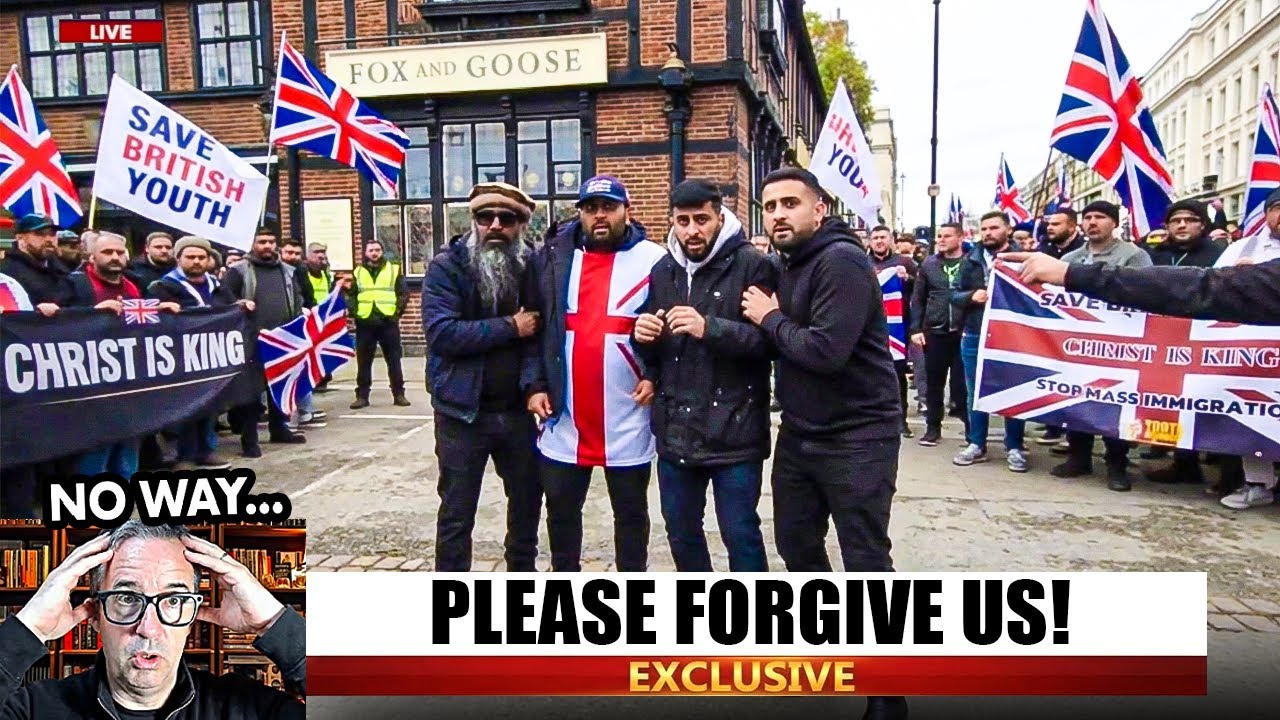
The man with the beard repeatedly tells the flag-bearer that despite his skin colour he remains “a blackie” and questions his right to identify with the English flag. He states phrases such as “No matter how much you wash yourself, you see a blackie. Get used to it.” The flag-bearer responds by defending his British identity and eventually tells the other man to leave, using strong language that includes a racial slur in return.
The exchange remains mostly verbal, though emotions run high. Onlookers film the interaction, and one participant later describes it as an example of cultural friction. The man holding the flag expresses frustration that his display of national symbols is being challenged by someone he perceives as not sharing the same cultural attachment to Britain.
Such incidents reflect broader discussions taking place across the United Kingdom, particularly in urban centres like London, Birmingham and Manchester. Many long-established residents, including those from immigrant families who have lived in Britain for generations, report feeling that rapid demographic changes have strained social cohesion. They argue that integration requires newcomers to respect and adopt core elements of British culture and law.
Critics of current migration patterns point to visible symbols — flags, language, dress and behaviour — as markers of whether communities are successfully blending or remaining parallel. The English flag, in particular, has become a flashpoint. While some view it as an inclusive symbol of national pride open to all who identify with England, others see its public display by non-White individuals as provocative or inappropriate.
The video also touches on wider cultural practices. The flag-bearer and commentators reference issues such as honour-based violence, ritual slaughter and attitudes toward women and children that they associate with certain imported traditions. These claims are frequently raised in public discourse when discussing integration failures, though they remain highly contested and sensitive.
Britain has a long history of absorbing waves of immigration. Post-war arrivals from the Caribbean, South Asia and elsewhere have contributed significantly to the economy and culture. Many families from those communities now consider themselves fully British or English in identity, even if their ethnic origins lie elsewhere. Public figures such as former footballer Ian Wright are often cited as examples of individuals who were born and raised in Britain and strongly identify with the nation.
However, recent decades have seen larger and more culturally distinct inflows, particularly from Muslim-majority countries. Official statistics show that parts of major cities now have neighbourhoods where English is not the primary language spoken at home and where parallel social norms persist. This has led to growing public concern, expressed in opinion polls and street-level sentiment, that multiculturalism has sometimes prioritised diversity over shared values.
Government policy has attempted to address integration through citizenship tests, language requirements and community cohesion initiatives. Yet critics argue that enforcement has been inconsistent and that political correctness has discouraged honest discussion. High-profile cases of grooming gangs, honour killings and protests featuring foreign flags have fuelled the perception that certain groups resist assimilation.
The incident in the video is not isolated. Similar confrontations have been recorded in other towns and cities, often involving disputes over flags, religious attire or public behaviour. Supporters of stricter immigration controls see these moments as evidence that the current model is failing. They call for reduced inflows, stronger enforcement of British law and clearer expectations of cultural adaptation.
Defenders of the existing approach emphasise Britain’s tradition of tolerance and the economic benefits of immigration. They argue that isolated incidents should not define policy and that racism, rather than cultural difference, lies at the root of many tensions. They point to successful integration stories across generations as proof that diversity can strengthen society when managed properly.
The English Constitution Society and similar groups have sought to clarify the distinction between British and English identity, arguing that Englishness carries a specific cultural and historical meaning that goes beyond legal citizenship. Seminars and public discussions on this topic have gained attention among those who feel their national heritage is being diluted.
Public reaction to the video has been divided. Some viewers praise the flag-bearer for standing his ground and defending his right to national symbols. Others condemn the use of racial language from both sides and call for calm dialogue. The broader debate continues in media outlets, parliamentary questions and street protests under slogans such as “Stop mass immigration” or “English people are waking up.”
Britain’s cities have changed dramatically in recent decades. Census data shows that White British residents are now a minority in London and in several other urban areas. This shift has prompted questions about whether social trust and shared identity can be maintained at scale without deliberate policy adjustments.
Integration is a two-way process. Newcomers are expected to learn the language, obey the law and respect democratic values. Long-term residents, in turn, are asked to accommodate reasonable cultural differences. When either side fails, friction increases. The street exchange captured on video illustrates one such moment of failure.
The United Kingdom continues to grapple with these issues at both local and national levels. Recent elections and opinion surveys indicate rising support for parties that promise tighter border controls and greater emphasis on assimilation. At the same time, community leaders from minority backgrounds warn against stigmatising entire groups and call for more investment in education and employment to foster belonging.
The incident serves as a reminder that national symbols carry deep emotional weight. For some, the English flag represents pride in history, institutions and way of life. For others, it can feel exclusionary when displayed by those whose recent ancestry lies elsewhere. Resolving such perceptions requires honest conversation rather than avoidance.
Ultimately, the sustainability of a diverse society depends on the willingness of all communities to uphold a common framework of values, laws and expectations. When significant portions of the population feel that this framework is being eroded, tensions rise and public confidence declines. The video from the street is a small but vivid example of that dynamic playing out in real time.
As Britain moves forward, the balance between openness and cohesion remains a central challenge. Policymakers, community leaders and citizens will need to address these questions with clarity and realism if social harmony is to be preserved. The exchange between the two men, though uncomfortable, reflects sentiments that many across the country now openly discuss.
The coming months and years will test whether Britain can successfully navigate these cultural currents or whether further divisions will emerge. The evidence from streets, polls and policy outcomes suggests that ignoring the underlying issues is no longer a viable option.
Promoted Content







Related Posts

Scandale Sur Le Service Public : Patrick Sébastien Lâche Une Bombe Sur Les Pratiques De France Télévisions Et Les Marges De Nagui.T.F
Scandale Sur Le Service Public : Patrick Sébastien Lâche Une Bombe Sur Les Pratiques De France Télévisions Et Les Marges De Nagui L’univers feutré et souvent opaque…
Betrayal of the Elite: SAS Veterans and Top Generals Launch Fierce Rebellion Against Starmer’s “Show Trials” – mycay
The bond between the British Crown and its most elite warriors is facing an unprecedented rupture. In a move that has sparked fury across the military establishment,…

🚨 Mark Carney SHUTS DOWN Trump’s “America First” Agenda LIVE 🇨🇦🇺🇸 — A Dramatic Clash That Turns Into One of the Biggest Political Backfires of 2026!!! 😳🔥chitam
The Resurgent North: How Trump’s Pressure Campaign Built a Canadian Majority OTTAWA — For the better part of a year, the political oxygen in the Canadian capital…

The 9-Minute Reset: How Mark Carney’s “Arctic Clause” Outmaneuvered Washington-liplip
At 9:41 a.m. Eastern time, the world of international finance shifted on its axis, not with a bang, but with a measured, nine-minute address from Ottawa. Standing…

„Die deutsche Politik kann alles von Milei lernen“ – Energieexperte Fritz Vahrenholt und Ulrich Reitz rechnen mit der Bundesregierung ab. phunhoang
Berlin – Javier Milei hat Argentinien mit radikaler Marktwirtschaftspolitik in kürzester Zeit spürbar verändert. Zum ersten Mal seit 123 Jahren erzielt das Land einen Haushaltsüberschuss, die Armutsrate…

Diplomatischer Eklat in Budapest: Peter Magyar beleidigt Staatspräsident Tamás Sulyok und fordert dessen sofortigen Rücktritt. phunhoang
Budapest – Nur wenige Tage nach seinem Wahlsieg hat der designierte ungarische Ministerpräsident Peter Magyar für einen schweren diplomatischen Zwischenfall gesorgt. Bei einem offiziellen Besuch im Präsidentenpalast…