
Content notice (historical): This article discusses occupation, persecution, and the Holocaust, which some readers may find distressing. It is shared for historical education and reflection on human rights. It does not promote violence, hatred, or any extremist ideology.
The photograph long known as “The Last Jew in Vinnitsa” has become one of the most striking documents of the Holocaust in Eastern Europe. For decades, however, it was linked to the wrong location. According to recent research by historian Jürgen Matthäus (former head of research at the United States Holocaust Memorial Museum – USHMM), the scene has been reassigned with high confidence to the Berdychiv Citadel (Ukraine), and the perpetrator pictured has been identified with very high probability as SS officer Jakobus Onnen. The victim’s identity remains unknown.
Matthäus’s work (published in 2023–2024 in specialized academic journals) brings together multiple sources and methods: archival research, family memory, on-site/topographical analysis, and facial-recognition technology used as a supporting tool. This interdisciplinary approach aims to clarify historical facts while also raising questions about the ethics of memory and how societies name—or fail to name—victims.
An iconic image and decades of mislabeling
The photograph gained wide attention during the Eichmann trial (1961) in Israel. It was provided by a Holocaust survivor who received a print in Munich in 1945. At the time, it was captioned “The Last Jew in Vinnitsa” and often dated to 1941–1943, reinforcing the belief that it depicted an event in Vinnytsia (Ukraine).
The turning point: war diaries and a caption on the print
In 2023, Matthäus located a high-quality print in the collection of Walter Materna, an Austrian Wehrmacht soldier, donated to USHMM. A note on the back points to Berdychiv and a date in late July 1941. Materna’s diary entry for the same day, along with topographical checks (comparing historical and modern views of the area), supports the conclusion about the site.
Identifying the perpetrator and restoring context
After these findings were published, reader tips and family connections directed attention to Jakobus Onnen (1906–1943). A person with family ties reported recognizing the man in the photograph as a relative who had served in a unit involved in mobile killing operations in Ukraine during the Nazi occupation.
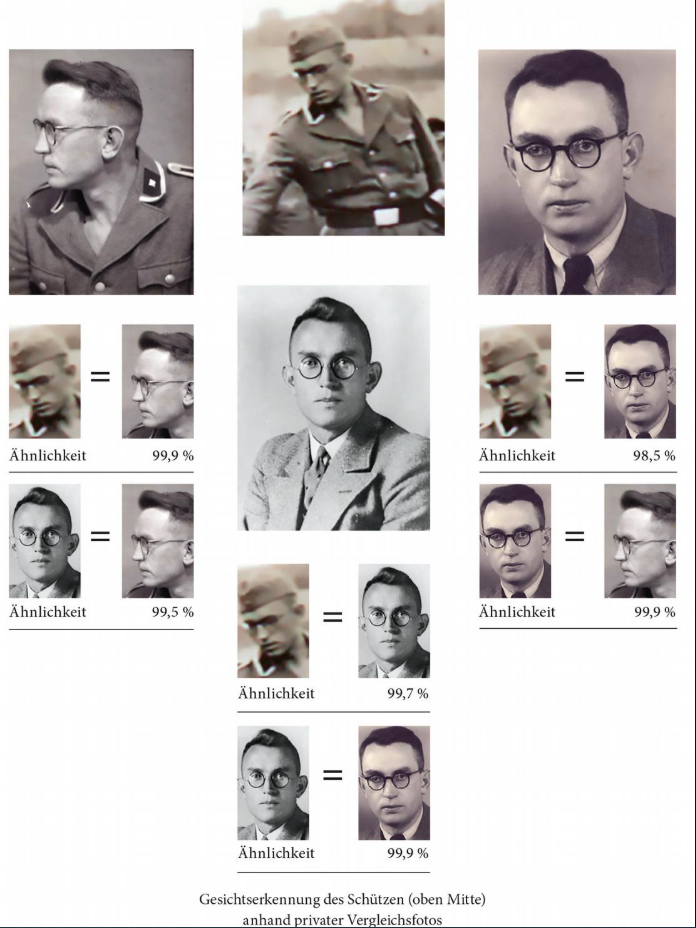
Biographical information in the research indicates that Onnen trained as a teacher, joined Nazi organizations in the early 1930s, and was assigned to a unit operating in Ukraine in the summer of 1941. Facial-recognition software was used to compare known photographs with the man shown in the image, producing a very high match level (described as close to 99%). Onnen died in combat in 1943 and was never tried after the war.
The victim remains unnamed
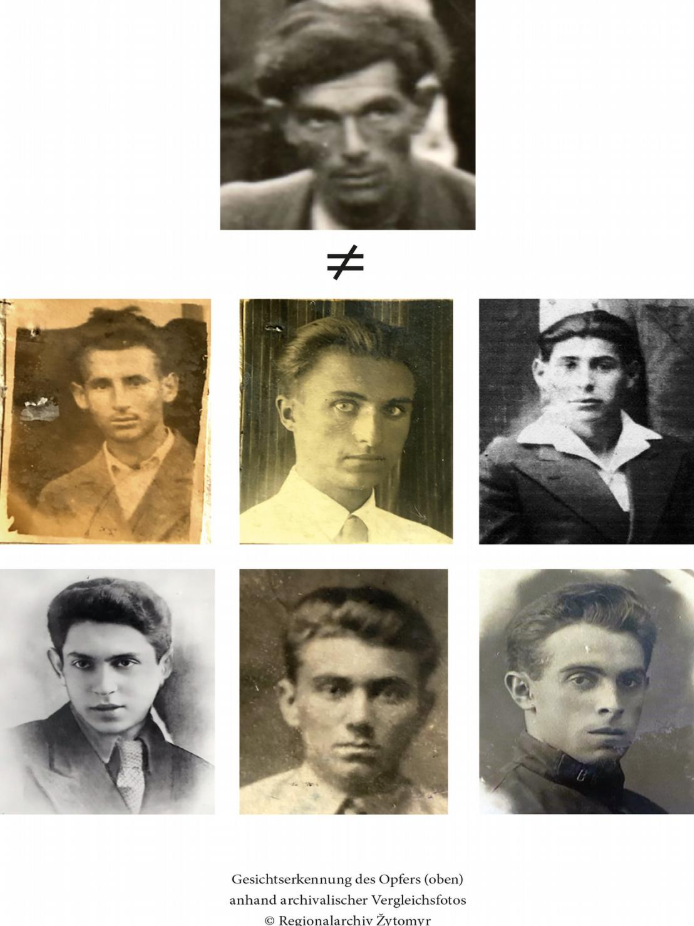
Although the victim’s face is relatively clear, his identity has not been established. This reflects a common reality of many mass killings in Eastern Europe, where victims’ names were often not recorded. Institutions and memory projects (collecting testimonies, archives, and databases) continue working to restore identities to victims who remain anonymous.
The significance of an interdisciplinary approach
This reconstruction combines several layers of evidence: archival discovery, family memory, site analysis, and digital tools used to support verification. Correcting the location and identifying the perpetrator helps deepen understanding of how persecution operated—while also reminding us that behind every historical document are real people, many still unnamed.
The story of this photograph—moving from a long-standing miscaption to conclusions built on recent cross-checks—is more than a documentary correction. It also underscores the value of rigorous research, respect for victims, resistance to historical distortion, and ongoing vigilance against discrimination and hatred in defense of human rights.