

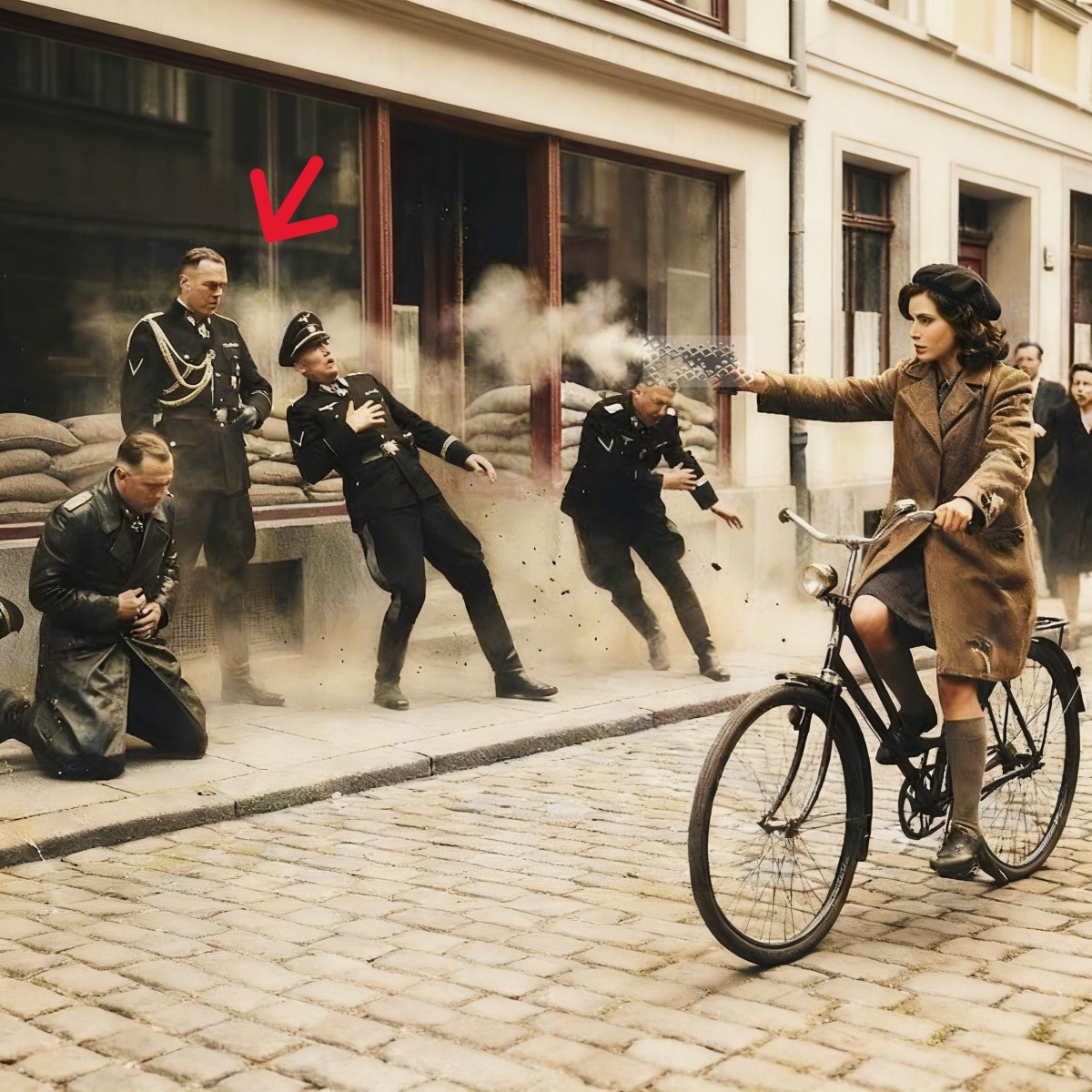
See how an innocent bicycle belonging to a 14-year-old girl helped bring down dozens of Nazi officers—without anyone suspecting a thing.
While German soldiers patrolled the streets of Haarlem searching for armed and dangerous resistance fighters, two teenage girls with braids and angelic smiles pedaled freely between checkpoints, carrying weapons hidden inside their bicycle baskets. The Nazis never imagined that these seemingly fragile, innocent girls were in fact trained killers—responsible for eliminating dozens of high-ranking officers, traitorous collaborators, and SS men.
This is the true story of Freddy and Truus Oversteegen, two sisters who learned to kill in a dark basement at ages 14 and 16; who lured enemies in smoke-filled bars and executed them coldly in isolated woods; who saved hundreds of Jewish lives while taking others without hesitation—yet never lost their humanity even while fighting real monsters.
Freddy was born in 1925 in the small village of Schoten, on the outskirts of Haarlem in the Netherlands. Her childhood was anything but normal or comfortable. The family lived in a modest prefabricated house in the suburbs. Her father never managed to earn enough to support them properly. Their mother, Truus Menger, was a convinced communist with an unbreakable principle she constantly repeated to her daughters:
“When you witness an injustice happening in front of you, you can’t simply look away and pretend you didn’t see it. You must act immediately to correct it—no matter the personal cost.”
When Freddy was still very young, her parents divorced for good. Her father sang a melancholy farewell song in French from the bow of a boat as he left toward an unknown future, and Freddy rarely saw him again after that sad day at the harbor. Truus moved the two girls—Freddy and her older sister Truus—into a tiny, cramped apartment in the heart of Haarlem. They slept on old mattresses stuffed with dry straw that pricked their backs at night.
The family had almost nothing of value, yet their mother always found room to shelter more people in need. Jewish refugees fleeing brutal persecution in Nazi Germany knocked on their door in the middle of the night. Political dissidents escaping the Gestapo desperately needed temporary refuge. They were complete strangers whose real names the family often didn’t even know. They shared their narrow beds and scarce resources. Freddy and Truus grew up making handmade dolls from fabric scraps for traumatized refugee children from the Spanish Civil War.
They learned very early that some things matter infinitely more than personal comfort or individual safety. Their mother taught them a lesson that would be permanently etched into their souls:
“If you truly want to help someone for real, you must be fully willing to sacrifice something important—your time, your resources, your comfort, or even your own life.”
Then came the day that changed everything forever: May 10, 1940. Nazi Germany invaded the Netherlands with brutal, overwhelming military force. Tanks crossed the borders in perfect formations. Aircraft bombed defenseless cities. Paratroopers descended from the skies like deadly locusts. The Dutch army—completely unprepared for the devastating Blitzkrieg—resisted bravely for five days of desperate, bloody fighting before surrendering completely to Germany’s crushing superiority.
Freddy was only 14 when she watched her entire nation fall beneath Nazi boots.
The occupation began immediately with the cold, terrifying German efficiency for which they were famous. German soldiers took over all key streets, their military boots striking the pavement in flawless formation. Enormous Nazi flags with red-and-black swastikas hung menacingly from government buildings and strategic points. New oppressive rules, suffocating restrictions, and paralyzing fear settled over the Dutch population like a fast-spreading disease.
Freddy vividly remembered the terrible feeling the occupation brought to her community. Years later, she would describe those days with a voice still heavy with emotion:
“I remember perfectly how people were violently dragged from their homes in the middle of the night without warning. German soldiers pounded on doors with the heavy butt of their rifles, making a metallic, terrifying noise so loud you could hear it throughout the neighborhood. And they always shouted orders in German with authoritative, frightening voices. It was absolutely horrifying to hear those shouts echo through the dark, empty streets as families were hauled out of their homes.”
But the Oversteegen family did not hide like most. They chose to fight from the first day of occupation. Freddy and Truus immediately joined their mother in distributing anti-Nazi leaflets and illegal underground newspapers—materials that could mean summary execution if they were caught carrying them.
At night, when the streets became deserted and dangerous, they slipped through the shadows with homemade glue and paper, systematically covering German propaganda posters with their own subversive resistance messages. “The Netherlands must be free” and “Don’t work for Germany” were their favorite lines, because every Dutch worker in German war factories meant one more German soldier freed to be sent to the front to kill Allied troops.
After quickly posting the forbidden messages, they would pedal away as fast as possible on their rattling bicycles, hearts racing, pounding wildly in their chests, pure adrenaline burning hot through their veins—fully aware that if they were caught at that exact moment with resistance materials, they would be shot against the nearest wall without trial or mercy. But they were never caught during those risky night missions; two innocent young girls on old bicycles rarely raised serious suspicion among bored German soldiers at checkpoints.
Their courageous resistance activities did not go unnoticed for long. In 1941, a determined man named Franz van der Wiel knocked firmly on the door of their tiny apartment. He was the respected commander of Haarlem’s Resistance Council, a crucial part of the well-organized underground network fighting the Nazi occupation across the Netherlands.
He had heard widely about the Oversteegen family: the fearless communist mother who hid hunted Jewish refugees in her cramped, crowded apartment; the two bold teenage daughters distributing dangerous illegal materials through watched streets without apparent fear. Franz wanted to recruit them urgently for operations far more dangerous and lethal than leaflet distribution. With complete seriousness he asked their mother:
“Can your daughters officially join the armed resistance and take part in combat operations?”
Freddy was only 14. Truus was 16. Their mother said yes without hesitation. The girls said yes immediately, determination shining in their young eyes.
But Franz still wasn’t fully convinced that inexperienced teenagers could truly keep vital secrets under the Gestapo’s brutal torture. He needed absolute certainty that he could trust them with information that could destroy the entire resistance network—whether they would break quickly under extreme physical and psychological pressure from experienced Nazi interrogators. So he devised a brutal, realistic test to assess their loyalty and resilience.
A few days later, he returned unexpectedly to their apartment at a random time. This time he was fully dressed as a Gestapo officer in a complete, authentic Nazi uniform. He burst through the door violently, waving a threatening Luger pistol, shouting in perfect German with an authoritative, terrifying voice, demanding to know immediately where a specific Jew was hiding—right then, in the building or nearby.
Freddy and Truus did not give an inch. They revealed no names at all—not even under the clear threat of imminent death with the gun aimed at their young heads. Instead of giving up any information that could endanger someone, they reacted physically with surprising fury, kicking and punching the man they truly believed was a real, dangerous Nazi officer—refusing categorically to betray any innocent person even if that stubborn refusal cost them their lives.
Franz stopped the dramatic performance at once and revealed his true identity with a broad smile of genuine approval on his face. They had passed the test with highest honors. Now he finally told them what it would mean in practice to officially join the armed resistance. In a grave, serious voice he said:
“You will learn to sabotage strategic bridges and vital rail lines to prevent the transport of German troops and supplies.” He paused heavily, letting the information sink fully into their young minds. “And you will learn to shoot to kill Nazis and traitorous collaborators.”
Truus glanced quickly at her younger sister. Freddy smiled with a strange mix of nervousness and teenage excitement and said firmly:
“Well, that is definitely something I’ve never done before in my life.”
Their mother gave them one final, crucial piece of advice before they left for training:
“No matter what happens, no matter what you are forced to do—always remain human inside.”
The Oversteegen sisters were taken secretly to a hidden underground shed used to store potatoes during winter. There, in the damp, cold darkness beneath packed earth, far from curious eyes and listening ears, they learned methodically to shoot with lethal precision. They learned to aim through iron sights, control their breathing before pulling the trigger, stay absolutely calm under extreme pressure, and kill another human being without fatal hesitation in the crucial moment. They spent entire weeks practicing on improvised targets until every movement became automatic and instinctive.
Their first official mission was not a direct killing—it was strategic arson. Nazi warehouses filled with vital military supplies had to be set on fire and destroyed completely, but they were constantly guarded by well-armed SS soldiers who shot to kill without warning.
The resistance leaders’ plan was simple in theory but risky in execution. Freddy and Truus would casually approach the bored German guards and strike up friendly conversation like innocent local girls. They would flirt openly—smiling charmingly and laughing brightly—while the rest of the resistance cell silently slipped in behind them and set multiple fires at once.
The plan worked perfectly on the first attempt. The warehouses burned quickly, reduced to ashes. The German guards never suspected the two adorable teenagers chatting animatedly with them moments before the coordinated attack.
Franz now clearly saw what these girls were truly capable of. These teenagers could reach places adult male resistance fighters never could without raising immediate suspicion. They could naturally get close to dangerous targets no one else could approach without being stopped and questioned. Their apparent youth and angelic innocence were weapons far more powerful and effective than any gun or explosive.
Then came the moment they would fully understand the brutal meaning of that reality. Freddy’s first assigned victim was not a uniformed German soldier. It was a Dutch woman—an ordinary civilian, a fellow countrywoman.
The resistance had received reliable information from multiple sources about a dangerous collaborator: a Dutch citizen who worked actively with the Nazis for dirty money. She had meticulously compiled a detailed list of names and addresses of Jews in hiding across the region. She planned to deliver that deadly list to the Germans that same afternoon in exchange for payment. That list was literally a collective death sentence for hundreds of innocent people—men, women, small children, babies—entire families who would be arrested, deported in overcrowded cattle cars, and systematically murdered in the gas chambers of extermination camps.
The resistance gave that critical mission specifically to Freddy because she was perfect for it. Freddy biked alone to a specific public park where the informant said the traitorous woman would be waiting for her Nazi contact. She found her target sitting calmly on a wooden bench, unaware of the mortal danger approaching. Freddy came closer slowly and casually, outwardly carefree and innocent—just a young girl with neatly braided hair and an angelic smile. In a soft, sweet voice she asked politely:
“Excuse me—what is your name?”
The woman answered automatically, suspecting nothing. Freddy confirmed she had the right target. She quickly pulled the pistol hidden under her coat, looked the woman in the eyes for one eternal second, and pulled the trigger once.
The shot rang out through the empty park. The woman slumped heavily to the side on the bench. Freddy immediately got back on her bicycle and rode away at an ordinary pace, as if nothing had happened—just another teenager heading home.
Much later, long after the war, she would describe the unsettling feeling of that first killing:
“The first strange thing you instinctively want to do when you shoot someone and see them fall is run over and help them get back up.”
That deep human instinct—to help someone who is hurt even after you have intentionally killed them with your own hands—never fully left her. No matter how many times she was forced to pull that cold trigger again.
Freddy and Truus quickly developed their own efficient lethal techniques. Sometimes they worked alone, sometimes together as a coordinated team. Their methods evolved constantly as they learned from experience what worked best and what was too dangerous.
“The forest technique” became their favorite specialty. They deliberately went to smoky bars and crowded taverns where German officers regularly gathered to drink and relax away from duty. One sister would enter alone, dressed attractively, and strike up a seductive conversation with a chosen officer. She would laugh loudly at his bad jokes, touch his arm suggestively, moving closer and closer. Then, casually, in an innocent voice, she would ask:
“Would you like to take a nice walk with me in the nearby woods?”
The officer always said yes eagerly, without a second thought, driven by alcohol and hormones. They would walk slowly deeper into the woods, farther from roads and houses, farther from potential witnesses. And there—hidden strategically among dense trees at a prearranged spot—the other sister would be waiting in silence with the gun already cocked.
One precise shot to the unsuspecting officer’s head, and he would collapse dead instantly. They left the body in a shallow grave dug in advance and rode away quickly on their bicycles before anyone noticed the officer was missing.
Other times, when speed and surprise mattered most, their technique was different. Truus would pedal fast while Freddy sat behind on the narrow rear rack, gripping a loaded pistol, ready to fire. They would spot the target walking unguarded in the street. They sped past at high speed, Freddy fired with precision as they passed, and they kept cycling without slowing down—just two young girls on an ordinary bicycle, nothing unusual to attract attention.
“We always went by bicycle, never on foot,” Truus explained decades later in an interview. “Walking was too dangerous because you can’t escape quickly if something goes wrong. I always made sure the escape route was completely clear before Freddy fired. This method worked incredibly well for us.”
Sometimes they were even bolder. They followed a target discreetly to his home, memorized the address and routine, then simply knocked politely at the door at the right moment. When he opened, he saw only a harmless young girl smiling. By the time he realized the real danger, it was already too late—the bullet had already gone through his skull.
In 1943, a third fighter joined their cell: Jannetje Johanna Schaft, known to everyone as Hannie. She was very different from the Oversteegen sisters in background and personality. Hannie came from a respectable, comfortable middle-class family. Her father was a university professor. She studied law at the University of Amsterdam, determined to become a lawyer devoted to international human rights.
But when the Nazi occupiers demanded that all university students sign a mandatory oath of loyalty to Nazi Germany, Hannie refused without hesitation. She was expelled immediately. She did not return home in humiliation as some expected. Instead, she joined the armed resistance.
Hannie had striking physical features that made her dangerously noticeable in any crowd: unmistakable bright red hair, piercing green eyes, extremely pale skin—exactly the kind of memorable face people remembered. That would eventually cost her her young life, but before that terrible day arrived, she became one of the most feared and effective resistance fighters in occupied Holland.
Franz tested her in the same brutal way he had tested the Oversteegen sisters. He gave her a gun and sent her to “assassinate” a specific high-ranking Nazi officer. She approached the target nervously on a busy street, raised the gun with both hands trembling, and pulled the trigger hard.
A dry click.
The weapon was completely empty. It was only a test of courage and determination. The “Nazi officer” turned around—it was Franz in disguise. She had passed the psychological test. Now she officially joined Freddy and Truus as a sister-in-arms.
Together the three young women formed a highly lethal, efficient unit. Hannie was the intellectual strategist, meticulous and detail-focused. Truus was the bold natural leader, decisive under pressure, brave to the point of recklessness. Freddy was the experienced scout, planning routes in advance and knowing every escape path through the city. Together they were almost unstoppable when coordinated.
The three young women did not only kill enemy soldiers and officers. They blew up vital railway lines to physically prevent deportation trains from carrying defenseless Jews to distant concentration and extermination camps. They bravely smuggled orphaned Jewish children out of the occupied country, sometimes carrying them in their arms on foot across guarded borders at night. They stole blank ID papers from government offices and skillfully forged convincing documents so hunted refugees could disappear and assume new safe identities. They gathered valuable intelligence on planned German troop movements and transmitted it quickly to Allied forces through clandestine channels.
And yes—they continued regularly killing German soldiers, Nazi officers of all ranks, and Dutch collaborators.
Collaborators were often the most dangerous and difficult targets: ordinary Dutch citizens who betrayed their own people for money or political power, who deliberately informed on hidden Jewish neighbors, who willingly worked for the Gestapo as informants. Freddy and Truus focused increasingly on these hated traitors as the war dragged on endlessly.
“We were effectively dealing with deadly cancerous tumors in Dutch society,” Truus explained later. “It was absolutely necessary to remove them surgically. Like a surgeon cuts out cancer—because you couldn’t arrest them, there was no justice system functioning. You couldn’t try them, the courts were controlled by Nazis. There was literally no other practical solution.”
Then came an extremely controversial order from the resistance leadership. The target was Arthur Seyss-Inquart, Reichskommissar of the Netherlands—one of the most powerful and protected Nazis in the occupied country. The mission was to kidnap his small children from school. The plan was to use the innocent children as leverage to force him to release captured resistance prisoners—and if he refused, to publicly kill the kidnapped children as retaliation.
Freddy, Truus, and Hannie categorically refused.
“We are not Hitlerites like they are,” Freddy said firmly. “Real resistance fighters do not murder innocent children for revenge. We have already killed many adults who chose to fight for an evil cause. We will probably kill many more before this war ends—but we will never, under any imaginable circumstances, kill innocent children who chose nothing.”
That was the thin but crucial moral line between legitimate resistance and pure terrorism—between fighting evil and becoming it. They would not cross it.
One afternoon, Truus was cycling calmly through the streets when she witnessed something so horrific it haunted her for the rest of her life. A Dutch SS man—a traitor who had voluntarily joined the Nazis—stood in the street holding a small baby from a terrified Jewish family. The father stood helpless, the baby’s older sister screamed in horror. The soldier lifted the crying baby above his head and slammed it violently against a brick wall. The child died instantly.
Truus stopped her bicycle in the middle of the street, pulled her hidden revolver, and shot the soldier dead on the spot—right there in broad daylight, in a busy street, in front of multiple civilian witnesses. It was not a planned mission. There were no orders.
“But I do not regret it at all,” she said decades later. “Some things simply do not need official orders.”
By 1944, Hannie Schaft had become one of the most wanted people in occupied Holland. Her distinctive red hair had been reported at multiple recent attacks. Terrified witnesses described her repeatedly. The Nazis issued an urgent high-priority alert: “Find the red-haired girl who is killing our officers.”
Hannie dyed her hair black, began wearing thick-framed glasses, changed her clothing and posture—yet she never stopped fighting.
In June 1944, she and a resistance partner, Jan Bonekamp, were assigned to eliminate a particularly dangerous Dutch collaborator named Willem Ragut. They found him walking alone. Bonekamp shot first, but Ragut did not die immediately. In the chaos of shouts and gunfire, Bonekamp was badly shot in the stomach by a guard who appeared unexpectedly.
Hannie escaped. Bonekamp was captured, taken to a German military hospital, and died slowly and painfully. Nazi interrogators pressured him brutally even as he was dying. He refused to talk. Then they tried a different psychological approach: an experienced officer convincingly pretended to be a secret resistance member, claiming to be a close friend who wanted to help everyone escape.
Delirious from blood loss and medication, Bonekamp believed the lie and gave Hannie’s home address. He died soon after, unaware he had doomed his friend.
The Nazis raided Hannie’s parents’ home at dawn, arrested her elderly, innocent parents, and sent them to a brutal concentration camp. Hannie wasn’t there. She went into hiding immediately. She could no longer fight openly—if captured, everyone she knew would be tortured to death as the Gestapo extracted every name from her memory.
For months she lived alone in damp basements and cramped attics, constantly changing hiding places—always one step ahead, but no one can stay hidden forever in an occupied country filled with informants.
March 21, 1945. The war was visibly nearing its end. Allied forces were advancing across liberated Europe. The full liberation of the Netherlands was only weeks away—maybe days. Everyone could feel it.
Hannie was cycling cautiously through Haarlem, carrying illegal communist newspapers hidden under her coat and a loaded pistol in her inner pocket.
She was suddenly stopped at a Nazi checkpoint she hadn’t expected on that route. Nervous, paranoid soldiers searched her and found everything. Hannie was arrested on the spot, handcuffed brutally, and taken to a grim prison in Amsterdam.
For weeks she was violently interrogated and tortured, held in solitary confinement in a tiny windowless cell. They sensed they had captured someone extremely important—but they needed confirmation and the names of her comrades.
Share this—and if this story makes you reflect, consider passing it on. You never know who might need to hear it.