
A Border Dispute That Has Become a Test of Europe’s Political Future
Europe’s long-running struggle over migration has entered another deeply consequential phase, and once again Poland stands near the center of the confrontation. Along the country’s eastern frontier, physical barriers, surveillance systems, expanded security deployments and exceptional border measures have become symbols of a dramatically changing European security environment. What Polish authorities describe as the defense of both their own territory and the European Union’s external frontier has become entangled with a second dispute that reaches directly into Brussels: how far a member state may go in restricting access to asylum when it believes migration itself is being deliberately manipulated as a political weapon. For Warsaw, the argument is increasingly framed not as a conventional dispute about people crossing a border in search of protection or economic opportunity, but as a question of national security. For human-rights advocates and legal critics, however, that framing creates an equally serious concern—whether governments confronting genuine security threats can suspend or narrow protections that were deliberately designed to remain meaningful during periods of crisis. The result is a confrontation in which border security, humanitarian law, national sovereignty and European solidarity are colliding at precisely the moment when the EU is attempting to build a more unified migration system.
The stakes extend well beyond Poland. If Warsaw succeeds in convincing European partners that extraordinary pressure at an external border requires extraordinary legal responses, other governments facing migration crises may seek similar flexibility. If Brussels and European institutions instead insist that core asylum guarantees must remain fully accessible regardless of political or security circumstances, the EU will face the difficult task of explaining how frontline countries should respond when neighboring governments are accused of intentionally facilitating irregular migration. Neither question has an easy answer. That is why Poland’s confrontation is rapidly becoming a defining test of what European cooperation means when national security priorities and common European rules appear to pull in different directions.
Poland Says This Is Not an Ordinary Migration Crisis
The central argument advanced by Polish officials is straightforward but enormously consequential: what is happening on the frontier with Belarus should not be understood as spontaneous migration alone. Poland and European officials have for years accused the Belarusian authorities of facilitating the movement of migrants toward EU borders as part of a broader campaign designed to destabilize neighboring states. Belarus has rejected Western accusations surrounding its role, but the dispute has fundamentally changed the way Warsaw approaches the border. Instead of viewing every surge in attempted crossings principally through the traditional framework of migration management, Polish authorities increasingly treat the frontier as part of a wider security confrontation involving hostile state pressure, organized smuggling networks and regional geopolitical instability.
That distinction matters because governments respond very differently to ordinary migration than to what they consider a coordinated security operation. A conventional migration challenge is generally addressed through border processing, asylum procedures, return agreements, reception facilities and cooperation between immigration authorities. A suspected hybrid operation, by contrast, may involve military personnel, intelligence agencies, reinforced physical defenses, restricted zones and emergency legislation. Poland has increasingly moved toward the second model.
Warsaw’s position is that failing to recognize the difference would leave democratic countries vulnerable to governments willing to exploit humanitarian systems strategically. If an adversarial state could intentionally move large numbers of people toward another country’s border and then rely upon that country’s asylum obligations to create sustained pressure, Polish officials argue, traditional migration rules could effectively become instruments of geopolitical coercion.
Critics respond that the intentions of a foreign government cannot automatically determine the legal rights of individual migrants. A person fleeing persecution does not necessarily cease to require protection simply because another state may have manipulated that person’s journey. This distinction—between the geopolitical circumstances creating a migration flow and the individual legal circumstances of each person arriving at the border—is at the heart of the controversy.
The Belarus Frontier Has Become One of Europe’s Most Heavily Defended Borders
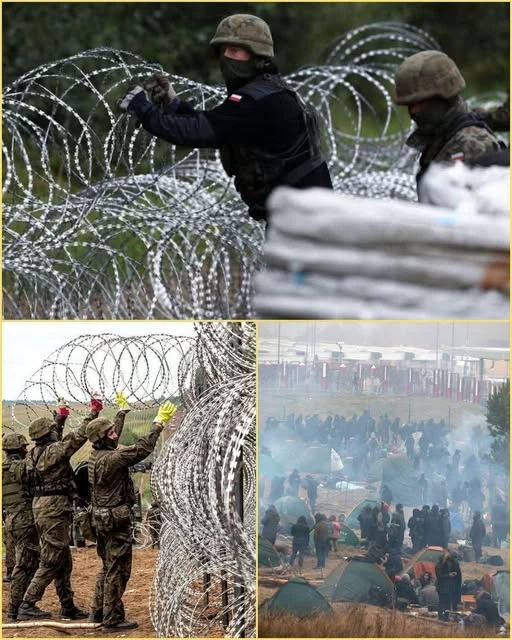
The physical transformation of Poland’s eastern border demonstrates how dramatically Warsaw’s thinking has changed. Sections of the frontier have been reinforced with substantial barriers and sophisticated surveillance infrastructure. Cameras, sensors, patrols and additional security personnel have become part of a defensive architecture designed to detect and prevent unauthorized crossings.
For supporters of the strategy, the barrier is evidence that Poland learned from previous migration crises and refused to leave an external EU border vulnerable. They argue that a functioning state has both the right and responsibility to determine who enters its territory, particularly when authorities believe another government may be deliberately encouraging irregular crossings.
Opponents see something different. Humanitarian groups have repeatedly raised concerns about conditions experienced by migrants caught near the border, particularly during severe weather. They argue that physical barriers can push desperate people toward more dangerous routes and make humanitarian assistance more difficult.
Both perspectives reveal the unusual nature of the situation. Poland is simultaneously defending an EU external border, confronting Belarus, managing asylum obligations and participating in a much larger European political debate over migration. Every decision taken at the frontier therefore carries consequences far beyond the immediate border region.
Emergency Powers Have Raised the Stakes
Poland’s willingness to use extraordinary measures has further intensified the controversy. Restrictions in border areas and measures affecting access to asylum procedures have prompted arguments over how governments should balance constitutional security responsibilities with international protection obligations.
Warsaw maintains that extraordinary circumstances require governments to possess tools capable of responding rapidly to organized pressure. Polish officials have emphasized attacks and dangerous confrontations involving border personnel as evidence that the situation cannot simply be treated as a routine immigration-management problem.
This security argument resonates strongly with many citizens who believe European governments underestimated border vulnerabilities during earlier migration crises. To them, a government waiting until a security problem becomes uncontrollable has already failed in one of its fundamental responsibilities.
But emergency powers inevitably create another question: where should the limit be?
Legal protections are often most consequential precisely when governments face difficult circumstances. Refugee advocates therefore warn against allowing the concept of national security to become so broad that individuals seeking protection lose meaningful opportunities to present their claims.
That tension is unlikely to disappear. In fact, it may become one of Europe’s defining legal debates over the coming decade.
Warsaw Is Also Challenging Europe’s New Migration Architecture
The conflict becomes even larger when Poland’s position toward broader EU migration reform is considered. European institutions have spent years attempting to overhaul the bloc’s fragmented asylum and migration system. The underlying objective has been to create clearer procedures at external borders while developing mechanisms through which member states share responsibility when particular countries experience disproportionate pressure.
The political logic appears straightforward: migration into one part of the Schengen area can eventually affect many other countries because internal borders are largely open. Frontline countries therefore argue that migration cannot be solely their responsibility, while governments farther from the EU’s external borders often demand stronger enforcement at the perimeter.
Creating a system satisfying both sides has proved extraordinarily difficult.
Poland has been among the governments resisting aspects of compulsory solidarity mechanisms, particularly where Warsaw believes they could require countries to accept relocated asylum seekers or make financial contributions connected to redistribution arrangements. Polish leaders have argued that the country has already carried enormous humanitarian responsibilities, particularly through its response to people displaced by Russia’s invasion of Ukraine.
From Warsaw’s perspective, Europe’s migration framework must recognize the dramatically different circumstances facing individual member states rather than imposing a uniform political solution.
That argument has considerable political power domestically. Yet other EU governments contend that a common border area ultimately requires some form of common responsibility.
Ukraine Changed Poland’s Migration Story
One of the most important facts complicating simplistic descriptions of Polish migration policy is the country’s enormous response to Ukrainians fleeing Russia’s full-scale invasion beginning in 2022. Poland became one of the principal destinations and transit countries for displaced Ukrainians, with ordinary citizens, charities, municipalities and government institutions mobilizing extensive assistance.
The experience demonstrated that Poland’s migration debate cannot accurately be reduced to a simple choice between being “pro-migrant” or “anti-migrant.” Polish policy has differentiated sharply between different categories of arrivals, routes of entry and perceived security circumstances.
Supporters of Warsaw’s position use the Ukrainian response as evidence that opposition to irregular migration across Belarus should not automatically be interpreted as opposition to refugees generally. They argue that Poland demonstrated extraordinary solidarity when confronted with people clearly fleeing a neighboring war, while simultaneously maintaining the right to resist migration flows it considers deliberately engineered by a hostile government.
Critics counter that humanitarian protection should depend upon an individual’s need for safety rather than nationality, ethnicity, religion or route of arrival. They argue that unequal treatment can undermine the universal principles underpinning refugee protection.
The contrast has therefore become one of the most important moral and political arguments surrounding Poland’s approach.
The Debate Is Really About Who Controls Europe’s Borders
Behind the technical language of asylum procedures and solidarity mechanisms lies a much simpler political question: who ultimately controls migration into Europe?
National governments insist they remain accountable to their own voters for security, housing, public services and social cohesion. EU institutions, meanwhile, argue that countries participating in a common border-free area cannot manage migration entirely independently because decisions made in one country can affect every other member.
This structural tension has existed since the creation of the Schengen system, but migration has exposed it more dramatically than almost any other policy area.
Poland’s position represents a particularly strong version of the sovereignty argument. Warsaw insists that responsibility for protecting Polish territory ultimately belongs to the Polish state and that European cooperation cannot remove the government’s fundamental obligation to protect its frontier.
For Brussels, however, a European Union in which every government simply ignores common migration rules whenever domestic politics becomes difficult would risk making collective policy impossible.
Both sides therefore see principles at stake that extend far beyond migration itself.
Other European Governments Are Watching Carefully
Poland is hardly alone in demanding tougher migration controls. Across Europe, governments that once favored comparatively liberal approaches have increasingly strengthened enforcement, accelerated deportation discussions, expanded agreements with countries outside the EU and reconsidered how asylum applications should be processed.
The political center of gravity has shifted.
Migration concerns have contributed to electoral gains for parties advocating stricter controls in several countries, while mainstream parties have increasingly adopted tougher positions of their own.
Germany has intensified debates over border enforcement and asylum procedures. Denmark has spent years developing restrictive policies. Italy has pursued agreements aimed at managing migration outside its territory. Other governments have explored external processing concepts or stronger return mechanisms.
This broader movement means Poland’s position is no longer as isolated within Europe as it might once have appeared.
That does not mean European governments agree with every Polish measure. Far from it. But the fundamental argument that irregular migration must be reduced has moved substantially closer to the center of European politics.
Human Rights Groups Warn Europe Is Crossing a Dangerous Line
For humanitarian organizations, that political shift creates serious concerns.
Their argument begins with a principle established after some of the darkest periods of European history: people fleeing persecution must have access to procedures through which their need for protection can be evaluated.
From this perspective, the central danger is not merely one Polish policy. It is the possibility of a broader European precedent in which governments increasingly use security emergencies to narrow asylum protections.
Human-rights advocates acknowledge that states have legitimate security interests and that borders can be controlled. But they insist that border control and refugee protection are not mutually exclusive.
Authorities can screen applicants, investigate security risks, prosecute smugglers and reject claims that do not meet legal standards while still allowing individuals to request protection.
The fear is that political pressure for visible border control could gradually overwhelm these distinctions.
Poland’s Government Faces Pressure From Multiple Directions
The domestic politics surrounding the issue are equally complicated. Polish leaders face voters demanding stronger border protection while simultaneously confronting European institutions, humanitarian organizations, opposition parties and courts scrutinizing the legality of government measures.
Any perception of weakness at the Belarusian frontier could produce significant political consequences. Yet aggressive restrictions can generate legal challenges and international criticism.
This creates an unusually narrow political corridor.
Warsaw must demonstrate that it can protect the border without appearing to abandon European legal principles. Brussels, meanwhile, must defend common rules without appearing indifferent to legitimate Polish security concerns.
Neither side has much room for an easy retreat.
The Human Smuggling Economy Is Another Part of the Crisis
One element frequently overlooked in political arguments is the enormous criminal economy surrounding irregular migration.
Smuggling networks profit from transporting people across borders, frequently charging migrants thousands of dollars while offering dangerous or misleading routes into Europe.
European governments argue that stronger borders are necessary partly because permissive systems enrich these criminal organizations. If migrants believe irregular entry will reliably result in long-term residence, officials contend, smugglers gain a powerful marketing tool.
Humanitarian groups respond that the absence of accessible legal pathways can itself increase reliance upon smugglers.
Both observations can be true simultaneously.
The challenge for Europe is constructing legal migration and asylum mechanisms that reduce incentives for dangerous journeys without creating unlimited entry.
That objective has been discussed for years, but achieving it has proved exceptionally difficult.
Russia’s War Has Made Every Eastern Border Question More Serious
Poland’s security concerns cannot be separated from the wider geopolitical environment created by Russia’s war against Ukraine.
Poland has emerged as one of NATO’s most vocal advocates for strengthening Europe’s defenses and has dramatically increased military investment. Its territory has become strategically important for supporting Ukraine and reinforcing NATO’s eastern flank.
Belarus remains closely aligned with Moscow.
Against this backdrop, activity along the Belarusian border is inevitably interpreted through a national-security lens in Warsaw.
Actions that might have been viewed primarily as immigration matters fifteen years ago can now be interpreted as components of a much broader confrontation between Russia-aligned governments and NATO members.
That geopolitical reality helps explain why Polish authorities react so strongly to developments at the frontier.
It also explains why simply describing the dispute as a disagreement about asylum policy fails to capture its full complexity.
Could Poland’s Approach Become Europe’s New Normal?
Perhaps the most consequential question is whether Poland represents an exception—or a preview.
European migration politics have changed substantially since 2015. Governments increasingly emphasize border control, faster asylum decisions, stronger return mechanisms and cooperation with countries outside Europe.
If those trends continue, policies once considered unusually restrictive may gradually become mainstream.
Poland’s approach could therefore influence future European policy even if Brussels continues challenging specific elements of Warsaw’s strategy.
The emerging compromise may eventually involve much stronger external borders combined with formal protections for individuals who qualify for asylum and expanded legal pathways for selected migrants.
Whether such a system can satisfy voters, courts, humanitarian organizations and governments simultaneously remains uncertain.
Brussels Faces Its Own Credibility Test
The European Commission and other EU institutions also face significant political risks.
If Brussels cannot demonstrate that common migration rules effectively control irregular entry, public confidence in European migration policy may continue declining.
But if EU institutions permit national governments to suspend common protections too easily, the legal foundations of the shared asylum system could weaken.
Europe therefore confronts two credibility problems at once.
It must convince citizens that borders are real and enforceable.
At the same time, it must convince people seeking legitimate protection that European law remains meaningful.
Failure on either side could carry profound political consequences.
This Confrontation Is Bigger Than Poland
The images from Poland’s eastern frontier—barriers, patrols, security vehicles and groups attempting to cross into EU territory—capture only the visible surface of a much deeper struggle.
Underneath lies a fundamental argument about what kind of political project the European Union intends to become.
Can Europe maintain open internal borders without imposing stronger controls at its external frontier?
Can national governments retain meaningful sovereignty while participating in a common asylum system?
Can refugee protections survive when migration routes are allegedly manipulated by hostile governments?
Can European countries distribute responsibility fairly without generating political backlash among their own citizens?
And perhaps most importantly, can governments create migration systems that citizens view as controlled while continuing to protect people genuinely fleeing persecution?
These questions cannot be answered by Poland alone.
Europe’s Next Migration Settlement May Be Forged on Its Eastern Frontier
Poland’s refusal to retreat from its increasingly security-focused approach has transformed its border with Belarus into far more than a national frontier. It has become a testing ground for competing visions of Europe’s future. Warsaw argues that a continent unable to defend its external borders ultimately risks losing control over both security and migration policy. Critics counter that Europe would betray its foundational legal principles if governments could restrict asylum protections whenever political or security pressure intensified. Between those positions lies the difficult reality confronting policymakers: Europe must protect both its borders and its legal commitments, even when doing both simultaneously is politically and operationally difficult.
The confrontation with Brussels therefore cannot be understood merely as another disagreement between Poland and European institutions. It represents a deeper struggle over sovereignty, solidarity and the meaning of collective responsibility inside the European Union. Poland wants recognition that its eastern frontier represents an exceptional security environment. Brussels needs a migration framework capable of functioning across twenty-seven countries with profoundly different political circumstances. Humanitarian organizations demand that individual rights remain protected regardless of geopolitical tensions. And European voters increasingly expect governments to demonstrate that immigration systems are genuinely under control.
That combination makes compromise extraordinarily difficult.
Yet compromise may ultimately be unavoidable. Europe cannot permanently function with open internal borders if member states fundamentally disagree over responsibility at the external frontier. Nor can it maintain a credible asylum system if the public comes to believe that existing rules cannot distinguish effectively between genuine protection needs, irregular migration and deliberate geopolitical manipulation.
This is why developments along Poland’s border matter far beyond Warsaw.
What appears at first glance to be a confrontation over fences, asylum applications and emergency measures is actually part of a much larger battle over who makes Europe’s migration decisions, what obligations countries owe one another, and how far democratic governments may go when migration becomes intertwined with national security.
The eventual answer could shape European politics for a generation.
For now, Poland is making its position unmistakably clear: it considers control of its eastern frontier a fundamental national-security responsibility and shows little appetite for retreating simply because that position creates political conflict elsewhere in Europe. Brussels, meanwhile, must determine how much flexibility can be granted without weakening the common legal framework the EU has spent years attempting to construct.
The outcome will not be decided by a single summit, border incident or piece of legislation. It will unfold through elections, court decisions, negotiations, security developments and the continuing movement of people toward Europe.
But one thing is becoming increasingly difficult to ignore.
Europe’s migration debate has moved beyond the arguments that defined 2015. The continent is now confronting a more complicated era in which migration, hostile-state activity, border security, humanitarian law and domestic political pressure increasingly overlap.
And on Poland’s fortified eastern frontier, that new era is already visible.