
Andy Burnham Issues Dire Warning as Nation Tackles Wildfires: ‘Britain Is a Tinderbox Right Now’
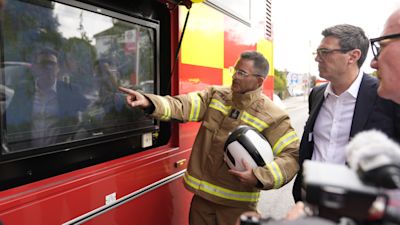
Andy Burnham has issued a stark warning as Britain battles a series of wildfires, describing the country as a “tinderbox” and urging the public to take the growing fire risk seriously.

The warning comes as extreme summer conditions place communities, emergency services and the countryside under increasing pressure. With dry vegetation providing highly flammable fuel, fires can spread rapidly when combined with hot weather and strong winds.
Burnham’s intervention highlights a growing concern that what might once have been treated as isolated summer incidents can quickly develop into major emergencies.
The situation in the West Midlands has attracted particular attention, with wildfires affecting areas around Stourbridge and prompting renewed concern about the risks created by Britain’s unusually dry conditions. Burnham described the country as a “tinderbox” and appealed to people to exercise extreme caution.
The message is simple but serious.
Do not assume that a small fire will remain small.
Do not underestimate dry grass or woodland.
And do not treat the countryside as though normal summer conditions apply.
Wildfires can move with extraordinary speed. Once vegetation becomes sufficiently dry, a spark that might normally be harmless can ignite grass, bushes or woodland.
That can create a rapidly developing emergency.
For firefighters, the challenge is particularly demanding.
Wildfires are often difficult to access, especially when they spread across open land, hillsides or woodland. Fire crews may have to work for hours to contain flames while also protecting nearby homes, roads and critical infrastructure.
The danger is not limited to the flames themselves.
Smoke can reduce visibility and affect air quality.
Roads may need to be closed.
Residents can be forced to leave their homes.
Wildlife can be killed or displaced.
And emergency services may be stretched by multiple incidents occurring simultaneously.
That is why Burnham’s warning carries significance beyond the immediate fires.
It is a call for prevention.
Britain’s summer landscape can appear green and relatively safe compared with countries more accustomed to large-scale wildfires. But prolonged hot and dry weather can change that situation rapidly.
Grasslands, parks, heathland and woodland can become extremely vulnerable.
A discarded cigarette, an unattended barbecue, a firework or another source of ignition can potentially create serious consequences.
Authorities have already moved to restrict some activities considered particularly risky.
Disposable barbecues, for example, have faced temporary bans in some areas because of the danger they pose during extreme conditions.
That development illustrates how seriously officials are taking the situation.
The public therefore has an important role to play.
Fire prevention is not solely the responsibility of firefighters.
It is also about individual behaviour.
People enjoying parks and open spaces need to understand that an action considered harmless during an ordinary summer may become dangerous during a period of extreme dryness.
That means following local restrictions, avoiding open flames and reporting fires immediately.
Early intervention can make an enormous difference.
A small fire detected quickly may be contained before it becomes a major incident.
A fire allowed to spread can become much harder to control.
The political dimension of the warning is also significant.
Burnham has built much of his public profile around issues affecting communities and local government. His intervention allows him to present himself as a politician focused on practical risks rather than abstract political arguments.
At a time when Westminster debates can often seem distant from everyday life, a wildfire is impossible to ignore.
People can see the smoke.
They can smell it.
They can watch emergency crews working.
And they can understand immediately why authorities are concerned.
That makes wildfire prevention a powerful example of the importance of local preparedness.
Councils, fire services, police forces and emergency planners must coordinate quickly when a major incident develops.
Communities also need clear information.
Residents should know when they need to evacuate.
They need reliable warnings.
And they need confidence that emergency services are prepared.
This becomes particularly important when multiple fires occur at the same time.
Fire services have finite resources.
A major incident in one location can require crews and equipment to be diverted from elsewhere.
If several fires develop simultaneously, the pressure can increase dramatically.
That is why prevention is so important.
Every fire that does not start is an emergency that does not have to be managed.
The current situation also raises broader questions about Britain’s ability to adapt to increasingly extreme weather conditions.
Whether one focuses on climate change, natural weather variability or immediate local conditions, the practical reality is the same: authorities must prepare for periods when the risk of fire becomes unusually high.
That means investment in emergency services.
It means effective warning systems.
It means responsible land management.
And it means public awareness.
The debate should not become an excuse for political point-scoring.
Wildfires do not care which party is in government.
They do not distinguish between political supporters.
They threaten homes, businesses, wildlife and public spaces regardless of political affiliation.
The priority should therefore be protecting communities and preventing unnecessary damage.
For Burnham, the phrase “Britain is a tinderbox” is deliberately striking.
It communicates urgency in a way that technical warnings sometimes cannot.
A tinderbox suggests a landscape where conditions are already dangerous and where only a small spark may be needed to trigger something much larger.
That is precisely the message authorities want the public to understand.
The risk may not always be visible.
A field can look peaceful.
A woodland can look inviting.
A park can appear completely normal.
But underneath the surface, dry vegetation can provide the fuel required for a fire to spread rapidly.
This is why responsible behaviour matters.
The public should not wait until flames are visible on the horizon before taking warnings seriously.
The same principle applies to businesses and landowners.
Those responsible for large areas of land need to consider fire prevention and emergency access.
Local authorities need to ensure that residents receive timely information.
And emergency services need the resources required to respond when prevention fails.
Britain’s experience with wildfires also demonstrates how quickly a local emergency can become a national story.
Images of huge flames, smoke-filled skies and exhausted firefighters can spread across social media within minutes.
That can increase public awareness, but it can also create confusion.
People may share outdated information or speculate about causes before authorities have established the facts.
Reliable communication is therefore essential.
The public needs accurate information about where fires are located, which areas are affected and what people should do.
Rumours can be dangerous during emergencies.
The most important message is therefore one of caution.
If authorities issue warnings, people should follow them.
If access to certain areas is restricted, there is a reason.
If disposable barbecues or other activities are banned, those restrictions should not be treated as unnecessary bureaucracy.
They are designed to prevent a small incident becoming a major emergency.
For firefighters, every preventable fire represents a risk avoided.
For residents, it can mean the difference between a normal evening and an emergency evacuation.
For wildlife, it can mean survival.
And for the countryside, it can prevent years of environmental damage.
That is why Burnham’s warning should be taken seriously.
Britain may not have the same wildfire culture as parts of southern Europe, Australia or North America, but that does not mean the country is immune to serious fires.
When conditions are exceptionally dry, familiar landscapes can become surprisingly vulnerable.
The current wave of incidents is therefore a reminder that emergency preparedness must evolve alongside changing weather patterns and increasingly challenging summer conditions.
The responsibility cannot fall on one politician or one emergency service.
It requires cooperation between national government, local authorities, firefighters, police, landowners and the public.
Most importantly, it requires common sense.
Do not leave fires unattended.
Do not ignore local restrictions.
Do not assume that a small flame cannot cause serious damage.
And if a fire is discovered, report it immediately through the appropriate emergency channels.
Britain’s wildfires will eventually be brought under control.
But the lessons from this period should remain.
Extreme conditions can transform ordinary activities into serious risks.
Emergency services can be placed under enormous pressure.
And prevention is often far easier than containment.
Burnham’s warning is therefore more than a dramatic headline.
It is a reminder that the conditions on the ground can change quickly and that the public has a role in keeping communities safe.
Britain is facing a dangerous summer.
The best response is not panic.
It is preparation, responsibility and vigilance.
Because when the countryside becomes a tinderbox, the smallest spark can have consequences far beyond anyone’s expectations.