
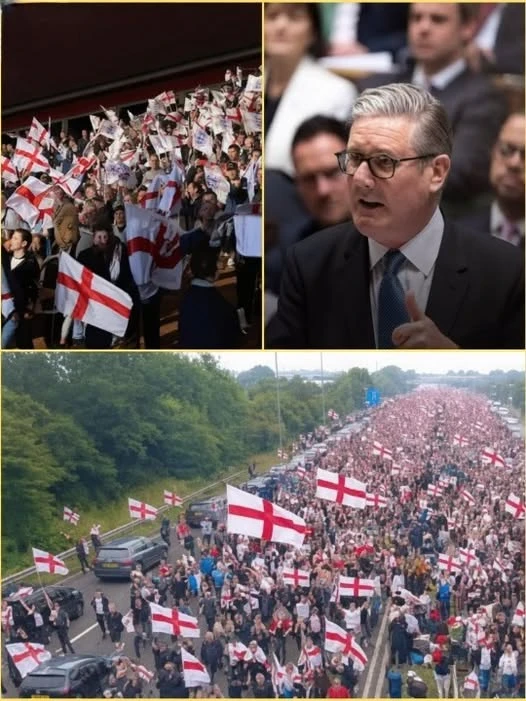
A remarkable story has been spreading through Britain’s increasingly heated immigration debate: a tiny English community, furious over plans connected to asylum accommodation, has supposedly responded by voting overwhelmingly to “leave the United Kingdom.” The viral version is dramatic enough to sound almost cinematic. A peaceful community with only around 180 adult residents is said to have discovered that accommodation for as many as 1,250 male asylum seekers could be established nearby, allegedly close to an area used by children. Residents, according to the claim, were so outraged that 96 percent voted for independence, rejecting Westminster and declaring that they had finally had enough. It is exactly the kind of story designed to race across social media: a small village standing against the machinery of the British state, ordinary residents confronting distant politicians, and a local planning dispute transformed overnight into a rebellion against the country itself. But there is an important problem at the heart of the viral narrative. The dramatic claims presented in the original account should not be treated as established fact without further verification. A local protest vote or symbolic declaration would not, by itself, legally remove an English village from the United Kingdom, and several details in the circulating version—including the place name, population figures, proposed number of asylum seekers and circumstances surrounding the alleged vote—require reliable corroboration. Yet even if the most sensational elements prove exaggerated, the reason the story has attracted attention tells us something significant about Britain in 2026: immigration, asylum accommodation, local consent and trust in central government have become powerful enough issues that even the idea of a village “declaring independence” can resonate with a substantial online audience.
WHY A STORY ABOUT ONE TINY COMMUNITY CAN SUDDENLY CAPTURE NATIONAL ATTENTION
The extraordinary reaction to the story cannot be understood simply by looking at one alleged village vote. Across Britain, disputes over asylum accommodation have repeatedly become intensely local even when the policies behind them are national. Residents may first encounter a major government decision not through a general election manifesto or parliamentary debate, but through reports that a hotel, former military facility, large building or other site in their area could be used to house asylum seekers. At that moment, an abstract national argument becomes immediate. Questions emerge about policing, transport, healthcare, schools, local infrastructure, safeguarding, planning procedures and communication. Residents who might hold very different views about immigration in principle can find themselves united by a much narrower complaint: why were we not consulted? That distinction is crucial. Opposition to a particular accommodation site cannot automatically be interpreted as hostility toward every refugee or migrant, just as support for humanitarian protection does not necessarily mean supporting every location or every method chosen by the government. The political danger begins when communities believe decisions are being imposed upon them rather than developed with them. Once that perception takes hold, arguments over practical capacity can quickly become arguments over democracy itself. A proposal involving several hundred people can feel especially significant in a settlement with a very small permanent population because the demographic comparison is so striking. If the number of newcomers is several times larger than the adult population of the surrounding community, residents are likely to ask questions that would not arise with the same intensity in a major city. How will local services respond? Who will manage security? How long will the accommodation operate? What happens if problems emerge? Who has authority to change the plan? And, perhaps most importantly, why did local people apparently have so little influence over a decision capable of transforming their immediate surroundings?
THE NUMBER THAT CHANGES EVERYTHING: WHY SCALE MATTERS IN SMALL COMMUNITIES
One of the most emotionally powerful elements of the circulating story is the comparison between roughly 180 adults and as many as 1,250 male asylum seekers. That figure should not be repeated as confirmed without reliable evidence, but the underlying issue of scale deserves serious attention. Numbers that appear manageable at a national level can look radically different when concentrated in one small location. Britain is a country of tens of millions of people, and national migration statistics are generally discussed in hundreds of thousands. Government departments naturally approach accommodation partly as a logistical problem: available buildings, capacity, contracts, cost, transport links and administrative efficiency all matter. Villages see the calculation differently. For residents, the denominator is not the population of Britain. It is the population living beside the proposed facility. This is why disputes involving large accommodation centers can become so politically explosive. A facility housing hundreds of people next to a community numbering only a few hundred may create the perception—not necessarily the reality—that the community itself is being fundamentally altered overnight. Even when government officials insist that services will be provided separately or that security arrangements will be established, anxiety may persist if communication is poor. Numbers become symbols. Residents may feel that the state considers their community too small to matter, while officials may believe opponents are misunderstanding the temporary and managed nature of the facility. Both sides can consequently talk past each other. The government discusses beds, processing capacity and national obligations. Residents discuss home, family, safety and whether anyone in power is listening.
THE CHILDREN’S PLAYGROUND CLAIM AND WHY SAFEGUARDING LANGUAGE TRANSFORMS THE DEBATE
The suggestion that a large group of adult male asylum seekers could be housed close to a children’s playground dramatically increases the emotional intensity of the story. Here again, proximity and the precise details need verification before being presented as established facts. But politically, the significance is obvious. Once children enter a debate about migration accommodation, the argument moves beyond budgets and planning rules into one of the most sensitive areas of public life: safeguarding. Parents naturally expect authorities to consider safety whenever large accommodation facilities are introduced near schools, playgrounds or family spaces. At the same time, responsible reporting requires avoiding the assumption that asylum seekers pose a threat merely because they are adult men. Being male, foreign or an asylum applicant is not evidence of criminality. Many people seeking asylum have themselves escaped violence, persecution, political repression or war. Some have endured dangerous journeys before reaching Britain. Treating an entire population as inherently dangerous would therefore be unjustified. The legitimate policy question is instead whether authorities have conducted appropriate risk assessments, whether facilities are properly supervised, whether residents know whom to contact when concerns arise, whether policing resources are adequate, and whether the accommodation model is suitable for the surrounding community. Those are questions governments should be able to answer without accusing every concerned resident of prejudice. Equally, campaigners should be able to demand safeguards without circulating unsupported allegations about individuals who have committed no offense. Maintaining that distinction becomes difficult once a local dispute explodes across social media, where fear travels faster than administrative detail and provocative claims generally receive far more attention than careful explanations.
“ZERO WARNING”: THE THREE WORDS THAT MAY MATTER MORE THAN THE MIGRATION NUMBERS
Perhaps the most politically consequential part of stories like this is not the nationality or immigration status of the people involved at all. It is the allegation that residents were given little or no meaningful warning. Across democratic societies, people are often more willing to accept difficult decisions when they believe the process was transparent, fair and open to scrutiny. The reverse is equally true. Even a policy that might otherwise receive reluctant acceptance can generate fierce resistance when residents believe it arrived as a fait accompli. Consultation does not necessarily mean giving every neighborhood a veto over national policy. Governments have obligations that cannot always depend upon unanimous local approval. Britain must process asylum claims, provide appropriate accommodation where legally required, protect borders, comply with relevant legal obligations and manage public spending. Yet consultation serves another function: legitimacy. It gives authorities an opportunity to explain why a site was chosen, how many people are expected, how long they will remain, what services will be available, what security measures will exist and how problems will be addressed. Without those answers, information vacuums develop. And information vacuums are rapidly filled by rumor. A proposed capacity becomes “thousands arriving tomorrow.” Temporary accommodation becomes a “permanent migrant camp.” Planning discussions become a secret government conspiracy. Individual incidents elsewhere in Britain are presented as proof of what will inevitably happen locally. Once public confidence collapses, correcting misinformation becomes far harder than preventing it in the first place.
DID A VILLAGE REALLY “VOTE TO LEAVE THE UK”? THE LEGAL REALITY BEHIND THE VIRAL HEADLINE
The claim that 96 percent of residents voted for independence is unquestionably the most spectacular element of the story, but it also requires the greatest caution. Even if residents held a local ballot, meeting or informal referendum in which an overwhelming majority supported “independence,” that would not mean the community had legally left the United Kingdom. English villages do not possess a unilateral constitutional mechanism allowing them to secede from Britain through a local vote. A parish council cannot simply announce that Westminster law no longer applies, establish an international border and transform itself into a sovereign state. Police jurisdiction, taxation, property law, citizenship, public services and national legislation would continue to operate. Any supposed declaration would therefore be symbolic rather than constitutionally effective unless extraordinary changes occurred at the national level. But symbolism should not automatically be dismissed as meaningless. Political protest has always relied upon gestures designed to attract attention precisely because protesters lack formal power. A mock declaration of independence can communicate a message far more effectively than another petition or council resolution. Its meaning is essentially: if the government will not listen to us as citizens, we will dramatize just how alienated we feel from the government. In that sense, the significance would not lie in whether a tiny community could realistically become a sovereign country. It would lie in residents believing that ordinary democratic channels had become insufficient to express their anger.