
The Royal National Lifeboat Institution (RNLI) has hit out at accusations it is operating a “migrant taxi service” by rescuing people at risk of dying in the water as they cross the Channel in small boats, which the charity says is its moral and legal duty.
Responding to accusations from Nigel Farage that it is facilitating illegal immigration, the volunteer lifeboat charity said it was “very proud” of its humanitarian work and it would continue to respond to coastguard callouts to rescue at-risk Channel migrants in line with its legal duty under international maritime law.
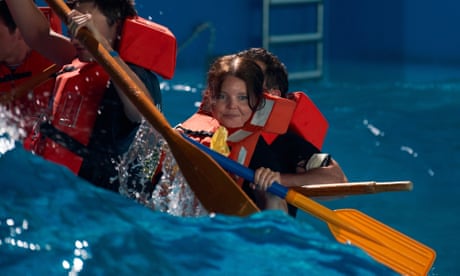
How an RNLI training pool gave me an insight into crossing Channel as a migrant
Read more
“Imagine being out of sight of land, running out of fuel, coming across incredibly busy shipping lanes when you’re frightened and you don’t know which direction you’re going in. That is by anyone’s standards distress. Our role in this is incredible important: simply to respond to a need to save lives,” said Mark Dowie, the chief executive of the RNLI.
Dowie’s comments came as the government prepared to enact its controversial borders and nationality bill, which aims to reduce the numbers of crossings by criminalising migrants who attempt illegal routes into the UK rather than entering via settlement schemes.
While the charity does not take a stance on political matters, Dowie said: “These islands have the reputation for doing the right thing and being decent societies, and we should be very proud of the work we’re doing to bring these people home safe.”
The RNLI’s work rescuing migrants began five years ago, but has greatly increased over the past two years across nine sites stretching between Margate in Kent and Eastbourne in east Sussex. In recent months, volunteers have observed an increase in larger boats, sometimes of up to 50 people, which are even more precarious than smaller vessels.
This reflects the rapid growth in the number of migrants attempting the dangerous crossing this year. Last week, the number of people who had crossed to the UK so far this year reached 8,452, which exceeded the figure for the whole of 2020, when 8,417 people made the trip. A further 600 were intercepted as they made the journey over the weekend.
The RNLI is looking to promote empathy and understanding among the British public with respect to migrants crossing the Channel following criticism on social media of its humanitarian work after the it was included in a Daily Mail article that claimed to reveal “migration madness”.
Dowie said he had spoken to crew members who shared “harrowing” details of “an appalling melting pot of possible risks” to understand the plight facing migrants and wanted to share these more widely. “I understand it’s a polarising and complex situation,” he said. “But unless you’ve experienced being in an open boat in the waves, it’s quite hard to get a feel for what it must be like.”
Anonymised testimonies from crew members released by the RNLI shed light on the dangerous situations for migrants. These include people lost in the ocean for 30 hours in -2C (28.4F) temperatures in January, families suffering from severe heatstroke and sea sickness on sweltering summer days, people travelling on unseaworthy vessels such as inflatable dinghies, sailing catamarans and canoes, or sometimes floating on the broken remnants of boats without any lifejackets, hoping to be saved.
One volunteer described an especially harrowing encounter: “They’d paddled this thing about 80% of the way across the Channel and they’d been doing this all night. They’d made it into the middle of the shipping lane, and they were just so exhausted they couldn’t go on and they had nothing left and they’d stopped. When we got there, they were so tired they hardly reacted to us.”
Other volunteers shared experiences of “vile abuse” on the beach as they returned with people, including young children, in desperate need of medical attention, such as having beer cans thrown at them and people shouting “fuck off back to France”.
RNLI crew members are mostly volunteers and wake up in the middle of the night or leave their regular jobs to rescue people in distress in the sea. Once they return with migrants, they ensure they are safe and well before handing them over to the police and border control officers.
Dowie stressed that the RNLI’s role was solely to save lives, not to act as an additional border control force.
While there had been “strong demand” for the RNLI’s service given the increase in the popularity of British seaside holidays, the charity had the resilience to cope, Dowie said, although he added that it was always trying to recruit more volunteers.
RNLI Hits Back at ‘Migrant Taxi Service’ Accusations as Channel Rescue Row Intensifies
The Royal National Lifeboat Institution has renewed its defence of its lifesaving work after facing accusations that it is acting as a “migrant taxi service” for people attempting to cross the English Channel in small boats. The charity insists that its mission is to rescue people in danger at sea, not to facilitate illegal immigration, and says its volunteers will continue responding whenever the coastguard calls upon them.
The dispute has become increasingly heated as the political debate over immigration intensifies across Britain. Recent protests, hostile online messages and allegations against lifeboat crews have placed the organisation under pressure, forcing it to defend both its operational role and the safety of its volunteers.
In a statement issued on 8 September 2026, RNLI chief executive Peter Sparkes said the charity remained independent of government and would continue rescuing people without discrimination. He also warned that misinformation about its work had contributed to abuse directed at staff, volunteers and their families. <Cite refs={[“turn859096search1″,”turn859096search6”]}/>
For the RNLI, the central issue is straightforward: when people are at risk of drowning, rescue teams must respond. Critics, however, argue that the consequences of rescuing people who have departed for Britain in small boats must be considered alongside the humanitarian obligation to save lives.
The disagreement reflects a wider national debate about immigration, border enforcement and the responsibilities of organisations operating in the English Channel.
Why Has the RNLI Faced Accusations of Being a ‘Migrant Taxi Service’?
The phrase “migrant taxi service” has repeatedly been used by critics who believe that rescuing people crossing the Channel encourages further attempts to reach Britain.
Some opponents argue that the knowledge that rescue services may intervene reduces the perceived risks of making the crossing. Others believe that humanitarian organisations should do more to avoid actions that they consider could indirectly assist people entering the country through unauthorised routes.
The RNLI strongly rejects the description.
Its position is that it does not organise migrant journeys, transport people as part of an immigration scheme or decide who should be allowed to enter the United Kingdom. Instead, its lifeboats respond to maritime emergencies when tasked by HM Coastguard.
The charity’s crews are trained to deal with dangerous conditions, including sinking or overcrowded vessels, exhausted passengers, severe weather and the risks created by busy shipping lanes.
A small boat that appears to be making progress can quickly become unsafe. Engine failure, a damaged hull, overcrowding or changing weather conditions can leave passengers vulnerable to drowning.
From the RNLI’s perspective, the question confronting a rescue crew is whether people are in danger and require assistance. Immigration enforcement is handled by the appropriate authorities after a rescue, rather than by volunteers making decisions about the legal status of those they find at sea.
This distinction lies at the heart of the dispute. The charity says its role is lifesaving; critics want the government to address the wider consequences of small-boat crossings through border policy and enforcement.
The RNLI Says Its Primary Mission Is Saving Lives
The RNLI has operated lifeboat services around the coasts of the United Kingdom and Ireland for more than two centuries. Its work includes responding to emergencies involving recreational sailors, fishermen, swimmers, paddleboarders and other people who encounter difficulties on the water.
Rescues involving people crossing the Channel are only one part of that work.
According to figures published by the RNLI, its lifeboats were launched 9,058 times during 2025. Of those launches, 109 involved small boats in distress in the Channel, representing approximately 1.2 per cent of its total launches that year. The charity also reported that 94.3 per cent of the 41,472 people recorded as crossing the Channel in small boats during 2025 were assisted by other agencies, including Border Force. <Cite refs={[“turn859096search1″,”turn859096search3”]}/>
These figures are important because they provide context for claims that migrant rescues define the organisation’s overall work.
The RNLI argues that its volunteers should not be judged solely on the basis of one politically contentious category of rescue. Its lifeboat crews face dangerous conditions wherever emergencies occur, and their responsibility to save lives does not disappear because a person is travelling on an irregular migration route.
The organisation also stresses that rescued people are handed over to the appropriate authorities. Depending on the circumstances, this may involve Border Force, the police or ambulance services.
The charity does not determine asylum applications or make decisions about whether someone should be permitted to remain in Britain.
Those decisions belong to the relevant government authorities.
Channel Crossings Remain a Dangerous Challenge
The English Channel is one of the world’s busiest shipping routes. Its waters can be unpredictable, and small inflatable boats are poorly equipped to withstand changing conditions.
People attempting crossings may face cold water, exhaustion, overcrowding and mechanical failures. A vessel can become unstable when passengers move around, while an engine problem can leave people drifting into dangerous areas.
The danger is not limited to extreme weather. Even relatively calm conditions can become hazardous when small boats encounter commercial shipping or lose the ability to navigate safely.
For rescue crews, these circumstances can require rapid decisions. Delaying assistance while attempting to establish the immigration status of everyone aboard would be incompatible with the RNLI’s stated lifesaving mission.
The charity maintains that the coastguard coordinates the response and determines when lifeboat crews are needed.
The wider political argument, meanwhile, concerns how to prevent dangerous crossings from taking place in the first place. That question involves government policy, international cooperation, action against people-smuggling networks and the processing of migrants who arrive in Britain.
The RNLI says those policy questions should not be confused with its immediate responsibility to protect human life.
Volunteers Face Growing Hostility
The dispute has become more serious because of reports of intimidation and abuse directed at RNLI personnel.
In September 2026, protests against small-boat arrivals in Portsmouth and Dover generated renewed criticism of the charity. Some volunteers were accused online of helping migrants enter Britain, while images of personnel were circulated alongside hostile commentary.
The RNLI said its people had been subjected to misinformation, threats and, in some cases, physical abuse. The charity also reported baseless rumours that it housed asylum seekers on its premises or operated missions to transport migrants to secret locations. <Cite refs={[“turn859096search1″,”turn859096search5″,”turn859096search6”]}/>
Such claims can have consequences beyond reputational damage. Volunteers may become concerned about being recognised in public, while their families can also be affected by online harassment.
The charity has advised volunteers to consider removing visible RNLI branding in situations where doing so could help protect their safety. It has also reviewed security arrangements amid concerns about protests and the circulation of personal information. <Cite refs={[“turn859096search4″,”turn859096search6”]}/>
For an organisation that depends heavily on volunteers, the possibility of intimidation creates a serious operational concern. Lifeboat crews give their time to emergency response, often leaving their homes or workplaces at short notice.
If volunteers fear harassment simply because they have performed a rescue, the consequences may extend beyond the individuals involved.
The RNLI has therefore called for a distinction between legitimate debate about immigration policy and attacks on people carrying out lifesaving work.
The Political Debate Over Immigration
The controversy has also drawn attention from politicians and campaigners who disagree sharply about Britain’s approach to irregular migration.
Critics of current policy argue that the government must do more to deter crossings, disrupt smuggling operations and ensure that immigration rules are enforced. Some believe that the involvement of rescue organisations should be examined as part of the wider system.
Supporters of the RNLI respond that lifesaving services cannot abandon people in danger as a means of discouraging migration. They argue that border policy should be enforced by the state and that rescuers should not be expected to make political or immigration decisions during an emergency.
These positions address different parts of the problem. The need to enforce immigration law does not eliminate the danger faced by people at sea, while the obligation to rescue people does not resolve the government’s responsibility to manage borders.
A functioning system must address both concerns.
Authorities can investigate people-smuggling networks, pursue those responsible for organising dangerous crossings, cooperate with international partners and process arrivals under the law. At the same time, maritime rescue crews can continue responding to emergencies without determining the immigration status of those involved.
Keeping these responsibilities distinct allows emergency services to concentrate on immediate risks while leaving enforcement decisions to the agencies legally responsible for them.
Is the RNLI Encouraging More Crossings?
One of the central arguments made by critics is that the availability of rescue services could encourage people to attempt the crossing.
The RNLI disputes the suggestion that it operates as a transport service. Its published explanation makes clear that lifeboats are deployed to assist people in difficulty, rather than to provide a planned journey to Britain. <Cite refs={[“turn859096search3″,”turn859096search7”]}/>
Whether the presence of rescue services affects an individual’s decision to attempt a crossing is a separate question that requires evidence. It cannot be established simply by pointing to the fact that a rescue took place.
People may attempt dangerous journeys for a range of reasons, including conflict, persecution, family connections, economic circumstances and the influence of smuggling networks. The motivations and circumstances vary, and the reasons for crossing should not be assumed to be identical for everyone.
Likewise, the fact that someone is rescued does not determine whether they have a legal right to remain in the United Kingdom. That question must be assessed through the relevant immigration and asylum procedures.
The practical priority during a maritime emergency is preventing deaths. Longer-term decisions about entry, asylum and removal belong to the authorities responsible for immigration policy.
A serious debate about deterrence should therefore examine the evidence about what drives crossings and which policies can reduce dangerous journeys, rather than treating the actions of rescue volunteers as proof of a particular political argument.
The Humanitarian Principle Behind Maritime Rescue
The RNLI’s position is rooted in the principle that people in immediate danger at sea should receive assistance regardless of their background.
That principle applies to a wide range of emergencies. A sailor whose vessel has broken down, a swimmer caught in strong currents and a passenger aboard an unseaworthy migrant boat may have very different reasons for being on the water, but all can face the risk of drowning.
Rescue crews are expected to respond to the emergency rather than make judgments about whether the person involved deserves help.
This does not mean that immigration law should be ignored. Once people have been brought to safety, the appropriate authorities can establish their identities, determine the circumstances of their arrival and apply the relevant legal procedures.
The distinction between rescue and immigration enforcement is therefore central to understanding the RNLI’s role.
The charity is not claiming that every Channel crossing is lawful or that the government should abandon efforts to control irregular migration. Its argument is that those issues must be addressed without compromising the basic duty to save lives.
What Happens Next?
The RNLI is likely to remain part of the public debate for as long as small-boat crossings continue to generate political controversy.
The charity has made clear that it will continue responding to coastguard requests and that it intends to protect its volunteers from intimidation. Its leadership has also called for the public to recognise the difference between legitimate disagreement over immigration policy and misinformation about the organisation’s activities.
The government faces a separate challenge: developing an effective response to irregular migration while maintaining the safety of people in British waters.
That involves several questions. How can dangerous crossings be reduced? How can people-smuggling networks be disrupted? How can asylum claims be processed fairly and efficiently? And how can authorities ensure that public debate does not expose emergency workers to threats?
No single organisation can resolve all these issues. The RNLI can provide maritime rescue, but it cannot substitute for immigration enforcement, international diplomacy or a comprehensive asylum system.
Similarly, criticism of government policy should not automatically be directed at volunteers who have responded to an emergency.
Conclusion: A Rescue Service at the Centre of a National Argument
The RNLI’s rejection of the “migrant taxi service” accusation highlights a growing tension between humanitarian rescue and the politics of immigration.
The charity says its crews respond when the coastguard tasks them to help people in danger, regardless of nationality or immigration status. Its published figures show that Channel small-boat rescues accounted for a small proportion of its total lifeboat launches in 2025, while other agencies assisted the overwhelming majority of people recorded crossing in small boats that year.
Critics continue to raise concerns about deterrence and the consequences of irregular migration. Those concerns form part of a wider political debate, but they do not change the immediate dangers posed by an unseaworthy vessel in busy shipping lanes.
The challenge for Britain is to address border security and dangerous crossings without undermining the principle that people in imminent danger at sea should be rescued.
For the RNLI, the message remains clear: its volunteers are there to save lives, not to decide immigration policy. The government must enforce the law, authorities must manage arrivals, and the charity will continue carrying out the lifesaving work for which it was established.
As the debate continues, the distinction between those responsibilities will remain central to any serious discussion of the Channel crisis.