
Andy Burnham Takes Lead Over Reform in New Makerfield By-Election Poll
Andy Burnham moved ahead of Reform UK in the final stages of the closely watched Makerfield by-election campaign, according to a new constituency poll that showed Labour’s candidate holding a five-point lead over his main challenger.
The polling put Greater Manchester Mayor Andy Burnham on 45%, compared with 40% for Reform UK’s Robert Kenyon. Restore Britain was on 8%, while the Greens, Conservatives and Liberal Democrats were all in single figures.
The figures offered a snapshot of voter intentions shortly before polling day. They did not, however, guarantee the eventual result.
The contest was being closely watched because Makerfield had become an unusual test of Labour’s support in a traditional northern stronghold, while Reform was seeking to build on its strong performance in local elections.
Burnham leads by five points
The poll, conducted by More in Common for the UCL Policy Lab, surveyed 515 adults living in the Makerfield constituency between 28 May and 12 June.
Among those asked about their voting intentions, Labour was on 45% and Reform UK on 40%.
Restore Britain, the party associated with Rupert Lowe, was on 8%, followed by the Greens on 3%, the Conservatives on 2% and the Liberal Democrats on 1%.
The poll also found that 13% of those intending to vote remained undecided about their choice.
That meant the race still contained a significant degree of uncertainty at the time the research was conducted.
Another poll produced a similar five-point gap.
Opinium’s research, carried out among 543 adults in Makerfield between 3 and 11 June, also put Burnham five points ahead of Kenyon among people considered at least 7 out of 10 likely to vote.
A close contest before polling day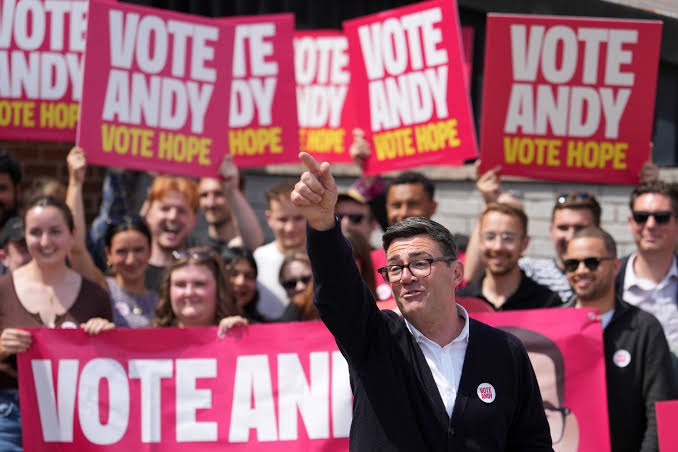
The polling represented a change from the broader political picture in Makerfield.
Survation’s earlier constituency poll, conducted between 18 and 22 May, had Burnham ahead by three points, with Labour on 43% and Reform on 40%.
That survey also showed Restore Britain on 7%.
The successive polls therefore showed Burnham holding a lead, but one that varied in size depending on the methodology and timing.
Full Fact noted that the by-election had been widely characterised as a close contest between Burnham and Reform’s Robert Kenyon, while the division of the non-Labour vote between Reform and Restore Britain had also attracted attention.
The polling should therefore be read as a series of measurements rather than as a definitive prediction.
Why Makerfield attracted so much attention
The by-election followed the resignation of Labour MP Josh Simons.
Burnham, who had previously represented the area in Parliament before becoming Greater Manchester mayor, entered the contest as Labour’s candidate.
His return to Westminster attracted unusually intense national interest because of his senior position in Labour politics and the wider uncertainty surrounding the party’s leadership at the time.
Reform UK, meanwhile, selected Wigan councillor Robert Kenyon.
The party had made substantial gains in local elections earlier in the year and was attempting to translate that support into a parliamentary victory.
Reuters reported before polling day that Reform had won 24 of 25 council seats in the area in May, adding to the significance attached to the contest.
Burnham’s personal vote
One of the most notable findings from the polling was the difference between support for Burnham personally and support for Labour in a more general question.
Survation found that Burnham was on 43%, compared with 40% for Kenyon, while Reform led Labour by 11 points when respondents were asked about their general Westminster voting intention rather than the by-election candidates.
The researchers described this as evidence of a potential personal-vote effect for Burnham.
The UCL/More in Common poll also found Burnham had a positive net favourability rating in the constituency.
Forty-four percent viewed him favourably, compared with 36% unfavourably, giving him a net rating of +7.
By comparison, 13% viewed then-Prime Minister Keir Starmer favourably and 61% unfavourably, while both Nigel Farage and Robert Kenyon had negative net ratings in the survey.
These figures suggested that the by-election was not simply a straightforward test of national party support.
The candidates themselves mattered.
Reform’s challenge
For Reform UK, the constituency presented both an opportunity and a challenge.
The party had increased its support considerably in the area compared with the 2024 general election.
But the presence of Restore Britain created another potential division among voters opposed to Labour.
The UCL poll put Restore Britain on 8%.
Opinium’s research similarly suggested that Restore Britain could affect the contest by taking votes from candidates on the right of Labour.
This was one of the central features of the campaign.
Instead of a simple two-party contest, voters had several competing choices.
That meant the final distribution of votes could not be determined simply by comparing Labour and Reform’s national polling numbers.
Immigration and the cost of living
The constituency polling also provided information about the issues voters considered important.
The UCL/More in Common survey found that the cost of living and the economy were the most frequently selected issues when residents were asked what politicians should address to demonstrate that they respected voters.
Forty-three percent selected the cost of living or economy.
Immigration and asylum seekers followed at 35%, while 29% selected the NHS and healthcare.
Crime and public safety and taxation were each selected by 16%.
The findings illustrated that the contest involved more than the personalities of Burnham and Kenyon.
Economic concerns, public services and immigration were all part of the political discussion.
A constituency with Labour roots
Makerfield has traditionally been a Labour-held area.
That history made the contest particularly significant for both parties.
For Labour, retaining the seat would preserve a parliamentary presence in an area closely associated with the party.
For Reform, winning would demonstrate that the party could convert its broader electoral growth into a Westminster seat in a constituency where Labour had historically been dominant.
The campaign therefore attracted considerable national media attention.
Reuters described the contest as one of unusual political importance, partly because Burnham’s return to Parliament could have implications for Labour’s leadership.
Polls are not results
The five-point lead reported by the UCL poll needs to be understood in context.
Polling measures the opinions of a sample at a particular point in time.
It can be affected by sampling, turnout assumptions, undecided voters and changes in opinion between fieldwork and polling day.
The UCL survey was conducted between 28 May and 12 June, meaning that some voters had more than a week to change their minds before the 18 June election.
Opinium’s fieldwork ended on 11 June, while Survation’s poll was conducted even earlier.
Consequently, the polls provided evidence about the campaign but could not establish the final result in advance.
The eventual result
The final result subsequently showed a larger Labour lead than the pre-election polls had recorded.
According to Parliament’s official result, Burnham won 24,927 votes, or 54.8%, while Reform’s Robert Kenyon received 15,696 votes, or 34.5%.
Burnham’s majority was 9,231 votes.
Turnout was 58.7%, with 77,462 people registered to vote.
Restore Britain finished third with 3,111 votes, or 6.8%.
The Conservatives received 997 votes, while the Greens received 308 and the Liberal Democrats 163.
The final figures therefore differed substantially from the polling conducted earlier in the campaign.
What the polls told voters at the time
The importance of the polling was not that it could determine the winner.
Instead, it showed how competitive the contest appeared during the final week.
Three separate polling exercises — Survation, UCL/More in Common and Opinium — all placed Burnham ahead of Reform, although the size of the reported lead varied.
Survation recorded a three-point advantage.
UCL/More in Common recorded five points.
Opinium also recorded five points among its likely-voter measure.
The consistency of the direction of those polls was notable, but the final margin could not be inferred from them with certainty.
Why the result mattered beyond Makerfield
The contest became more than an ordinary by-election because of Burnham’s political position.
He was not simply a first-time candidate seeking a parliamentary seat.
He was the serving mayor of Greater Manchester and a prominent Labour politician returning to Westminster.
The result therefore generated national attention beyond the constituency itself.
Following his victory, YouGov reported that Burnham’s public favourability rating rose to a net -4 in its June polling, although the survey was conducted largely before Keir Starmer’s resignation and therefore did not measure the effect of that subsequent event.
The political consequences consequently extended beyond the individual constituency.
A snapshot of Britain’s changing political landscape
Makerfield also illustrated the fragmentation of British electoral politics.
Labour remained capable of winning strongly in a constituency where it had deep historical roots.
At the same time, Reform had become a significant competitor, while smaller parties such as Restore Britain were capable of attracting several thousand votes.
The 2026 contest therefore demonstrated why constituency-level elections can produce very different patterns from national voting-intention surveys.
Local candidates, turnout, campaign organisation and the distribution of votes between several challengers can all affect the result.
The key takeaway
The headline that Andy Burnham had “taken the lead” over Reform was accurate as a description of the polling available before the election, but it should not be confused with the eventual result.
The UCL/More in Common poll put Burnham at 45% and Reform at 40%, while Opinium also recorded a five-point Labour lead.
The actual vote on 18 June produced a considerably larger Labour lead, with Burnham winning 54.8% against Kenyon’s 34.5%.
The Makerfield contest therefore provides a useful example of the difference between polling snapshots and election results.
The polls showed a close race during the campaign.
The ballot ultimately produced a clear Labour victory and returned Andy Burnham to the House of Commons.