
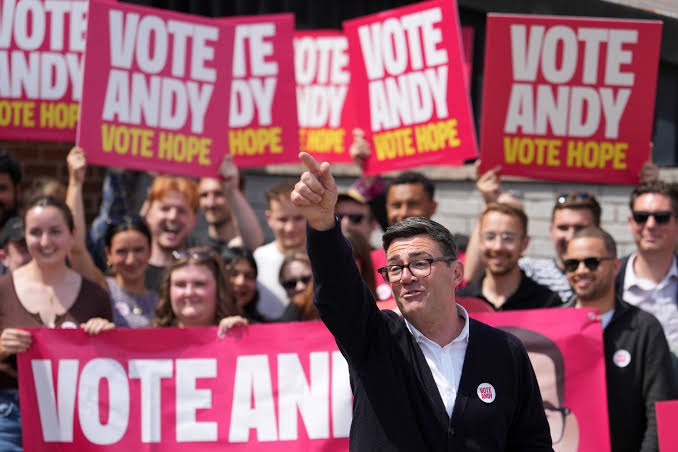
 Andy Burnham Takes Lead Over Reform in New Makerfield By-Election Poll
Andy Burnham has moved into a narrow lead over Reform UK in a new poll conducted in the Makerfield constituency, providing a closely watched snapshot of the race ahead of the June 2026 by-election.
The polling placed the Labour and Co-operative candidate on 43 per cent, compared with 40 per cent for Reform UK candidate Robert Kenyon. Rebecca Shepherd, representing Rupert Lowe’s Restore Britain, was on 7 per cent, while the Liberal Democrats, Greens and Conservatives were further behind.
The figures came from a Survation telephone poll of 504 adults living in Makerfield, conducted between 18 and 22 May 2026 on behalf of Election Data Ltd. The voting-intention figures were based on respondents considered likely to vote, with undecided and refused responses removed.
Although Burnham’s three-point advantage was relatively small, the poll attracted considerable attention because Makerfield was expected to be one of the most closely watched parliamentary contests of the year. The constituency had become a significant test of Labour’s position among working-class voters and of Reform UK’s ability to translate its national support into a parliamentary seat.
A close contest between Labour and Reform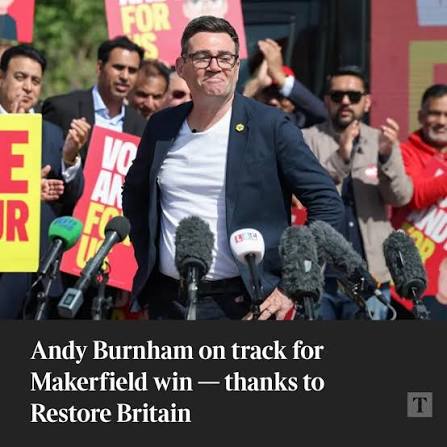
The Survation poll suggested that the contest was primarily developing into a battle between Labour and Reform UK.
Burnham’s 43 per cent represented a narrow lead, but the figures also demonstrated the strength of Reform’s challenge. Kenyon was only three percentage points behind, meaning that relatively modest changes in voter preferences or turnout could potentially have a substantial effect on the final result.
The poll also showed that Reform was performing particularly strongly among voters aged between 35 and 54. At the same time, Burnham appeared to retain substantial support among people who had voted Labour at the 2024 general election.
According to Survation, 83 per cent of Labour’s 2024 voters said they would support Burnham again, while 12 per cent were switching to Reform. Among Reform’s 2024 voters, 82 per cent remained with Kenyon, while 13 per cent were moving towards Restore Britain.
These figures illustrate why the Makerfield contest attracted attention beyond the constituency itself. It was not simply a question of whether Labour could retain a traditionally Labour seat. It was also an indication of how much Reform UK could expand its support in areas where the party had made significant gains.
Burnham’s personal vote
One of the central themes emerging from the polling was the difference between support for Burnham personally and support for Labour as a national party.
Survation’s research found that Burnham was ahead in the constituency even though Reform UK held an advantage when voters were asked about their general Westminster voting intention. According to the poll, Reform led Labour by 11 points on that broader question.
That distinction suggested that Burnham’s political profile could have an important influence on the contest.
The Greater Manchester mayor was already a nationally recognised Labour politician before entering the by-election. His political career included several years as a Labour cabinet minister and more than a decade as mayor of Greater Manchester.
His decision to contest Makerfield therefore generated significant attention. Supporters presented his candidacy as an opportunity for a prominent Labour politician to return to Parliament, while the campaign also became a test of whether his personal popularity could withstand a strong Reform challenge.
Later polling reinforced the idea that Burnham was performing differently from Labour’s national position.
A More in Common and UCL Policy Lab survey published in June put Burnham on 45 per cent, compared with 40 per cent for Kenyon, while Restore Britain stood at 8 per cent.
That survey also found a substantial difference between views of Burnham and views of Labour’s then national leadership. Burnham recorded a net favourability rating of plus 7 in the constituency, while Keir Starmer’s net favourability rating was minus 48 in the same research.
The findings indicated that some voters could distinguish between their views of individual politicians and their views of political parties.
Reform’s challenge
For Reform UK, Makerfield represented an opportunity to demonstrate that the party’s growing support could translate into success in a constituency with a long Labour history.
The party selected Robert Kenyon, a Wigan councillor, as its candidate. Reform had performed strongly in the constituency’s local elections, adding to expectations that the by-election could become a serious contest.
The first Survation poll nevertheless showed that Reform’s national support did not automatically translate into a lead over Burnham.
The figures also highlighted the importance of vote distribution. While Reform had significant support, other parties competing for voters outside the Labour-Reform contest could affect the final outcome.
Restore Britain, associated with Rupert Lowe, entered the contest with Rebecca Shepherd as its candidate. Although the party’s 7 per cent in the Survation poll was well below the two leading candidates, its presence added another variable to an already competitive election.
The possibility of competition between Reform and Restore Britain was therefore an important feature of the campaign.
Other parties remain in the race
The Survation survey put the Liberal Democrats on 4 per cent, the Greens on 3 per cent and the Conservatives on 2 per cent.
These figures were considerably below the shares recorded by Labour and Reform, but smaller parties could still have an influence if their voters changed preferences as polling day approached.
The importance of these voters became even clearer in subsequent research.
An Opinium poll conducted between 3 and 11 June found Burnham on 46 per cent, with Reform on 41 per cent and Restore Britain on 7 per cent. Opinium described Burnham as having a narrow lead while also noting that voters who had previously supported smaller parties appeared to be moving towards Labour in the by-election.
This pattern helped explain how Burnham could lead despite Labour facing challenges in the wider political environment.
A changing political landscape
Makerfield’s political significance also reflected broader changes in British politics.
The constituency has traditionally been associated with Labour. However, the rise of Reform UK has complicated the traditional political map in many working-class and post-industrial areas.
At the 2024 general election, Labour won Makerfield with 45.2 per cent of the vote, while Reform UK received 31.8 per cent, according to constituency data compiled by PollCheck.
The relatively strong Reform performance in 2024 provided the basis for expectations of a competitive by-election.
At the same time, the contest was taking place against a backdrop of significant public debate about immigration, the cost of living, public services, taxation, Brexit and the future direction of Britain’s economy.
Those issues were particularly relevant in Makerfield, where many voters had concerns about household finances and the future of communities affected by industrial decline.
Why the poll matters
The three-point Survation lead should not be interpreted as a definitive prediction of the result.
Polling samples are subject to uncertainty, and a constituency survey involving several hundred respondents cannot perfectly measure the views of every voter. Turnout can also have a major effect on a by-election, particularly when the electorate is smaller than at a general election.
Survation’s subsequent polling showed that the balance could move during the campaign. Later surveys produced larger Labour leads, including figures showing Burnham ahead by five and, in one later constituency poll, by 12 points.
The variation between polls demonstrated that the race remained sensitive to methodology, fieldwork dates, turnout assumptions and changes in voter preference.
The polling therefore provided a snapshot rather than a guarantee.
The wider significance of Makerfield
Regardless of the final margin, the Makerfield contest became an important case study in Britain’s changing electoral politics.
For Labour, Burnham’s candidacy offered a test of whether a prominent individual politician could attract support in a constituency where Reform had established a substantial presence.
For Reform UK, the contest provided an opportunity to demonstrate whether its national rise could be converted into a parliamentary breakthrough in a traditionally Labour area.
The role of third parties also made the contest unusual. With Restore Britain attracting several percentage points in the published surveys, the distribution of non-Labour votes became an important part of the campaign discussion.
Ultimately, voters in Makerfield had to make their choice among a broad field of candidates, with Labour and Reform occupying the two leading positions in the published polling.
The subsequent result showed Burnham retaining the seat for Labour, and he is now listed as the constituency’s MP.
The polling that preceded the election nevertheless remains significant because it captured a moment when the outcome was far from certain. Burnham’s initial three-point lead over Reform illustrated both the strength of his personal political profile and the scale of Reform UK’s challenge.
More broadly, the Makerfield campaign demonstrated how Britain’s electoral contests are becoming increasingly competitive in areas once regarded as dependable territory for particular parties.
The combination of a well-known individual candidate, changing party loyalties and a strong Reform challenge ensured that Makerfield received national attention. The final result settled the immediate parliamentary contest, but the underlying political questions revealed by the polling — about working-class voters, party loyalty, personal popularity and the changing balance between Labour and Reform — are likely to remain important features of British politics.
