
Andy Burnham’s ‘EU Reset’ Torn Apart by Alex Burghart: ‘Completely Against the Referendum!’
Andy Burnham’s plans to reshape Britain’s relationship with the European Union have come under renewed attack from Conservative deputy leader Alex Burghart, who has accused Labour of moving the country back towards the EU framework rejected by voters in the 2016 referendum.
Burghart has argued that Labour’s approach risks tying Britain more closely to European rules while leaving the country outside the institutions where those rules are made. He described the direction of travel as being fundamentally at odds with the result of the Brexit referendum.
The criticism comes at a sensitive moment for Burnham’s government, as ministers attempt to revive negotiations with Brussels while insisting that Labour’s existing Brexit red lines remain intact.
The argument over the so-called EU reset is therefore becoming increasingly complicated. Labour says it wants a closer and more practical relationship with Europe without reversing Brexit. The Conservatives, meanwhile, argue that some of the proposed arrangements could gradually increase Britain’s dependence on EU rules.
At the centre of the dispute is a fundamental disagreement over what Brexit should mean in practice.
Burghart challenges Labour over its European direction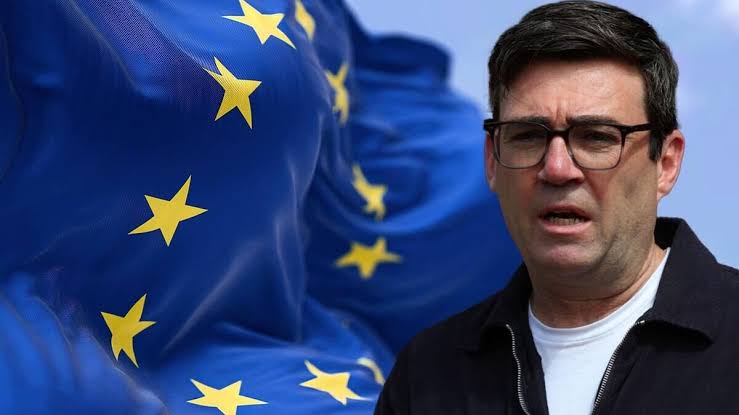
Speaking about Labour’s approach, Burghart claimed that the Government was pursuing closer alignment with the EU in areas ranging from regulation to legal oversight.
He questioned ministers in Parliament about whether Labour would explicitly rule out Britain eventually seeking to rejoin the European Union.
Foreign Office minister Hamish Falconer declined to commit the next Labour manifesto to such a promise, instead stressing that the Government was focused on improving the agreement inherited after Brexit.
Falconer told MPs that Labour remained committed to the red lines contained in its 2024 manifesto and did not intend to reopen the arguments of 2016.
Those red lines are significant.
The Labour manifesto pledged that the party would not return Britain to the EU single market or customs union and would not restore freedom of movement.
That means the Government’s stated objective is not formal re-entry into the EU’s economic structures, even while it seeks closer cooperation in selected areas.
Burghart, however, has argued that the distinction between cooperation and alignment deserves much closer scrutiny.
What does the “EU reset” actually involve?
The reset began under the previous Labour government and was designed to improve relations following years of tension after Brexit.
The programme includes proposals aimed at reducing trade barriers, strengthening security cooperation and improving opportunities for young people to live, work and study across Britain and Europe.
Among the areas under discussion are arrangements to simplify some food and agricultural trade, greater cooperation on emissions trading and a possible youth mobility programme.
The latter could allow people aged between 18 and 30 to travel, work, study or volunteer across the UK and EU under agreed conditions.
The Government presents these measures as practical attempts to remove unnecessary barriers created by the post-Brexit settlement.
Critics see a different risk.
Their concern is that regulatory cooperation could eventually become a process of Britain following EU standards without having a formal vote over how those standards are developed.
That is the argument behind Burghart’s warning that Britain could end up accepting European rules while remaining outside the European institutions.
The referendum remains at the heart of the argument
The political significance of the 2016 referendum continues to shape the debate.
The referendum produced a vote to leave the European Union, and Britain formally left in 2020.
For Conservatives who campaigned for Brexit, maintaining the ability to establish an independent regulatory and economic policy framework remains one of the central principles of leaving the EU.
Burghart has therefore framed Labour’s reset as a question of democratic legitimacy as well as economic policy.
His criticism is that voters were promised greater independence from EU institutions and that closer regulatory alignment could undermine that objective.
Labour’s response is that leaving the EU does not require Britain to minimise every form of cooperation with its nearest major trading bloc.
The Government argues that the post-Brexit relationship can be improved without returning to membership, the single market or the customs union.
That difference in interpretation is likely to remain at the centre of British politics for years.
The “Made in Europe” problem
The debate has become even more complicated because of the EU’s proposed “Made in Europe” legislation.
The measure, formally known as the Industrial Accelerator Act, is intended to strengthen European industry and reduce dependence on Chinese manufacturing.
However, the proposals could prioritise European suppliers in strategically important sectors, including areas such as cars and defence.
British officials are concerned that UK companies could be disadvantaged if British products are not treated as sufficiently European under the new framework.
This has created an unusual situation.
While Labour wants closer economic ties with Brussels, it is simultaneously demanding that Britain be protected from policies that could put British manufacturers at a disadvantage.
The issue has become one of the major obstacles to the next stage of the reset.
Reports indicate that the UK Government wants the “Made in Europe” legislation included in future negotiations before agreeing to a new summit date.
European governments are not united over the question of Britain’s participation.
Germany, the Netherlands, Italy and Poland have reportedly shown support for including Britain, while France has remained more cautious.
The disagreement illustrates one of the difficulties facing Burnham.
A closer relationship with the EU could provide opportunities for British exporters, but it can also expose Britain to European policy decisions over which the UK has no direct vote.
A reset facing delays
The timetable for the next UK-EU summit has already been disrupted.
A meeting originally expected earlier in the year was postponed following the change of prime minister. Another possible date in November has also come under pressure because of disagreements over the substance of the talks.
The “Made in Europe” issue is one of the reasons for the delay, alongside unresolved questions over youth mobility and other elements of the reset.
That creates an important test for Burnham’s government.
The Prime Minister wants to demonstrate that closer European cooperation can deliver tangible benefits without reopening the Brexit settlement.
At the same time, Brussels has its own priorities and may not be willing to accept every British request simply because London wants a closer relationship.
Youth mobility remains particularly sensitive
One of the most politically difficult elements is the proposed youth mobility scheme.
The idea has attracted interest because Brexit significantly reduced the ability of younger Britons to live and work across EU countries, while EU citizens also lost automatic rights to do the same in Britain.
However, negotiations have encountered disagreements over issues including visa numbers, tuition fees and healthcare charges.
EU countries have reportedly considered Britain’s proposed cap on youth visas too restrictive, while questions remain about whether European students would face higher fees and NHS charges.
For Labour, the scheme offers a potential way to rebuild some of the opportunities lost after Brexit without returning to freedom of movement.
For Brexit supporters, however, it raises another question: how far should Britain go in restoring mobility arrangements with the EU?
Again, the disagreement is not simply about economics. It is about the meaning of Brexit itself.
Labour insists the red lines remain
Despite Conservative criticism, the Government has repeatedly stated that its fundamental position has not changed.
Falconer has said Labour’s manifesto commitments remain in place, including the rejection of a return to the single market, customs union and freedom of movement.
Burnham’s government has therefore attempted to present the reset as an effort to improve the existing relationship rather than reverse Britain’s departure from the EU.
That distinction will be important if the Government eventually secures agreements with Brussels.
A closer trading relationship does not necessarily mean EU membership, and cooperation on individual programmes does not automatically recreate the pre-Brexit settlement.
However, Burghart’s criticism highlights a legitimate political question about how much regulatory alignment Britain is prepared to accept in exchange for easier access to European markets.
The Conservative alternative
The Conservatives have indicated that they would take a substantially different approach.
Burghart has argued that a future Conservative government would pursue a more independent regulatory framework rather than accept arrangements that increase Britain’s dependence on EU rules.
He has characterised Labour’s approach as leaving Britain caught between two systems: outside the EU but increasingly aligned with it.
That argument reflects a wider Conservative attempt to redefine Brexit as an opportunity for regulatory and economic divergence rather than simply a change in Britain’s constitutional relationship with Brussels.
Labour, by contrast, is attempting to make the post-Brexit relationship more functional while preserving the formal separation established by Brexit.
A debate that is far from settled
The clash between Burnham and Burghart ultimately reflects two competing interpretations of Britain’s future relationship with Europe.
Labour’s position is that Brexit has happened and should not be relitigated, but that Britain should still cooperate closely with its largest nearby economic and political partners.
The Conservative criticism is that some forms of cooperation can gradually develop into regulatory dependence, potentially weakening the independence that Brexit was intended to provide.
Neither side disputes the basic fact that Britain is outside the European Union. The disagreement is over what that independence should look like in practical terms.
For Burnham, the challenge will be proving that closer cooperation can deliver economic and diplomatic benefits without crossing Labour’s own stated red lines.
For Burghart and the Conservatives, the task is to demonstrate why greater separation from European rules would better serve Britain’s interests.
As negotiations continue, the “EU reset” is therefore likely to remain one of the most closely watched parts of Burnham’s premiership.
The argument is no longer simply about whether Britain should be closer to Europe. It is about how close is too close — and whether the practical advantages of cooperation can be achieved while preserving the political and regulatory independence created by Brexit.