

Shabana Mahmood should consider outlawing far-right group Patriot Platform under terrorism laws like Palestine Action, peers have been told.
Article continues below
Baroness Shami Chakrabarti said there is a risk of perceived double standards if similar action is not taken against the anti-migrant group led by Danny “Tommo” Thomas.
Article continues below
Balaclava-clad followers have brought chaos to Dover and Portsmouth this month, and Thomas has spoken about blockading sites housing asylum seekers. Labour peer Baroness Chakrabarti said in a Lord Speaker’s lecture that the government must look at proscribing the group as a terror organisation.
Article continues below
Hundreds of Palestine Action supporters have been arrested after the same action was taken against it in July 2025. Baroness Chakrabarti, a barrister and human rights activist who served as shadow attorney general from 2016 to 2020, said: “I maintain my view that the proscription of Palestine Action was a disproportionate and counterproductive mistake, given the breadth of that movement and the possibility of prosecuting the violent few rather than the peaceful many.
“That issue is of course pending before the Supreme Court. Still, I wonder whether it isn’t time to at least give consideration to the proscription of the so-called Patriot Platform after recent events on our south coast. That is if we, as legislators, are not to lose the public over inaction in the face of rising threats, and perceived double standards.”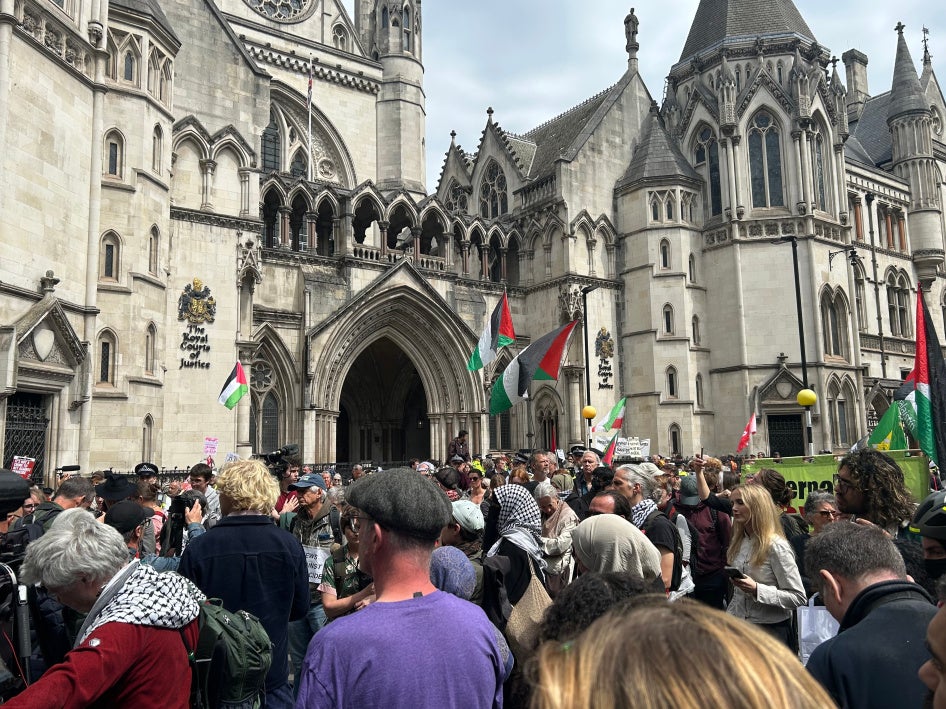
Patriot Platform sparked alarm earlier this month when a large group of masked men blocked the Port of Dover, claiming to be stopping small boat crossings. Thomas has indicated more such demonstrations are likely in the coming weeks and months, saying in an interview with fellow rabble rouser Tommy Robinson, real name Stephen Yaxley-Lennon: “I predict in the next six months, the Patriot Platform, with one message through a secure app, will be able to bring five to 10,000 people to a location within a matter of hours.”
And he hinted that Piddington in Oxfordshire could be targeted, with men camping for days around a former MoD site set to house more than 1,200 male asylum seekers.
Article continues below
The group’s actions have sparked calls for a blanket ban on face coverings. Under current law police can arrest people who wear coverings in a designated area during protests.
Baroness Chakrabarti said: “To be clear, I have spoken against the blanket banning of face coverings at protests. We must protect the immune compromised and those who reasonably fear repercussions when protesting outside the embassy of a repressive state or office of an abusive employer.
“Nonetheless, political uniforms in public were understandably banned by section 1 of the Public Order Act 1936. The year is pertinent.”
Article continues below
More than 3,000 people are believed to have been arrested for showing support for Palestine Action since it was proscribed. At one protest in April the Met Police arrested 523 aged between 16 and 87.
In June the Court of Appeal ruled that the government’s decision to proscribe Palestine Action as a terror organisatin was legal. Co-founder Huda Ammori has appealed the ruling to the Supreme Court.
The Home Office declined to comment.
Calls Grow to Ban Patriot Platform Under Terror Laws
Calls for the British government to consider banning Patriot Platform under terrorism legislation have intensified following a series of anti-immigration demonstrations in Dover and Portsmouth.
The proposal has been made by Shami Chakrabarti, the former director of civil rights organisation Liberty and a former Labour shadow attorney general. Her intervention is particularly notable because she previously criticised the government’s decision to proscribe Palestine Action under the Terrorism Act.
Chakrabarti has argued that the two cases should not be judged simply according to their political positions. Instead, she says the authorities should consider the behaviour of each organisation, including whether there is evidence of violence, intimidation or the intention to encourage such activity.
Her comments have opened a difficult debate about the limits of political protest, the use of counter-terrorism legislation and the growing presence of organised anti-immigration groups on Britain’s streets.
Who Is Patriot Platform?
Patriot Platform is a recently established anti-immigration organisation led by Daniel Thomas, widely known as Danny Tommo.
The organisation emerged from the bringing together of several local nationalist groups and became particularly visible during demonstrations in Dover and Portsmouth in September.
According to reporting by The Guardian, hundreds of masked and hooded demonstrators gathered during protests connected with the arrival of migrants and asylum seekers. In Dover, protesters blocked the A20, disrupting traffic travelling to and from the port.
The group has presented itself as a movement concerned with Britain’s borders, national identity and opposition to irregular migration.
Thomas has promoted the organisation as a disciplined movement rather than simply a loose collection of protesters.
However, its tactics have attracted significant criticism.
The use of masks, coordinated black clothing and road blockades has become a particular focus of concern among politicians and civil-rights campaigners.
The Dover Protests
The controversy intensified after demonstrations in Dover.
Dover is one of Britain’s most important international transport hubs, with large numbers of passengers and freight vehicles travelling through the port every day.
During the protest, groups of masked men wearing black clothing moved onto the A20 and blocked traffic.
National Highways reported significant congestion, with delays extending for several miles.
Protesters chanted slogans including “stop the boats” and “England till I die”.
Graffiti was also reportedly left outside a facility used to process people arriving in Britain.
Kent police described the demonstration as spontaneous and made no arrests at the event.
However, Labour MP Mike Tapp questioned that description, arguing that the organisation had appeared to coordinate its activities in advance.
The incident quickly became a national political issue.
The central question was no longer simply whether people opposed immigration.
It was whether organised groups should be permitted to use intimidation or disruption as a political tactic.
Portsmouth Adds to the Pressure
The situation developed further in Portsmouth.
Protesters gathered after asylum seekers arrived in the area following a Channel rescue operation.
The demonstrations resulted in confrontations between protesters, police and other groups.
Police reported incidents involving damage to vehicles and injuries to officers.
Patriot Platform’s involvement increased scrutiny of the organisation and its leadership.
The demonstrations also placed pressure on local emergency services.
The Royal National Lifeboat Institution temporarily suspended operations at its Portsmouth station after volunteers and staff were subjected to abuse and intimidation following the rescue of migrants.
The RNLI maintained that its role was to save people in danger at sea rather than enforce immigration policy.
The organisation has said that its crews respond when instructed by HM Coastguard and that their lifesaving responsibilities apply regardless of nationality or immigration status.
The controversy has therefore extended beyond political demonstrations to questions about whether emergency workers can perform their duties safely.
Chakrabarti’s Call for Consideration
Against this background, Chakrabarti has argued that the government should at least consider whether Patriot Platform meets the legal threshold for proscription.
Her argument is significant because she has previously opposed the use of terrorism legislation against Palestine Action.
Palestine Action was proscribed by the government in July 2025 under the Terrorism Act 2000.
The Home Office’s official list records Palestine Action among organisations proscribed under the legislation.
Chakrabarti has argued that she continues to regard the proscription of Palestine Action as disproportionate.
Nevertheless, she says that recent events involving Patriot Platform warrant consideration of the same legal mechanism.
She has distinguished the two organisations according to what she describes as their apparent conduct rather than their political ideology.
In her view, the question should be whether an organisation is involved in violence or intimidation and whether terrorism legislation is proportionate to the threat presented.
That distinction is at the heart of the debate.
What Does Proscription Mean?
Under the Terrorism Act 2000, the home secretary can proscribe an organisation if they reasonably believe it is concerned in terrorism and that proscription is proportionate.
Once an organisation is proscribed, membership and certain forms of support become criminal offences.
The consequences are therefore considerably more serious than those associated with ordinary restrictions on public demonstrations.
The government’s official guidance states that proscription is intended for organisations meeting the statutory definition of terrorism.
It is not simply a mechanism for banning organisations whose political views are controversial or unpopular.
That distinction is important in the Patriot Platform debate.
Opposition to immigration, even strongly expressed opposition, is not automatically terrorism.
Likewise, participation in a protest does not automatically turn an organisation into a terrorist organisation.
The legal threshold is considerably more specific.
The Palestine Action Comparison
The comparison with Palestine Action has become unavoidable because both cases involve arguments about the use of terrorism legislation against political organisations.
The government proscribed Palestine Action in July 2025.
The House of Commons Library notes that the organisation’s stated objective involved supporting Palestinian sovereignty through direct criminal action intended to halt the sale and export of military equipment to Israel.
The decision generated significant controversy.
Supporters of the government’s position argued that proscription was necessary to respond to criminal activity and deter further offences.
Critics argued that terrorism legislation was too broad a mechanism for dealing with politically motivated criminal damage and that individual offences could instead be prosecuted through ordinary criminal law.
The issue has subsequently become the subject of continuing legal and political debate.
Chakrabarti’s position is therefore unusual.
She is not arguing that Patriot Platform and Palestine Action are politically equivalent.
Rather, she is asking whether the government’s approach should be consistent when dealing with organisations accused of using or encouraging intimidation and violence.
The Government’s Position
The government has not announced that Patriot Platform will be proscribed.
Home Secretary Shabana Mahmood has instead emphasised that the government will use existing laws against criminal behaviour.
In a recent interview, Mahmood described Daniel Thomas as a far-right activist and warned that individuals who break the law would face its consequences.
She also stressed the importance of distinguishing between legitimate concerns within local communities and extremists who seek to exploit those concerns.
That distinction is politically important.
Communities can have genuine concerns about asylum accommodation, local services and migration.
People have a legal right to express those concerns peacefully.
The government’s position is that such legitimate debate should not be confused with intimidation, violence or criminal activity.
The Question of Far-Right Extremism
Patriot Platform’s activities have also prompted debate about the meaning of “far right”.
The label is used by journalists, campaigners and politicians to describe groups whose politics are associated with nationalism, anti-immigration activism or other forms of radical right-wing politics.
However, describing a group as far right does not itself establish that it has committed terrorism.
The more important legal questions concern specific actions and organisational behaviour.
Reports about Patriot Platform have highlighted masked demonstrations, road blockades, confrontations with police and threats of further protests.
Thomas has also previously been imprisoned for his involvement in an attempted kidnapping, according to reporting about his background.
These facts are relevant to assessments of the organisation and its leadership, but they do not by themselves establish the legal threshold for proscription.
That determination belongs to the government and, ultimately, the courts where decisions are challenged.
Links to Reform UK
The controversy has also become politically sensitive because of reported links between Patriot Platform supporters and people connected to Reform UK.
The Guardian reported that at least five Reform councillors had been members of a Facebook group linked to Patriot Platform.
The councillors were based in areas including Solihull, Gateshead and Kent.
Some subsequently distanced themselves from the group or denied any meaningful affiliation with Patriot Platform.
Reform leader Nigel Farage has previously criticised masked demonstrations and said that peaceful protest should be distinguished from intimidating or paramilitary-style activity.
The issue has nevertheless created internal political tension.
Reform is attempting to build support around tougher immigration policies while also maintaining a distinction between electoral politics and street-based activism.
The Patriot Platform controversy makes that distinction increasingly difficult to manage.
Freedom of Protest
Any proposal to ban a political organisation under terrorism legislation inevitably raises questions about freedom of expression and assembly.
Britain’s democratic system protects peaceful political activity.
People can oppose immigration.
They can campaign for stronger borders.
They can demonstrate against asylum accommodation.
They can criticise the government.
The legal boundaries become more complicated when protests involve intimidation, violence, criminal damage or deliberate obstruction.
Police forces therefore have powers to deal with unlawful behaviour without necessarily banning an entire organisation.
This is one reason why the question of proscription is so significant.
A ban represents a much broader intervention than arresting individuals who commit specific offences.
Why the Debate Matters
The argument over Patriot Platform comes at a time when Britain’s immigration debate has become increasingly confrontational.
Small-boat crossings have generated anger in coastal communities.
The government has sought to strengthen border enforcement while working with France.
Reform UK has called for substantially tougher measures.
Anti-immigration groups have organised demonstrations in places where asylum seekers have arrived or where accommodation has been proposed.
At the same time, counter-protests have emerged.
Police have been required to manage increasingly tense gatherings while protecting public order and allowing lawful protest.
The RNLI controversy demonstrates how these tensions can affect organisations that are not directly involved in immigration policy.
A lifesaving charity has found itself at the centre of a political dispute simply because its volunteers rescued people at sea.
The Risk of a Wider Confrontation
There is concern among authorities and campaigners that repeated demonstrations could lead to further confrontation.
Patriot Platform has indicated that it intends to continue campaigning.
Thomas has publicly called for supporters to mobilise around proposed asylum accommodation sites.
Mahmood has warned that the government will act if protesters break the law.
The authorities therefore face a difficult balancing act.
They must allow lawful political expression while preventing intimidation and disorder.
They must also determine whether existing criminal and public-order laws are sufficient or whether more serious measures are justified.
The Legal Threshold
Ultimately, the question of whether Patriot Platform could be proscribed cannot be determined simply by the political controversy surrounding the group.
The Terrorism Act contains a specific legal framework.
The government would have to establish that the statutory criteria were met and that proscription was proportionate.
That is different from deciding whether the organisation is offensive, extremist or politically unacceptable.
The distinction matters because terrorism legislation carries exceptionally serious consequences.
The House of Commons Library has noted that proscription has been described both as a powerful deterrent and as a tool for tackling lower-level support for terrorism, while critics have raised questions about its effectiveness and compatibility with the rule of law.
A Test for Britain’s Political System
The Patriot Platform controversy therefore presents a broader test for Britain’s approach to political extremism.
The government must decide how far existing laws can deal with disruptive demonstrations and alleged intimidation.
Civil-liberties advocates must consider how to protect peaceful political activity while responding to genuine threats.
Political parties must decide how closely they wish to associate themselves with street movements operating outside conventional electoral politics.
And police forces must maintain public order without appearing to suppress lawful political expression.
Chakrabarti’s intervention has brought those questions into sharper focus.
Her proposal does not establish that Patriot Platform legally qualifies as a terrorist organisation.
Instead, it asks whether the government should examine that possibility in light of the group’s recent activities.
For now, Patriot Platform remains a political organisation rather than a proscribed terrorist organisation under UK law.
The debate over whether that should change is likely to continue.
As Britain’s arguments over immigration become more heated, the central challenge will be maintaining a clear boundary between legitimate political dissent and unlawful intimidation.
Where that boundary should be drawn — and which legal tools should be used when it is crossed — will remain one of the most difficult questions facing British politics.