
Clacton By-Election Results LIVE: Nigel Farage Wins as Count Binface Surges Past 9,000 Vote
Nigel Farage has won the Clacton by-election, securing a decisive victory for Reform UK in a contest that quickly became one of the strangest and most closely watched parliamentary elections in recent British political history. Yet while Farage comfortably retained the seat, the extraordinary performance of Count Binface ensured that the result was far more colourful than a conventional victory for a major party leader.
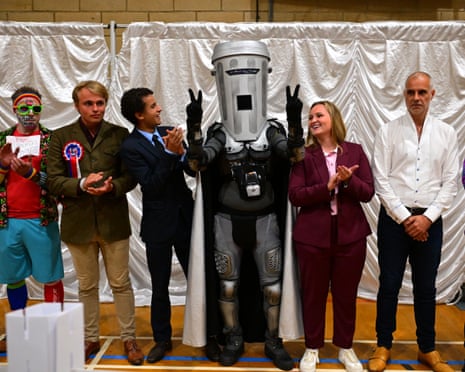
Farage received 22,239 votes, equivalent to around 63.3 per cent of the vote, while Count Binface finished second with an astonishing 9,455 votes, or approximately 26.9 per cent. Turnout was around 44 per cent, significantly below the 58.7 per cent recorded in the 2024 general election.
The result was unusual from the very beginning. Rather than facing the traditional Labour, Conservative, Liberal Democrat and Green challengers, Farage was effectively presented with an extraordinary field of candidates after the major Westminster parties decided not to contest the election.
That decision transformed what might normally have been a routine by-election into a national political spectacle.
A total of 34 candidates stood, producing the longest ballot paper in British by-election history. The election was widely criticised by Farage’s political opponents as a publicity exercise, while the Reform UK leader presented it as an opportunity to demonstrate the strength of his support in Clacton and challenge what he describes as the political establishment.
But perhaps the biggest surprise was the scale of support for Count Binface.
The satirical candidate, famous for appearing in a distinctive bin-shaped helmet, had initially been regarded largely as a novelty figure. Yet with the established political parties absent from the ballot, Binface succeeded in turning himself into the principal alternative to Farage.
His 9,455 votes represent an extraordinary result for a candidate whose campaign was deliberately built around political satire. Rather than simply disappearing into the list of independent candidates, he emerged as the clear runner-up.
The result is particularly striking because opinion polling before polling day had suggested that Farage would win by a much larger margin. One earlier Survation poll put the Reform leader at approximately 75 per cent, with Binface on around 20 per cent. The final result was therefore considerably closer than some expectations had suggested.
For Farage, the victory is undoubtedly significant.
He increased his raw vote from the 21,225 he received at the 2024 general election to 22,239 this time around. Parliament’s official record shows that Farage won the Clacton seat in 2024 with 21,225 votes, taking 46.2 per cent of the vote in a much more conventional contest against Conservative and Labour candidates.
However, the comparison also needs to be treated carefully.
In 2024, Farage faced genuine competition from established parties. This time, Labour, the Conservatives, the Liberal Democrats and Greens did not contest the seat. That meant the political environment was fundamentally different.
Consequently, while Farage’s increased vote total gives Reform UK plenty to celebrate, it cannot automatically be interpreted as evidence that his support has dramatically expanded among the wider electorate.
Indeed, the turnout figure provides another important part of the story.
Only around 44 per cent of eligible voters participated, compared with almost 59 per cent at the general election. That means millions of voters who participated in the previous contest did not return to the polls for the by-election.
For Reform UK, the task now will be to explain what the result actually means.
Farage is likely to present the victory as confirmation that voters in Clacton continue to support his political project. He has long argued that the constituency represents a particularly strong base for Reform’s message on immigration, national sovereignty and dissatisfaction with the traditional parties.
But his opponents will argue that the unusual circumstances make the result impossible to compare directly with a normal general election.
There is another reason why this by-election attracted such intense attention: Farage himself triggered it.
The Reform UK leader resigned his parliamentary seat in July, forcing voters back to the polls only a short time after the 2024 general election. His decision came amid continued controversy surrounding a £5 million gift from cryptocurrency billionaire Christopher Harborne and questions about whether the donation should have been declared differently. A parliamentary standards investigation is expected to continue following the election.
Farage has strongly defended himself and has argued that the money was connected to personal security and other expenses. However, the controversy has remained a major source of political pressure.
The by-election therefore became more than a contest for a parliamentary seat. It was also a referendum of sorts on Farage’s political standing and his response to the financial controversy.
His victory gives him an important political argument: Clacton voters had another opportunity to remove him and instead returned him to Parliament with a substantial majority.
But it does not automatically end the controversy.
The parliamentary investigation is separate from the electoral result. Even after winning, Farage remains subject to scrutiny over the allegations surrounding the gift. According to reports, the investigation is set to resume, meaning that the result may not be the final chapter in the story.
There was also controversy surrounding Farage’s absence from the count.
The Reform leader said he had received what he described as a credible threat and therefore did not attend the official declaration of the result. Reform defended the decision on security grounds. Essex Police, however, said it had not advised Farage to stay away from the count and reported no major incident on polling day.
That created another unusual feature of an already extraordinary election: the winning candidate was not present when his victory was formally announced.
Instead, the attention inside the count increasingly focused on the extraordinary performance of his satirical opponent.
Count Binface’s campaign was never expected to produce a conventional political breakthrough. His appeal was partly based on humour and protest, offering voters an opportunity to express dissatisfaction with the political system without supporting another established party.
In that sense, his 9,455 votes may be one of the most interesting statistics of the entire election.
A vote for Binface does not necessarily mean that 9,455 people literally wanted a satirical candidate to become their MP. Some may have been protesting against Farage. Others may have been expressing frustration with the absence of mainstream parties. Some may simply have wanted to participate in an unusual political moment.
Nevertheless, the number is too large to dismiss as a joke.
It demonstrates the extent to which voters can use elections to send messages to politicians. When traditional parties choose not to compete, the electorate does not necessarily become politically silent. Instead, voters can look for alternative ways to register their dissatisfaction.
The Clacton result therefore contains two very different stories.
The first is a clear victory for Farage and Reform UK. With more than 22,000 votes and over 60 per cent of the ballot, Farage remains firmly established as the dominant political figure in the constituency.
The second is the remarkable emergence of Count Binface as the leading challenger. His second-place finish has transformed him from a novelty candidate into one of the defining characters of the by-election.
For the established parties, the result should also provide food for thought.
Labour, the Conservatives and the Liberal Democrats may have decided that participating in what they regarded as a stunt would legitimise the contest. But their absence left the field almost entirely open to Farage and protest candidates.
That raises a difficult question: did boycotting the election actually weaken Farage’s position, or did it simply ensure that the Reform leader had no serious conventional opponent?
The answer will remain contested.
Farage will undoubtedly argue that the people of Clacton have spoken clearly. His opponents will point to the low turnout, the absence of mainstream parties and the extraordinary circumstances surrounding the election.
Both interpretations can coexist.
The most important long-term question is what happens next.
Farage returns to Parliament with his position strengthened in Clacton, but he still faces scrutiny over his finances and questions about the political value of the by-election. Meanwhile, Reform UK will need to demonstrate that the support shown in a highly unusual contest can be converted into sustained support in ordinary elections where Labour, Conservatives, Liberal Democrats and Greens are all competing.
Count Binface, meanwhile, has achieved far more than many expected.
His 9,455 votes are likely to become one of the most memorable statistics of the 2026 by-election cycle. In an election dominated by political controversy, boycotts, security claims and a record number of candidates, the satirical candidate managed to become the story almost as much as the winner.
Ultimately, the Clacton by-election has delivered a result that is both predictable and surprising.
Nigel Farage won — and won comfortably.
But he did not receive the overwhelming share of the vote that some polls had predicted, while Count Binface’s extraordinary second-place finish demonstrated that a large section of the electorate was prepared to use the election as an opportunity for protest.
The result may therefore strengthen Farage’s position in the short term, but it does not end the political arguments surrounding him.
If anything, the Clacton contest has ensured that the Reform UK leader returns to Westminster with renewed attention on his political future, his finances and the wider question of whether his party can translate its growing visibility into lasting electoral power.
For now, however, one fact is beyond dispute: Nigel Farage has won Clacton again — but Count Binface has made sure that nobody will remember this as an ordinary by-election.