

Count Binface: “I Am 1,000x More Popular Against Farage Than Against Burnham”
Count Binface has celebrated his remarkable performance in the Clacton by-election with a characteristically humorous claim: he is “1,000 times more popular” when running against Nigel Farage than when competing against Prime Minister Andy Burnham.
The satirical candidate, portrayed by comedian Jonathan Harvey, finished second in the Clacton contest with 9,455 votes, securing around 27% of the vote. Farage won the seat with 22,239 votes and more than 63%. Despite losing the election, Binface’s result represented by far his strongest performance in a parliamentary contest.
His comparison with Burnham came from a previous election campaign. Just weeks earlier, Binface had stood against Burnham in the Makerfield by-election, where he received only 95 votes, representing approximately 0.2% of the total. In Clacton, his vote increased to more than 9,000.
Strictly speaking, Binface’s calculation was exaggerated. His vote increased roughly 100-fold rather than 1,000-fold. But the joke captured the extraordinary difference between his two recent electoral performances.
The Clacton election was highly unusual. The major political parties decided not to contest the seat, leaving Farage to face a large collection of independent, fringe and novelty candidates. That created an unusual political environment in which Binface quickly emerged as the most prominent alternative to the Reform UK leader.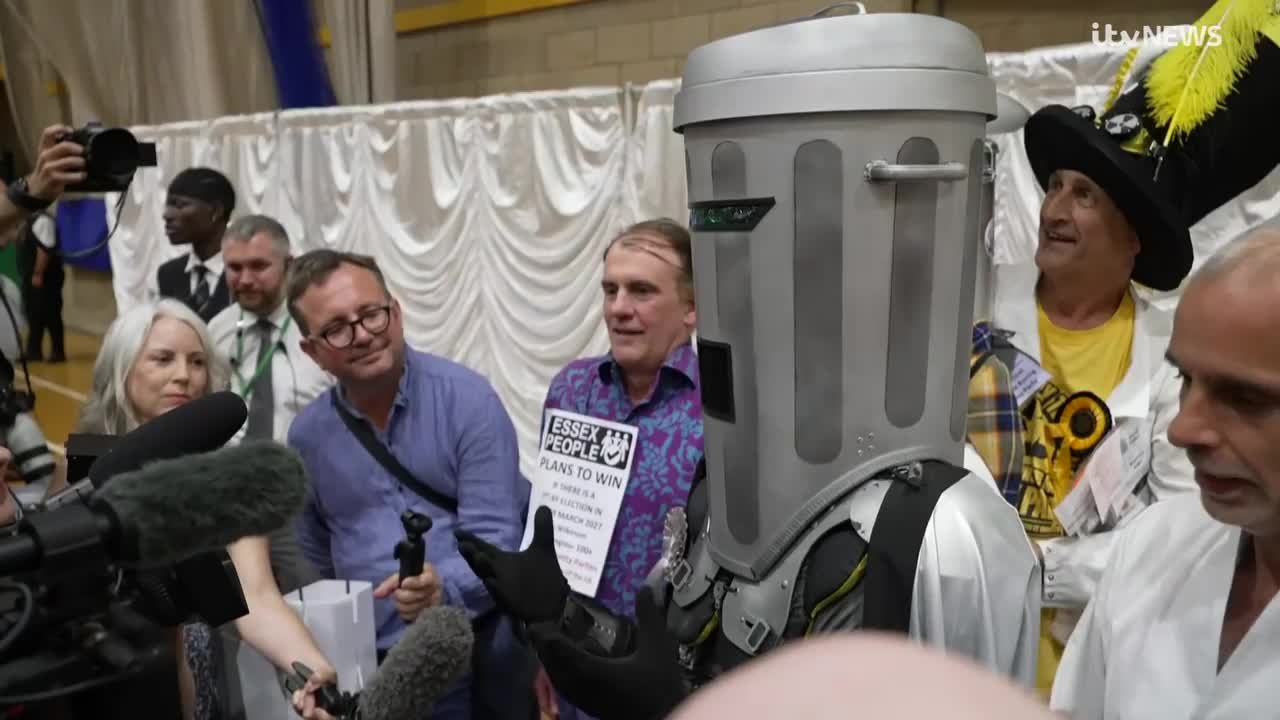
For Binface, the result was more than a joke. It demonstrated that protest candidates can attract significant support when voters are dissatisfied with conventional political choices. His campaign combined political satire with deliberately absurd policies, allowing him to present himself as an alternative to what he described as traditional political politics.
The candidate’s appearance is impossible to miss. Wearing a silver outfit and a helmet shaped like a rubbish bin, Binface presents himself as a 5,000-year-old space warrior from the planet Sigma IX. The character has become a familiar presence in British elections and has previously stood against major political figures.
His campaign against Farage was particularly effective because the political circumstances were unusual. Farage had resigned his Clacton seat and triggered the by-election himself, arguing that voters should have the opportunity to decide whether they wanted him back in Parliament. The major parties refused to participate, criticizing the election as a political stunt.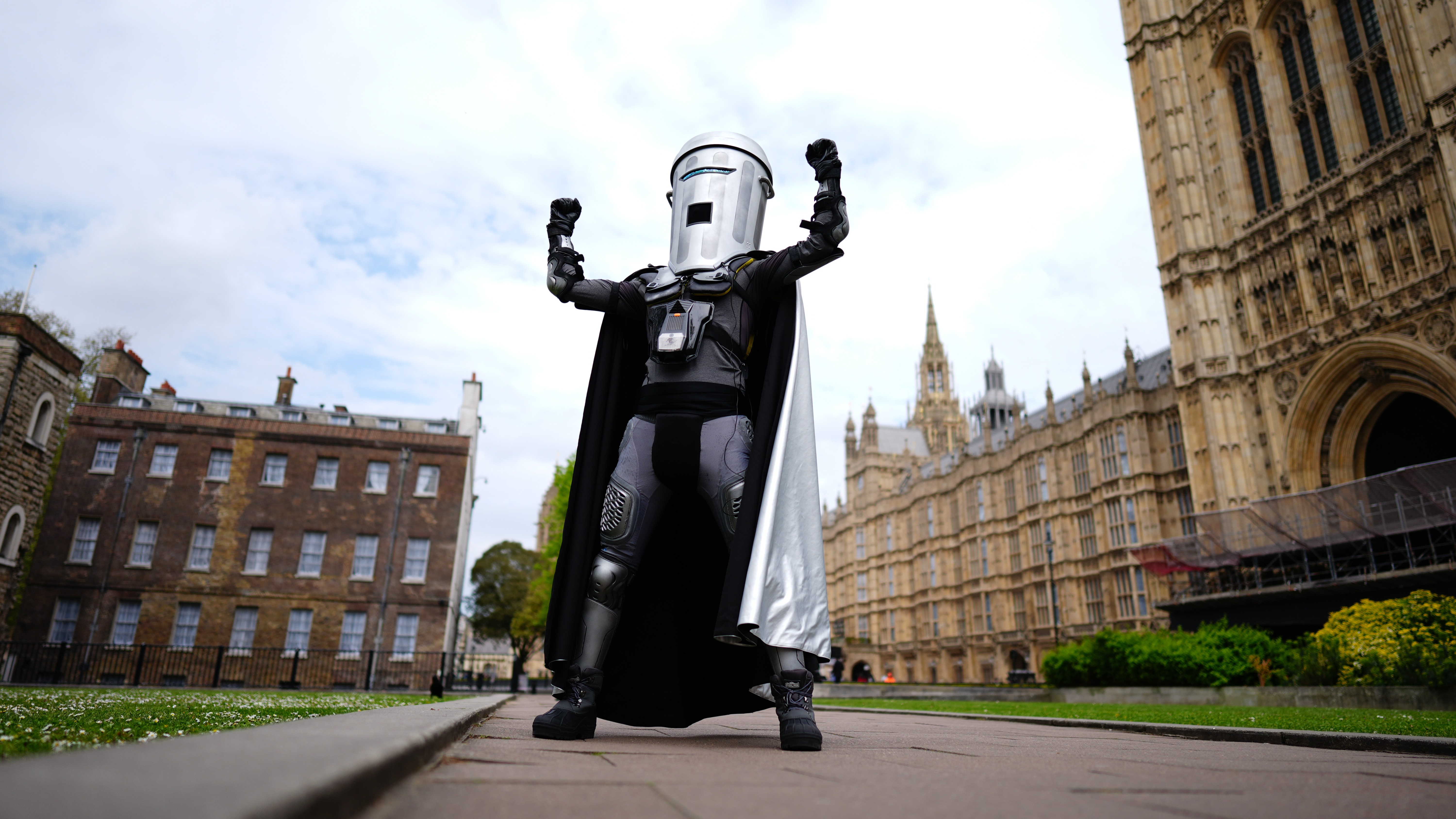
That decision inadvertently created an opportunity for Binface. With Labour, the Conservatives, Liberal Democrats and Greens absent, voters looking for an alternative to Reform UK had fewer conventional choices.
Binface appears to have understood that situation perfectly. Rather than attempting to compete with Farage on conventional political terms, he embraced satire and turned the election into a wider commentary on British politics.
His second-place finish was therefore symbolically important. A candidate who had received just 95 votes in Makerfield suddenly attracted more than 9,000 votes in Clacton. Reuters described the result as a historic achievement for a British comedy candidate.
The result also highlighted the continuing popularity of protest voting. Voters do not always choose candidates because they expect them to form a government. Sometimes they use their vote to express dissatisfaction, make a political statement, or simply have some fun with an unusual election.
Binface’s campaign provided an easy vehicle for that kind of protest. His humorous policies attracted attention while his public appearances generated media coverage far beyond what his campaign budget could have achieved through conventional advertising.
His success also raises questions about the relationship between political satire and serious politics. In Britain, novelty candidates have a long history. They can use humor to expose contradictions, criticize politicians, and highlight public frustration. Although they rarely win seats, they can influence the tone of an election.
The Clacton result shows that this influence should not automatically be dismissed. Nearly 9,500 people deliberately chose Binface when they could have supported one of dozens of other candidates. Even if many votes were intended as jokes or protests, the scale of the result indicates that his campaign resonated with a substantial number of voters.
There was also a clear contrast between Binface’s performance and Farage’s expectations. Farage won comfortably, but his share of the vote was lower than some predictions had suggested. The Reform leader also chose not to attend the official declaration, instead holding a separate celebration with supporters. His absence became another talking point during an already unusual election.
Binface used that absence to deliver another joke. He questioned whether Farage’s decision not to appear at the declaration reflected concerns about his own support, particularly after claims that Reform could secure more than 80% of the vote. It was classic Binface: turning an electoral defeat into another opportunity for satire.
Yet beneath the humor lies an interesting political phenomenon. Binface’s popularity appears to rise when he competes directly against highly recognizable political figures. He has previously challenged major politicians, including former prime ministers and London mayoral candidates. His latest result suggests that his brand of political comedy has developed a recognizable audience.
The comparison with Burnham is especially striking because the two elections were completely different. In Makerfield, Binface was competing in a contest dominated by established political forces. In Clacton, the major parties stayed away. That difference makes it difficult to conclude that Binface suddenly became 100 times or 1,000 times more popular nationwide.
Instead, his result reflects the particular circumstances of Clacton. A large field of fringe candidates and the absence of mainstream parties gave him an unusually strong position.
Nevertheless, his performance should not be ignored. Political parties traditionally assume that voters will choose between established candidates when serious elections take place. Clacton demonstrated that when those options disappear, protest candidates can attract substantial support.
The result may also encourage other satirical candidates to consider standing in future elections. The publicity generated by Binface’s campaign demonstrates that novelty politics can attract enormous media attention without the resources normally required for a national campaign.
For Binface himself, the result represents a significant milestone. He has moved from receiving tiny vote totals in parliamentary elections to finishing second in a high-profile by-election. That does not make him a conventional political force, but it does make him one of Britain’s most successful comedy candidates.
Whether he can reproduce the result elsewhere is another question. His performance depended heavily on the unusual circumstances in Clacton. If Labour, Conservatives, Liberal Democrats and other established parties contest future elections normally, Binface is unlikely to receive the same level of support.
But that may not matter. His objective has never been simply to win office. His political persona is built around satire, commentary and challenging the seriousness with which politicians often present themselves.
In that sense, the 9,455 votes are valuable even without a parliamentary seat. They provide evidence that a humorous candidate can capture public attention and turn an otherwise predictable election into a national conversation.
Binface’s “1,000 times more popular” claim should therefore be understood as a joke rather than a serious statistical analysis. The actual increase from 95 votes to 9,455 was approximately 100 times. But the underlying point remains: his performance against Farage was dramatically stronger than his performance against Burnham.
The bigger question is why.
The answer probably lies in a combination of factors: the absence of major political parties, Farage’s unusually controversial campaign, widespread interest in the by-election, and Binface’s ability to position himself as the leading protest alternative.
The Clacton contest may ultimately be remembered less for Farage’s victory than for the strange political spectacle surrounding it. A Reform UK leader returning to Parliament, a satirical candidate in a silver rubbish-bin helmet finishing second, dozens of fringe candidates competing for attention, and major parties refusing to participate created an election unlike almost anything seen in modern British politics.
For Count Binface, however, the conclusion is simple. He lost the seat, but he gained thousands of votes, enormous publicity and perhaps his strongest electoral result yet.
And if he is right about one thing, it is that facing Nigel Farage certainly seems to be good for business.
After receiving only 95 votes against Burnham, Binface walked away from Clacton with more than 9,000. His mathematics may have been questionable, but his punchline was undeniably effective.
In British politics, sometimes losing spectacularly can still look like a victory.