
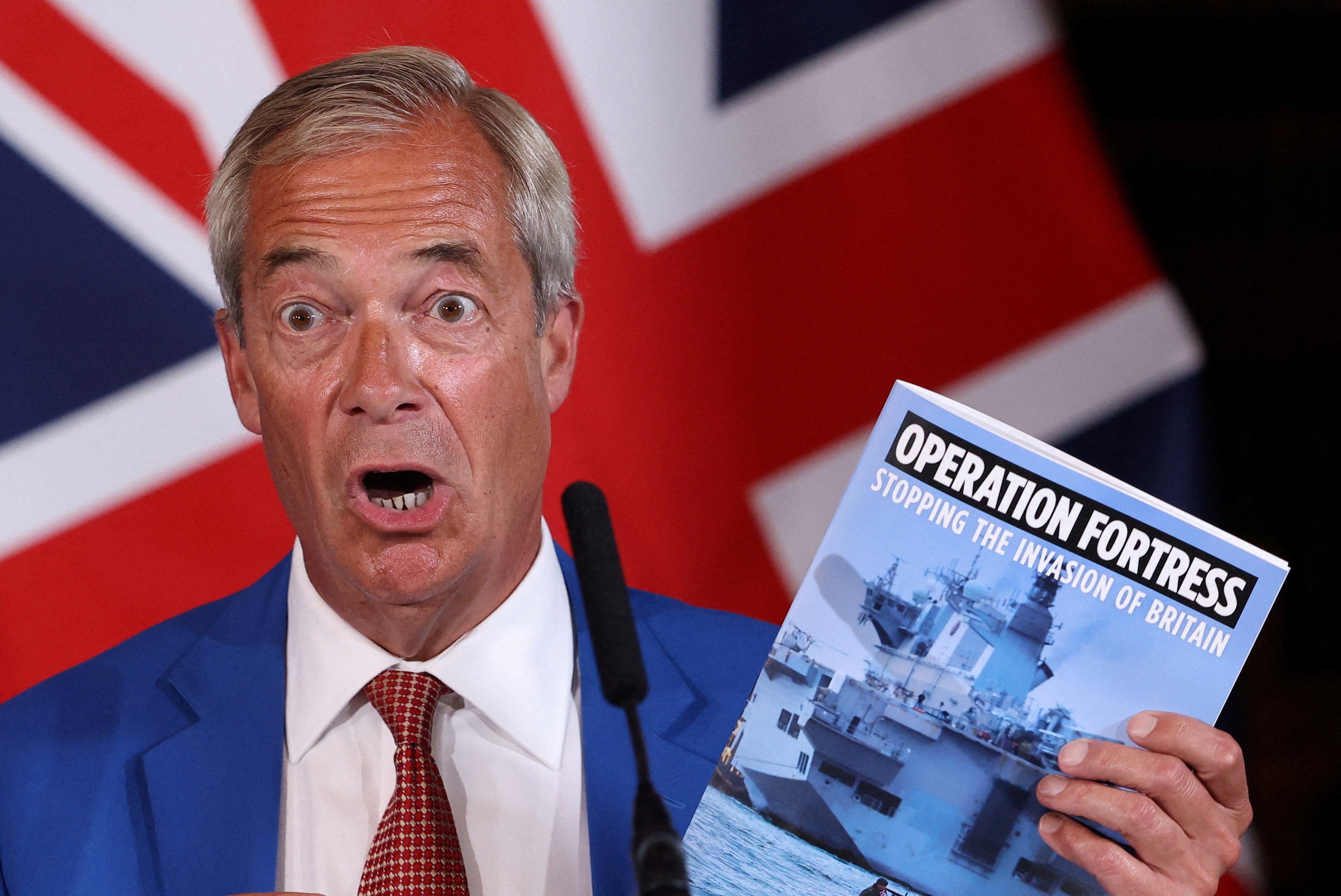
Farage Warns France Exactly What He Plans to Do on Migrants – “You Will Have to Lump It!”
Nigel Farage has issued a blunt warning to France over the growing crisis in the English Channel, declaring that Paris will simply “have to lump it” if a future Reform UK government begins intercepting migrant boats and returning those on board to French territory.

The extraordinary intervention marks another escalation in Farage’s increasingly hardline approach to illegal migration and puts Britain’s relationship with France at the centre of the political storm.
The Reform UK leader has made clear that he would not allow French objections to prevent his proposed policy from going ahead.
Under the plan, dubbed “Operation Fortress”, the Royal Navy would be deployed to intercept small boats attempting to cross the Channel. Migrants would be transferred to naval vessels and returned towards France or Belgium, with medical assistance provided where necessary.
Farage’s message to Paris was uncompromising.
France may dislike the policy, he said, but it would ultimately have to accept it.
That threat has immediately raised questions about international law, French sovereignty and whether Britain could realistically force another country to accept people returned from UK waters.
But politically, Farage appears determined to make the issue a defining part of Reform UK’s offer to voters.
Farage draws a line in the Channel
For years, successive British governments have struggled to reduce the number of migrants crossing the Channel in small boats.
The issue has become one of the most politically explosive subjects in British politics.
Farage has consistently argued that deterrence is the only way to stop the crossings.
His latest proposal is based on a simple premise: if migrants know they will not be allowed to complete the journey to Britain, the smuggling business will eventually become financially unsustainable.
Instead of allowing boats to reach British beaches and processing the passengers after arrival, Reform wants British authorities to intercept the vessels at sea.
The migrants would then be returned.
The objective would be to make the Channel route effectively pointless.
Farage believes that once the people making the journey understand that reaching Britain is no longer possible, demand for the smugglers’ services will collapse.
It is a deliberately uncompromising strategy.
And his warning to France makes clear that he expects opposition.
“They’re going to have to lump it”
Farage has acknowledged that France may strongly object to the policy.
But he has dismissed the idea that French resistance should prevent Britain from acting.
“This policy initially, the French may not like,” he said. “But you know what, they’re going to have to lump it.”
The language is significant.
Rather than presenting the proposal as something that would depend entirely on French cooperation, Farage is framing it as a matter of British political will.
His argument is that France already benefits from substantial British spending on border security.
He has pointed to more than £1.1 billion in British funding for measures designed to help France tackle Channel crossings.
From Farage’s perspective, Britain is already paying France to prevent boats from leaving its shores.
If those efforts continue to fail, he believes Britain should be prepared to take unilateral action.
That is likely to be one of the central arguments of the next phase of the immigration debate.
France faces a difficult response
The French Government is unlikely to welcome the proposal.
Any attempt by Britain to return migrants to French territory without an agreement would raise serious questions about sovereignty.
France is a sovereign state.
Britain cannot simply decide that people intercepted in the Channel will automatically be accepted back by French authorities.
That means Farage’s plan would face an immediate diplomatic test.
Would France agree to receive the migrants?
If not, what would happen to people intercepted by the Royal Navy?
Could they remain aboard British vessels indefinitely?
Would Britain have to take them back?
These questions are crucial.
A political announcement is one thing.
Turning it into a functioning border policy is considerably more complicated.
The legal battle could be enormous
There are also questions about international law.
Any government implementing a policy of maritime interception and returns would need to ensure that it complied with Britain’s legal obligations.
The treatment of asylum seekers is particularly sensitive.
Individuals arriving by boat may make claims for international protection, and authorities cannot simply ignore those claims without considering the relevant legal framework.
The Government would also have to consider the circumstances of individual migrants.
That means Reform’s proposal would almost certainly face legal challenges if it became government policy.
Farage, however, appears prepared for that fight.
His broader political argument is that Britain’s immigration system has become so ineffective that fundamental changes are required.
He believes legal obstacles should not prevent the Government from taking control of the border.
Why the Channel has become such a political battleground
The Channel crossings have become a symbol of Britain’s wider immigration crisis.
For supporters of tougher controls, every small boat represents a failure of the Government to protect the border.
For humanitarian organisations, the journeys represent a dangerous consequence of people seeking safety through increasingly desperate routes.
The political debate has therefore become highly polarised.
Farage has deliberately placed himself at the toughest end of that argument.
He wants voters to believe that Reform is prepared to do what previous governments have been unwilling to do.
The proposed Royal Navy deployment is therefore not simply a military measure.
It is a political statement.
It would demonstrate that Britain is prepared to use the full resources of the state to stop unauthorised Channel crossings.
Reform’s “Operation Fortress”
The proposed operation would involve the armed forces intercepting boats before they reach Britain.
Passengers would be transferred to Royal Navy ships where necessary, with medical support available.
The vessels would then be escorted towards France or Belgium.
The plan is designed to fundamentally alter the economics of people-smuggling.
At present, smugglers can sell migrants a journey that, despite its dangers, may ultimately result in arrival in Britain.
Farage wants to remove that incentive.
If migrants believe that reaching Britain is impossible, the smugglers’ business model becomes much less attractive.
This is the theory behind the policy.
Whether it would work in practice is another matter.
Smugglers could change their tactics.
Boats could be launched from different locations.
Routes could become even more dangerous.
Migrants could attempt to evade British patrols.
That could create new challenges for the Royal Navy and Border Force.
Farage believes deterrence is the key
The Reform leader has long argued that the Government has focused too heavily on processing migrants after they reach Britain rather than preventing them from arriving.
His proposed approach reverses that logic.
The border would effectively move out into the Channel.
Instead of waiting for migrants to arrive, British authorities would intercept them before they reached UK territory.
That distinction is politically important.
Farage can present it as a preventative policy rather than a reaction to the problem.
His supporters believe that strong deterrence is necessary because the current system creates an incentive for people to make the journey.
The Government, by contrast, has to balance deterrence with legal obligations and humanitarian concerns.
The scale of the challenge
The pressure is already considerable.
More than 14,500 people have reportedly attempted to cross the Channel this year, according to reporting surrounding Farage’s latest intervention.
Every successful crossing creates another political argument about Britain’s border policy.
Every failed attempt can result in dangerous confrontations at sea.
And every death in the Channel generates renewed calls for governments on both sides to act.
Farage’s proposal therefore comes at a time when the issue is already politically combustible.
The question is whether his strategy would reduce the number of crossings or simply move the problem somewhere else.
The role of France
Britain’s relationship with France is central to the entire issue.
The two countries have a shared interest in preventing dangerous Channel crossings.
Yet they do not necessarily agree on how that should be achieved.
Britain wants France to prevent boats from leaving its shores.
France wants Britain to address the incentives that encourage migrants to seek entry into the UK.
The two governments have therefore spent years negotiating financial support, policing cooperation and arrangements for dealing with migrants.
Farage’s proposal represents a dramatic shift.
Rather than relying primarily on cooperation, he is suggesting that Britain should be prepared to act independently.
That could fundamentally alter the relationship between London and Paris.
A new confrontation with Europe?
The proposal also fits into Farage’s wider political philosophy.
Brexit was, for him and many of his supporters, about restoring British sovereignty.
The Channel policy allows him to apply that principle directly to immigration.
His message is effectively that Britain should decide who enters the country and how its borders are controlled.
If France objects, Farage says Britain should proceed regardless.
That is likely to resonate strongly with voters who believe the UK has lost control of its borders.
But it could also create a major diplomatic confrontation with one of Britain’s closest neighbours.
Labour faces a difficult challenge
For Andy Burnham’s Government, Farage’s proposal presents a political headache.
If Labour rejects the plan outright, Reform can accuse ministers of being unwilling to take decisive action.
If Labour adopts elements of it, Farage can claim that Reform forced the Government to change course.
And if the Government continues with its existing approach while crossings remain high, the issue will remain one of Reform’s strongest weapons.
That makes immigration particularly dangerous for Labour.
The party needs to demonstrate that it can reduce illegal crossings while maintaining Britain’s legal commitments.
Farage, meanwhile, can simply argue that the Government is not being tough enough.
Could the Royal Navy really do it?
This is where the proposal faces its biggest practical question.
The Royal Navy can intercept vessels.
It can rescue people from dangerous boats.
It can provide medical assistance.
But returning people to another sovereign country requires a legal and diplomatic framework.
The Navy cannot simply deliver migrants to France if France refuses to accept them.
That means Farage’s policy would require either a negotiated agreement or a willingness to engage in a major legal confrontation.
The political slogan is therefore much simpler than the policy implementation.
Nevertheless, Reform believes that governments have spent too long explaining why things cannot be done.
Farage wants to reverse that mindset.
The political calculation
Farage’s strategy is also clearly aimed at strengthening Reform UK.
The party has made immigration one of its defining issues.
Its message is designed to appeal to voters who believe that Conservative and Labour governments have failed to reduce illegal migration.
A highly visible Royal Navy operation would provide a powerful symbol of that commitment.
It would also allow Farage to present Reform as a party prepared to use government power rather than simply complain from opposition.
That could be crucial as the party attempts to convert its polling support into parliamentary seats.
Critics will accuse Farage of recklessness
Opponents are likely to argue that the proposal risks turning the Channel into a confrontation between Britain and France.
They may also warn that military interception could make an already dangerous maritime route even more hazardous.
If smugglers believe British authorities are actively intercepting boats, they could attempt to launch vessels further from the French coast or use more dangerous tactics.
There is therefore a risk that deterrence could produce unintended consequences.
The Government would have to prepare for those possibilities.
But Farage is betting on public anger
The Reform leader’s calculation appears to be that voters have become tired of explanations, legal arguments and promises of future action.
They want results.
Farage believes his proposal provides a clear answer.
Stop the boats.
Return the migrants.
Break the smugglers’ business model.
And, crucially, refuse to allow another government to determine Britain’s border policy.
His warning to France is simply an extension of that philosophy.
Paris may object.
But, in Farage’s words, it will have to “lump it”.
A potentially explosive showdown
The consequences of such a policy could extend far beyond immigration.
A dispute over migrant returns could become a major diplomatic confrontation between Britain and France.
It could affect defence cooperation, border arrangements and Britain’s broader relationship with Europe.
At the same time, the policy could become one of Reform UK’s most important electoral propositions.
If Farage succeeds in convincing voters that he has a credible plan to stop the boats, he could strengthen his position considerably.
If critics demonstrate that the proposal is legally impossible or operationally unworkable, the policy could instead become an example of the gap between opposition rhetoric and the realities of government.
For now, however, Farage is showing no sign of backing down.
He has told France exactly what he intends to do.
He wants the Royal Navy to intercept migrant boats.
He wants those on board returned towards France or Belgium.
He wants the crossings to become economically pointless for people smugglers.
And he is warning Paris that British action will not necessarily wait for French approval.
That is an extraordinarily bold promise.
The real test will come if Farage ever gets the opportunity to implement it.
At that point, “you will have to lump it” would no longer be a campaign slogan.
It would become a direct challenge to France, British courts and the international legal system.
And that could make the Channel crisis one of the most explosive political and diplomatic battles of the next British government.