
Fraudster George Cottrell Seen at Numerous Reform Events Despite ‘No Formal Role’ in Party
The growing controversy surrounding Reform UK has increasingly focused not only on its leader Nigel Farage, but also on the people who surround him. One of the most controversial figures is George Cottrell, a convicted fraudster and long-time associate of Farage. Although Reform UK insists that Cottrell has no formal position within the party and is merely an unpaid volunteer, his repeated appearances at party events, fundraisers and alongside Farage have raised questions about his real influence. The controversy has become particularly serious because Cottrell has also reportedly provided financial support for aspects of Farage’s personal life, including accommodation and security.
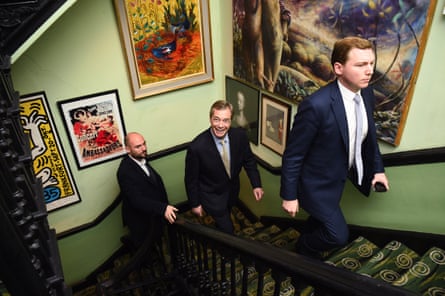
George Cottrell is not a new figure in Farage’s political circle. The two men have known each other for years, and photographs have shown Cottrell accompanying Farage at political events. However, recent reporting has brought renewed attention to the extent of their relationship. Cottrell has reportedly appeared at Reform press conferences, rallies, fundraisers and other political gatherings. He has also accompanied Farage during media appearances and on overseas trips. These repeated appearances have made it increasingly difficult for critics to accept the idea that he is simply an ordinary party volunteer.
Reform UK and Cottrell’s lawyers have consistently stated that he has never held an official position within the party. They describe him as an unpaid volunteer, similar to thousands of other party members. They have also rejected suggestions that a business card bearing Cottrell’s name, the Reform UK logo and Farage’s official email address demonstrated that he held an official role. According to their explanation, the card was simply intended to help donors and members of the public contact Farage’s office.
On paper, this distinction appears straightforward. Political parties can have volunteers who are highly active without giving them formal titles or official responsibilities. A volunteer may attend events, help with campaigning or maintain close relationships with senior politicians without technically being an employee or officer. However, the controversy surrounding Cottrell is not simply about whether he has an official job title. It is about the access he appears to have to Farage and the financial support he has reportedly provided.
According to reports, Cottrell has helped support Farage’s lifestyle by providing accommodation and private security. He has also reportedly paid for staff and other expenses connected with Farage’s activities. Reform has argued that these were personal gifts rather than political contributions and therefore did not necessarily need to be declared as political support. Robert Jenrick, Reform’s financial spokesperson, acknowledged that Farage had stayed at Cottrell’s house and had received private security paid for by him.
This distinction between personal and political support is extremely important. Political leaders, like other citizens, can receive personal gifts from friends. However, when a politician receives substantial benefits from someone who is closely involved in political activities, questions naturally arise about whether those benefits are genuinely private. If a wealthy supporter provides accommodation, security, staff or transport to a political leader, the public may reasonably ask whether those benefits have indirectly helped the politician perform his political role.
The controversy is especially sensitive because of Cottrell’s criminal history. In 2016, he was charged in the United States with numerous offences connected with an alleged “dark money” laundering scheme. He ultimately pleaded guilty to wire fraud and served a prison sentence in Arizona. The fact that someone with this background has such close access to a major British political leader inevitably attracts public scrutiny.
It is important, however, not to confuse a previous criminal conviction with proof of current wrongdoing. Cottrell’s conviction does not automatically mean that his current activities are illegal, nor does his association with Farage establish that Reform UK has broken electoral rules. Those are separate questions that must be determined by evidence and, where appropriate, by the relevant authorities.
Nevertheless, political parties have a responsibility to maintain high standards of transparency. Reform UK has positioned itself as an alternative to the established political parties and has frequently criticised what it sees as corruption, inefficiency and establishment privilege. Because of this political identity, the party is particularly vulnerable when questions arise about wealthy supporters and undeclared benefits.
The issue has also become connected to Reform UK’s wider funding controversies. The party has attracted major financial support from wealthy individuals, including cryptocurrency businessman Christopher Harborne. Harborne has reportedly donated millions of pounds to Reform UK and separately given £5 million to Farage. Questions about that gift have already contributed to scrutiny of Farage’s financial affairs.
Cottrell’s relationship with Harborne adds another layer to the story. The Guardian previously reported that Cottrell was present on a 2022 trip to Thailand with Farage at a resort belonging to Harborne. Cottrell also accompanied Farage to Abu Dhabi in December 2025, where the Reform leader attended Formula 1 events and meetings. Nick Candy, Reform’s honorary treasurer, was also present on the Abu Dhabi trip.
These connections create an image of a relatively small circle of wealthy individuals and political figures surrounding Reform’s leadership. This does not by itself demonstrate improper behaviour, but it raises legitimate questions about who has access to the party’s senior figures and how personal relationships overlap with political and financial relationships.
The controversy also illustrates a broader problem for Reform UK: its political organisation is closely associated with a small number of prominent individuals. Farage is clearly the central figure in the party, while major donors and senior allies have played important roles in its development. Such a structure can be highly effective because decisions can be made quickly and political messages can remain focused. However, it can also create vulnerabilities if one individual’s reputation becomes damaged.
For Farage personally, the Cottrell controversy is particularly uncomfortable because his political appeal depends heavily on his image as an ordinary man challenging Britain’s political establishment. His supporters see him as a politician who speaks for people who feel ignored by traditional political institutions. Critics, however, can point to his relationships with wealthy donors and influential associates as evidence that his political life is increasingly connected to a privileged financial network.
This contradiction could become politically significant. Voters do not necessarily object to politicians having wealthy friends or receiving legitimate personal support. The problem arises when the public cannot clearly understand where personal relationships end and political influence begins. Transparency is therefore crucial. The more valuable the benefits involved, the more important it becomes for politicians to explain exactly what they received, from whom and for what purpose.
The issue also raises questions about Reform’s internal standards. If Cottrell really has no formal role, why does he appear so frequently at important party events? Why does he have such close access to Farage? Why has he reportedly been involved in supporting the leader’s security, accommodation and staffing? These questions do not necessarily have sinister answers, but they deserve clear explanations.
Reform’s response has largely been to emphasise the absence of a formal title. Yet formal status is only one measure of influence. In politics, informal relationships can sometimes be more important than official positions. A person who regularly speaks with a party leader, attends private meetings and provides personal support may have significant influence even without appearing on an organisational chart.
This is why the phrase “no formal role” has failed to end the controversy. The public is not simply asking whether Cottrell is officially employed by Reform. It is asking what role he actually plays in Farage’s political world. That is a much more difficult question to answer.
The issue became even more controversial when reports emerged that Cottrell had been seen at Reform’s headquarters. The Times reported in July that he spent time at the party’s headquarters despite Reform’s repeated assertion that he had no official role. The sighting intensified questions about the nature of his relationship with the organisation.
There are also wider concerns about the sources of money associated with Cottrell. Later reporting raised questions about financial transfers involving his mother, Fiona Cottrell, and donations made to Reform UK and its fundraising operation. The Electoral Commission referred matters to the Metropolitan Police for assessment, while Reform denied wrongdoing and said it follows the relevant electoral rules.
These developments demonstrate why the controversy cannot easily be dismissed as a media story about an unpopular political figure. Questions about political donations are fundamental to democratic accountability. Voters need to know who finances political parties because money can provide access, resources and influence. If there is uncertainty about the true source of a donation, regulators have a legitimate reason to investigate.
At the same time, accusations must be treated carefully. Political opponents have obvious incentives to portray Reform UK in the worst possible light. Allegations are not the same as findings, and investigations must be allowed to establish the facts independently. Reform UK is entitled to defend itself, just as Cottrell is entitled to legal representation and due process.
The central issue, therefore, is transparency rather than guilt by association. Reform UK could reduce some of the controversy by providing a detailed explanation of Cottrell’s relationship with Farage and the party. If he is genuinely only an unpaid volunteer, the party could explain precisely what activities he performs, why he has access to senior figures and how personal gifts and expenses are separated from political funding.
For Farage, the stakes are particularly high. He has spent years building a reputation as a politician who distrusts the establishment and demands greater accountability from others. The public will therefore expect him to apply the same standards to his own political circle. If he appears unwilling to answer questions about people who provide him with significant financial or personal support, critics will inevitably argue that there is a gap between his rhetoric and his behaviour.
Ultimately, the George Cottrell controversy is about more than one individual. It raises fundamental questions about political influence, transparency and the relationship between personal wealth and public power. A person can have no formal position within a political party while still being influential. Conversely, being frequently seen with a politician does not automatically prove that someone exercises improper influence. The challenge is to establish where the truth lies.
Reform UK’s rise has made these questions increasingly important. As the party seeks to present itself as a serious alternative government, it must demonstrate that its internal practices can withstand the same level of scrutiny expected of established political parties. Its supporters may see the investigation as another example of hostile media coverage, while its critics may regard it as evidence of deeper problems. Neither reaction should replace careful examination of the facts.
In conclusion, George Cottrell’s repeated presence at Reform events is significant because it challenges the simple claim that he is merely an ordinary volunteer with no meaningful connection to the party’s leadership. His history, his relationship with Farage and the financial support he has reportedly provided make his role a legitimate subject of public interest. At the same time, allegations about improper conduct should not be treated as established facts before investigations are completed.
The most effective response from Reform UK would be greater transparency. If Cottrell has no formal role, the party should explain his informal relationship with Farage and clarify the nature of the support he has provided. For a party that promises to challenge the political establishment and restore trust in British politics, openness should not be an inconvenience. It should be one of the foundations of its credibility.