

Local Election Results: Nigel Farage Hails ‘Astonishing’ Wins After Labour Humiliation
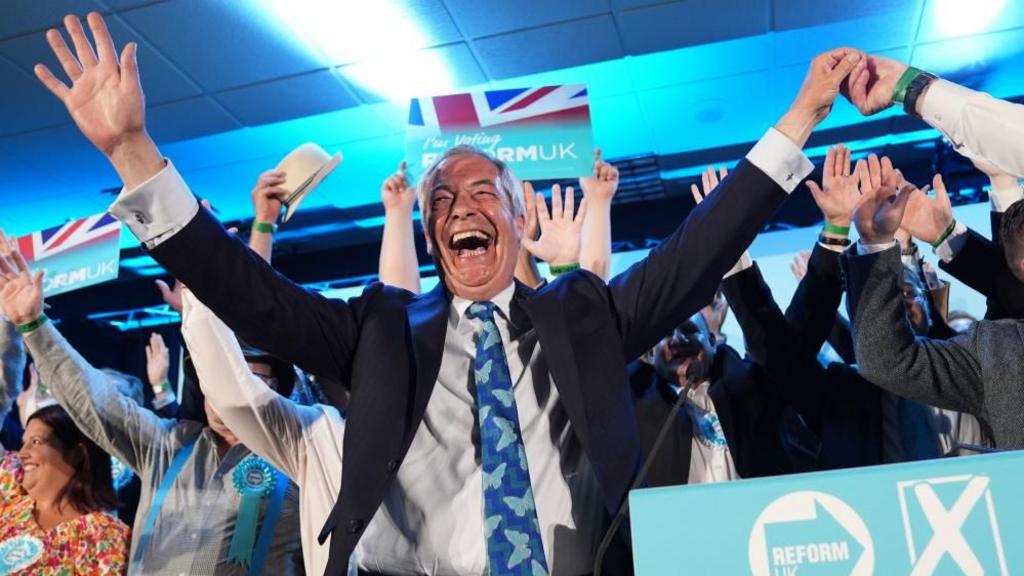
The latest local election results in the United Kingdom have revealed a dramatic change in the country’s political landscape. Reform UK, led by Nigel Farage, made major gains across England, winning support in areas that were once regarded as safe territory for the Labour Party and the Conservatives. Farage described the results as a “historic shift” in British politics, while Labour suffered heavy losses that raised serious questions about its ability to maintain the support it received when it came to power.
The scale of Reform UK’s success was particularly significant because the party did not simply win in traditionally Conservative areas. It also made substantial advances in former Labour strongholds, especially in northern England. According to reports, Reform gained hundreds of council seats and took control of several councils, including Essex County Council, Sunderland City Council and Havering. Farage argued that his party had demonstrated that it was now a genuinely national political force rather than a temporary protest movement.
For Labour, the results represented a deeply uncomfortable moment. The party had won the 2024 general election with a large parliamentary majority, but its performance in the local elections suggested that many voters were becoming increasingly dissatisfied. Labour lost seats in communities that had supported the party for generations. In northern England, places such as Sunderland, Gateshead and South Tyneside experienced major political changes as Reform made significant advances. These areas were once central to Labour’s political identity.
One of the most important reasons for Reform’s success is the growing dissatisfaction among voters with the established political parties. Many people feel that neither Labour nor the Conservatives have adequately addressed their concerns about the economy, immigration, public services and the cost of living. Although local elections are primarily about councils and local services, voters often use them to express their feelings about national politics. In this sense, the results can be interpreted as a warning to the Labour government.
The economy is an especially important factor. Britain has experienced years of economic uncertainty, while many households continue to face pressure from high living costs. For ordinary voters, national political arguments can seem distant compared with practical problems such as expensive housing, rising household bills and concerns about employment. When people feel that their financial situation is not improving, they may become more willing to support parties promising significant change.
Immigration is another major issue behind Reform UK’s growing popularity. Nigel Farage has made immigration one of the central themes of his political career, particularly his criticism of illegal migration and the government’s management of Britain’s borders. Many Reform supporters believe that successive governments have failed to control immigration effectively. They argue that rapid population growth can place additional pressure on housing, healthcare, schools and other public services.
However, it would be too simple to suggest that every Reform voter is motivated by immigration. The election results demonstrate a much broader dissatisfaction. Some voters may support Reform because they are unhappy with Labour’s economic policies, while others may be frustrated with the Conservative Party or simply want to challenge the political establishment. The party’s ability to attract voters from different political backgrounds is one of the most important features of its recent success.
Farage has attempted to present Reform as a party that goes beyond the traditional division between left and right. Following the election results, he argued that there was effectively “no more left-right” division in British politics and pointed to Reform’s strong performance in traditional Labour communities. This is an ambitious claim. Traditionally, British politics has been dominated by competition between Labour and the Conservatives. Reform’s rise suggests that this two-party system may be becoming increasingly fragmented.
The situation in Sunderland provides a particularly powerful example. The city voted strongly for Brexit in 2016 and has historically been associated with Labour. Reform’s success there illustrates how the political loyalties of working-class voters have changed. The old assumption that working-class communities would automatically support Labour can no longer be taken for granted.
The decline of traditional political loyalty is not limited to Labour. The Conservative Party has also suffered badly from Reform’s rise. In some areas, Reform has attracted voters who previously supported the Conservatives because of concerns about immigration, taxation, national sovereignty and the political establishment. Farage’s party is therefore challenging both sides of the traditional political divide.
This creates a difficult situation for the major parties. If the Conservatives move further towards Reform’s positions, they risk losing moderate voters to Labour, the Liberal Democrats or the Greens. If Labour adopts tougher policies on immigration and public spending, it risks disappointing parts of its traditional progressive coalition. Reform therefore benefits from the difficulties faced by both major parties.
At the same time, the election results do not necessarily guarantee that Reform will win the next general election. Local elections are different from national elections. Voters may support a smaller party locally without being prepared to give it national power. Reform also has to demonstrate that it can govern effectively. Winning council seats is one thing; managing budgets, improving public services and delivering practical results is another.
This may be the biggest challenge facing Farage. His party has built much of its support around dissatisfaction with the political establishment. However, once a party gains responsibility for local government, voters can judge it according to its actual performance. Reform councillors will therefore have to prove that they can transform their political promises into practical policies.
Farage himself appeared highly confident following the results. He described Reform’s performance as an “historic shift in British politics” and argued that the party was becoming a truly national organisation. His confidence is understandable. Reform reportedly won more than 1,450 council seats and took control of 14 councils in the 2026 local elections, according to the party itself.
For Labour leader Keir Starmer, however, the results represented a serious political warning. Labour’s victory at the 2024 general election created expectations that the party would establish a long period of political stability. Instead, the government has faced growing criticism over economic conditions, public services and political decisions. The local elections showed that simply being the alternative to the Conservatives is no longer enough to guarantee voter loyalty.
The results also demonstrate that British politics is becoming more competitive and unpredictable. Reform is not the only party benefiting from dissatisfaction with Labour and the Conservatives. The Greens and Liberal Democrats have also made gains in different parts of the country, while nationalist parties remain important in Scotland and Wales. This suggests that Britain may be moving towards a more fragmented political system in which several parties compete for influence.
Nevertheless, Reform’s breakthrough is particularly important because of the geographical diversity of its support. The party has made progress in both traditionally Conservative and traditionally Labour areas. That gives it the possibility of building a broader coalition than many smaller British parties have achieved in the past.
Ultimately, the local election results should be understood as more than a collection of council victories. They represent a change in voter attitudes. Millions of people appear increasingly willing to abandon traditional party loyalties and experiment with alternatives. For Reform UK, this is an opportunity to establish itself as a permanent force in British politics. For Labour and the Conservatives, it is a warning that voters cannot be taken for granted.
Nigel Farage’s celebration of “astonishing” victories therefore reflects a genuine political transformation. Reform has moved from the margins of British politics closer to the centre of national debate. However, its long-term success will depend on whether it can convert protest into effective government.
The most important question is no longer simply why voters are turning towards Reform. It is whether Reform can satisfy the voters who have placed their trust in it. If it succeeds, Britain’s traditional two-party system could face an even greater transformation. If it fails, many of those voters may once again search for another political alternative.
For now, however, one conclusion is difficult to avoid: the old political map of Britain is changing. Labour’s traditional strongholds are no longer guaranteed, the Conservatives are under pressure from a powerful rival on the right, and Reform UK has demonstrated that it can compete across large parts of the country. The local elections may therefore prove to be an important moment in the continuing transformation of British politics.