
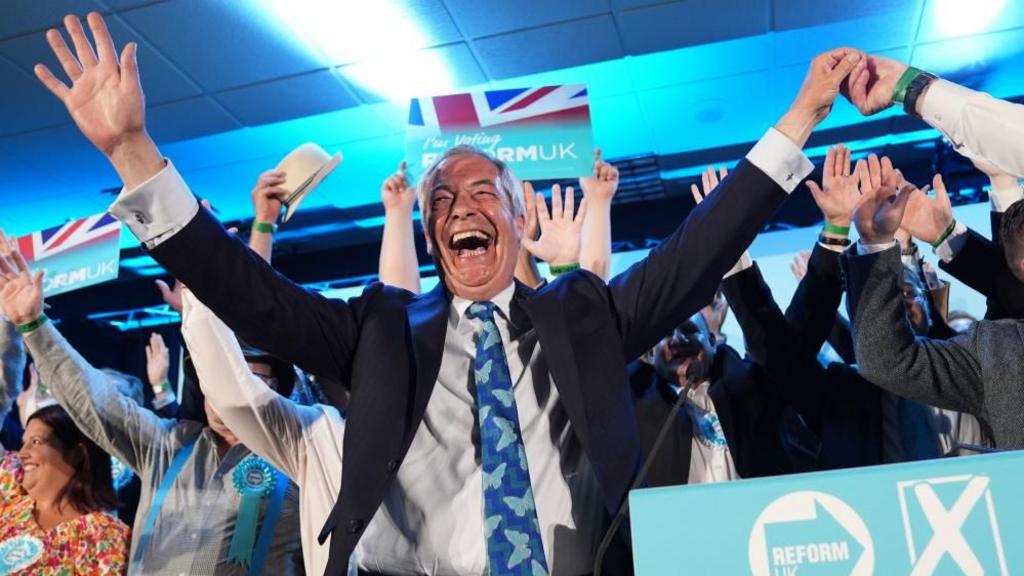
Nigel Farage Hails Major Reform Milestone After Huge By-Election Victories
Nigel Farage has every reason to celebrate. Reform UK has reached another important milestone in its extraordinary rise through British politics, with a succession of by-election victories and strong performances giving the party fresh momentum and strengthening its claim to be far more than a protest movement.

The significance of these victories lies not simply in the individual seats won. Their real importance is psychological and political. Every successful campaign makes it harder for Labour and the Conservatives to argue that Reform’s popularity is temporary. Every additional victory provides evidence that voters are prepared to trust Reform candidates with elected office.
The transformation has been remarkable.
Only a few years ago, Reform UK was regarded by many Westminster politicians as a fringe force whose principal purpose was to pressure the Conservative Party from the right. Today, it is one of the most important forces in British politics. The party’s performance in the 2026 local elections was described by Farage as a “truly historic shift”, after Reform made hundreds of gains and took control of councils across England.
That success has fundamentally altered the political calculation facing Labour and the Conservatives.
For Keir Starmer’s Labour Party, Reform represents a direct threat to the coalition of voters that traditionally formed the backbone of the party. For the Conservatives, the threat is even more obvious: Reform is competing for voters who once regarded the Conservative Party as the natural political home of the British right.
Farage’s latest milestone therefore matters because it reinforces a much larger political trend.
Reform is winning elections.
That simple fact is potentially more damaging to the established parties than any opinion poll.
Opinion polls can fluctuate. Voters can change their minds. Political campaigns can alter the mood of an election. But when a party repeatedly turns votes into victories, it demonstrates something much more powerful: organisational strength.
By-elections are particularly important because they provide a direct test of whether a party can convert political momentum into electoral success.
Unlike a national opinion poll, a by-election forces voters to make an actual choice. Candidates must campaign, activists must organise, and supporters must turn up on polling day. A strong performance therefore provides evidence that a party’s support is not merely theoretical.
Reform has benefited enormously from this process.
Its breakthrough in the Runcorn and Helsby by-election in 2025, for example, demonstrated that Labour could lose a seat that had previously appeared secure. Reform won the constituency by just six votes, but the symbolism was enormous. Farage described the result as a major moment for his party and linked Labour’s defeat to dissatisfaction with the government’s performance, particularly over immigration.
Since then, the party’s political momentum has expanded considerably.
The 2026 local elections were especially important. Reform gained hundreds of seats across England and took control of councils including Essex, Havering, Suffolk, Sunderland and Newcastle-under-Lyme. Labour suffered heavy losses, including in areas that had traditionally provided the party with strong support.
For Farage, this represents the fulfilment of a political strategy that he has pursued for years.
His argument has always been that Britain’s established parties have become disconnected from ordinary voters. Reform’s message is based on the belief that Westminster has failed to address issues such as immigration, the cost of living, taxation, public services and national sovereignty.
Whether voters agree with every Reform policy is not the central point.
The important development is that an increasing number of voters appear willing to give the party their support.
That changes everything.
When Reform was small, Labour and the Conservatives could dismiss it as a protest vote. When Reform began winning seats, that argument became more difficult. Now that it is accumulating electoral victories, the established parties have to consider the possibility that the party is participating in a long-term realignment of British politics.
Recent YouGov research underlines the scale of the transformation. The polling organisation has described immigration as a key factor behind Reform’s rise and noted that the party has spent a prolonged period leading national voting-intention polls while establishing itself as the largest force on the political right.
Yet the most important question is not whether Reform can win elections.
It is whether Reform can sustain its support.
That will be much harder.
A protest party can campaign on dissatisfaction. A serious political party must offer solutions.
Voters may support Reform because they are angry about immigration, frustrated by the state of the economy or disappointed by public services. But once Reform controls councils and wins parliamentary seats, those voters will expect results.
That creates a completely new challenge for Farage.
The party must demonstrate that it can govern as effectively as it campaigns.
This is particularly important because Reform’s rapid growth has also produced internal difficulties. The party has experienced disputes among councillors and controversies involving candidates and elected representatives. Such problems are not unique to Reform, but they attract particular attention because the party’s central message is that the established political system is incompetent.
Reform cannot demand higher standards from other parties while appearing unable to maintain those standards within its own organisation.
That is why the current period is so important.
The party is moving from insurgency towards institutional politics.
Its supporters may still see Reform as an outsider movement, but voters increasingly expect it to behave like a potential government.
That means professional candidates, coherent policies, disciplined councillors and credible financial and administrative structures.
Farage’s greatest strength remains his ability to communicate directly with voters who feel ignored by traditional politicians. He has spent decades developing a political identity built around challenging the establishment.
But that strength can also become a weakness.
The outsider can blame the establishment for failing.
The potential governing party cannot.
Once Reform becomes responsible for public services and political decisions, voters will ask whether it can actually deliver the changes it promises.
The answer will determine whether today’s victories represent the beginning of a historic political realignment or simply another phase in Britain’s cycle of protest voting.
There are also reasons for Reform to remain cautious.
Not every by-election victory will translate into a general-election victory. Local circumstances can be unusual, turnout can be low and tactical voting can have a major effect. Reform’s opponents can also coordinate their campaigns when they believe the party is vulnerable.
The political environment remains highly competitive.
Indeed, Reform itself has recently encountered setbacks. In the Makerfield by-election, the party failed to secure the victory that some commentators had expected, while the Conservatives also managed a significant Westminster by-election victory in Aberdeen South. These results demonstrate that Reform is powerful but not unstoppable.
That distinction is crucial.
Farage’s supporters may see each victory as confirmation that Reform is on an unstoppable march towards government. But British politics rarely moves in a straight line.
Voters can change direction quickly.
The emergence of other parties on the right, including Rupert Lowe’s Restore Britain, also creates another challenge for Reform. A divided right-wing electorate could make it much harder for any single party to dominate.
Nevertheless, the fact that such competition exists is itself evidence of Reform’s influence.
A few years ago, Britain’s political right was dominated by the Conservatives.
Today, it is fragmented, competitive and increasingly volatile.
That is the political legacy of Reform’s rise.
For Labour, the danger is that the party continues losing voters in communities that once regarded Labour support as part of their political identity. For the Conservatives, the danger is that Reform becomes the primary home for voters demanding a more radical approach to immigration, taxation and national sovereignty.
For Farage, however, the opportunity is enormous.
He now has the chance to prove that Reform can transform electoral anger into a genuine governing movement.
The next stage will require considerably more than speeches and campaign rallies.
It will require competence.
It will require discipline.
And above all, it will require Reform to convince voters that it can do something that many new political movements fail to accomplish: turn opposition into effective government.
That is why the latest by-election victories matter so much.
They are not simply another collection of results.
They represent another step in Reform’s transition from political insurgency to serious electoral force.
Nigel Farage can rightly celebrate the milestone, but celebration should not obscure the challenge ahead.
The bigger Reform becomes, the higher the expectations will be.
The party has already shown that it can disrupt British politics.
It has shown that it can defeat established parties.
It has shown that voters are willing to abandon traditional loyalties.
Now it must answer the most difficult question of all:
Can Reform UK actually govern Britain better than the parties it has spent years attacking?
The answer remains unknown.
But after its remarkable electoral progress, nobody in Westminster can seriously pretend that Reform is going away.
The political earthquake has already begun.
The question now is how far it will go.