
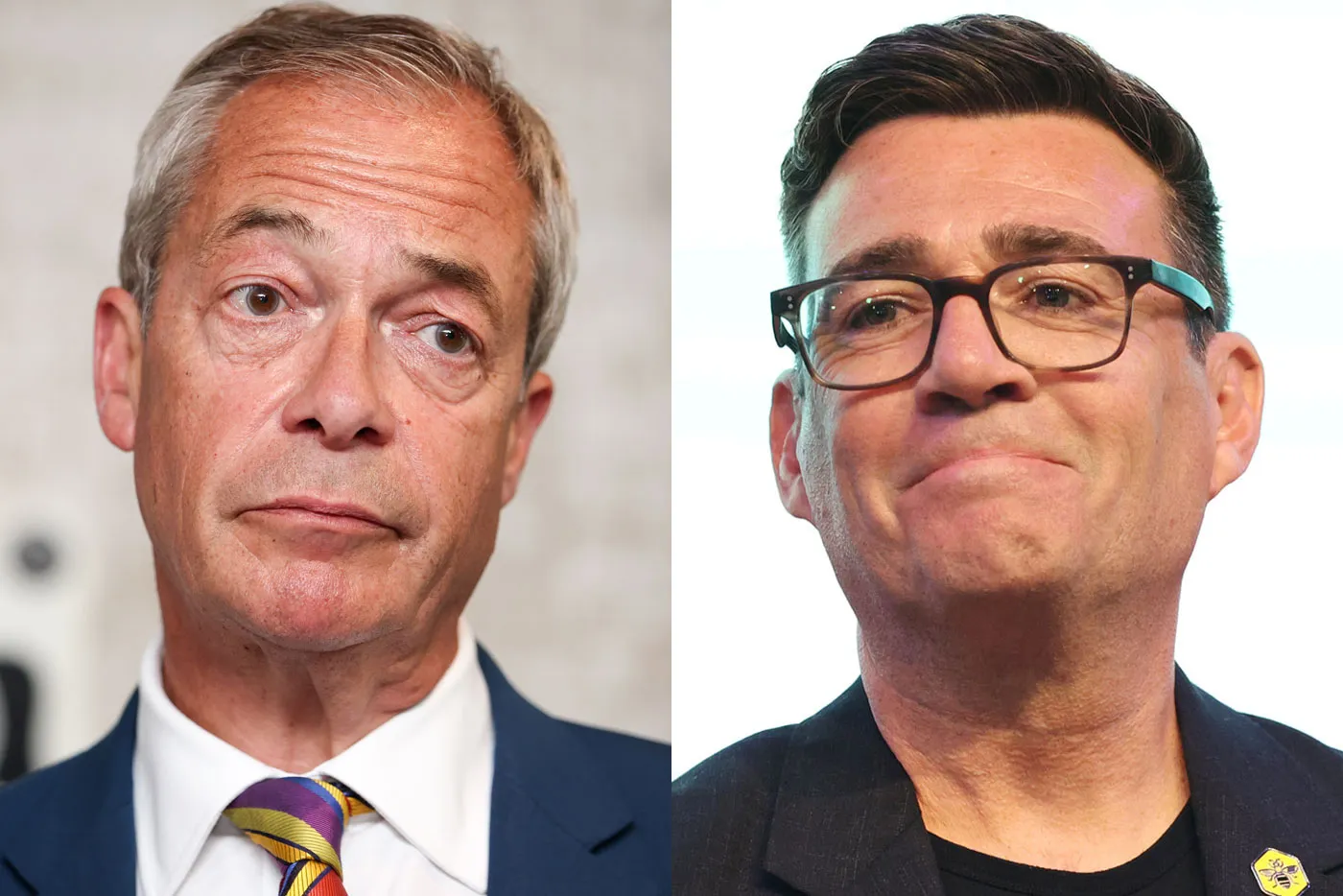
Nigel Farage Is Nowhere Near Finished – And Andy Burnham’s Dithering Proves It
Nigel Farage is nowhere near finished.
That is the increasingly difficult conclusion facing Britain’s political establishment as Reform UK’s influence continues to shape the national conversation and established politicians struggle to decide how they should respond.
For years, Farage has been declared politically finished more times than many observers can count. Yet each time his opponents believe his moment has passed, he has found another way to return to the centre of British politics.
His political career has survived electoral disappointments, leadership changes, party controversies and repeated predictions that the public had finally moved on.
But Britain has changed.
And so has the political environment in which Farage operates.
The rise of Reform has demonstrated that a significant number of voters are willing to challenge the traditional political parties. Immigration, taxation, public services, national identity and dissatisfaction with Westminster remain powerful issues, and Reform has positioned itself as the political vehicle for voters who believe the established parties have failed to listen.
That creates a problem for Labour.
And it creates an especially interesting challenge for figures such as Andy Burnham.
Burnham is one of the most recognisable politicians in the Labour movement. As Mayor of Greater Manchester, he has built a distinctive political profile that reaches beyond the traditional boundaries of Westminster politics.
His political style is very different from Farage’s.
Burnham generally presents himself as a pragmatic, moderate and locally focused politician, while Farage thrives on confrontation, controversy and national political campaigning.
Yet their political futures are connected by one increasingly important reality: Reform has changed the calculations facing mainstream parties.
The question is no longer whether Farage can attract attention.
He clearly can.
The question is whether Reform can turn that attention into a long-term political realignment.
That is where the stakes become much higher.
Farage’s opponents have often assumed that his support is temporary. They have described Reform voters as protest voters and suggested that many would eventually return to the Conservatives or Labour.
But that assumption is becoming harder to maintain.
Once voters discover a political alternative that reflects their frustrations, they may not automatically return to the parties they previously supported.
Political loyalty is changing.
The traditional idea that British voters will remain attached to one party throughout their lives has weakened considerably.
Younger voters are less likely to inherit the political loyalties of their parents.
Older voters who once considered themselves lifelong Conservatives or Labour supporters can now change their vote when they become dissatisfied.
And Reform has understood this shift.
Its message is built around disruption.
Farage’s greatest political strength is arguably his ability to turn dissatisfaction into a simple narrative: the establishment has failed, and voters need an alternative.
It is an extraordinarily effective political argument because it does not require voters to agree on everything.
A voter can be angry about immigration.
Another can be frustrated about taxes.
Another can feel ignored by Westminster.
Another can simply dislike the major parties.
All of them can find a reason to support an anti-establishment movement.
This creates a broad coalition.
The challenge for Farage is maintaining that coalition once the movement becomes more serious.
It is easier to oppose than to govern.
It is easier to criticise government policy than to implement an alternative.
And it is easier to promise change than to deliver it.
That is why the coming years could determine whether Farage becomes a permanent force in British politics or simply another chapter in Britain’s long history of political protest movements.
But the behaviour of mainstream politicians matters enormously.
If Labour and the Conservatives respond to Reform by dismissing its voters, they risk making Farage stronger.
If they instead address the issues driving voters toward Reform, they may reduce its appeal.
This is where Andy Burnham becomes relevant.
Burnham’s political position gives him an unusual perspective.
He has demonstrated that a Labour politician can build a powerful electoral base while presenting himself as somewhat independent from Westminster.
His popularity in Greater Manchester has often been connected to his emphasis on local government, transport, public services and regional identity.
That approach has helped him develop a political brand distinct from the national Labour leadership.
But political ambiguity has its limits.
At some point, politicians must decide what they stand for.
And that is where accusations of dithering become politically damaging.
If Burnham appears unwilling to take a clear position on the major issues reshaping British politics, his opponents can portray him as cautious rather than principled.
Farage, by contrast, rarely suffers from a lack of clarity.
You may strongly disagree with him, but his supporters generally know what he is arguing.
That contrast is politically significant.
Modern politics rewards clarity.
Social media rewards short statements.
Television rewards confrontation.
Campaigns reward simple messages.
Farage understands these dynamics exceptionally well.
He knows how to turn a complicated political debate into a headline.
He knows how to make opponents react.
And perhaps most importantly, he understands that political attention itself is a form of power.
Every argument about whether Farage is relevant gives him another opportunity to demonstrate that he is relevant.
Every attack can become another campaign message.
Every controversy can become evidence for supporters that the establishment is threatened.
This is why declaring Farage finished can be counterproductive.
It allows him to return as the supposed underdog.
And Farage has always been most effective when presenting himself as the outsider fighting against a powerful political class.
Burnham’s hesitation, whether real or exaggerated by his critics, therefore provides an interesting contrast.
The Labour politician represents one possible approach to the future of British politics: cautious, managerial and focused on practical government.
Farage represents another: disruptive, populist and deliberately confrontational.
The battle between these political styles may become increasingly important.
Britain is entering a period in which voters are demanding more than traditional party labels.
They want results.
They want politicians who appear authentic.
They want answers to difficult questions.
And many are increasingly unwilling to accept the idea that political choices are limited to two major parties.
That is why Reform’s rise should not be dismissed.
It may not inevitably lead to long-term success.
Political movements can rise rapidly and disappear just as quickly.
But the grievances that created the opportunity for Reform are unlikely to disappear overnight.
Immigration will remain a political issue.
Economic pressure will remain a political issue.
Public services will remain a political issue.
Trust in government will remain a political issue.
And dissatisfaction with Westminster will remain a political issue.
Unless established parties can provide convincing answers, Farage will continue to have political space.
That may be the most important lesson.
Farage does not necessarily need everyone to agree with him.
He simply needs enough voters to believe that the alternatives are worse.
That is how political disruption works.
And that is why his opponents should take him seriously.
For Andy Burnham, the challenge is different.
If he wants to play a larger role in Britain’s political future, he will need to demonstrate more than political popularity in Greater Manchester.
He will need a clear national argument.
He will need to explain what he believes Labour should become.
He will need to decide how Britain should respond to Reform’s rise.
And he will need to show voters that his approach offers something more compelling than simply being less controversial than Farage.
Because the future of British politics may not be decided by who can avoid controversy.
It may be decided by who can define the central questions of the next political era.
Farage is already attempting to do that.
He wants immigration, national sovereignty, political accountability and distrust of Westminster to remain at the heart of the debate.
Whether he succeeds is another question.
But he has certainly ensured that those issues cannot easily be ignored.
That is why the claim that Nigel Farage is finished looks increasingly unconvincing.
His political future is not guaranteed.
Reform faces serious challenges.
Its organisation, candidates, policies and ability to maintain public support will all be tested.
But the idea that Farage can simply be dismissed as yesterday’s politician is becoming harder to defend.
And if established politicians continue to hesitate while Reform continues to define the argument, Farage may find that his greatest political advantage is not his own popularity.
It may be the uncertainty of his opponents.
That is the real warning.
Britain’s political landscape is changing, and the politicians who fail to recognise that change risk being overtaken by it.
Farage knows what he wants to do.
His opponents now have to decide what they want to do about him.
And until they find an answer, one conclusion seems increasingly difficult to escape:
Nigel Farage is nowhere near finished.