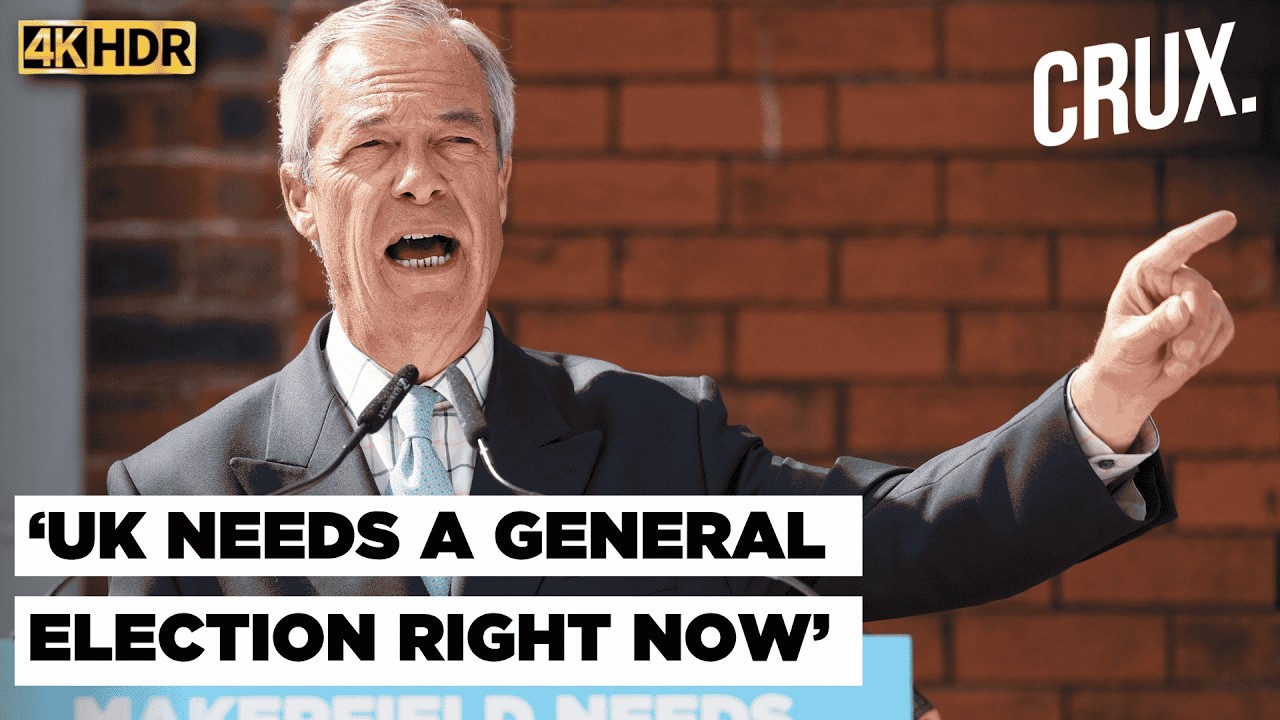
Nigel Farage Slams Andy Burnham’s First Speech: “Utterly Vacuous!”
The arrival of Andy Burnham as Britain’s new prime minister has immediately triggered a fierce political confrontation with Nigel Farage, one of the most prominent figures on the British right. Within hours of Burnham’s first major political speech, Farage launched a devastating attack on the new Labour leader, describing his address as “utterly vacuous” and portraying Burnham as a politician who has spent his career changing positions to suit the political moment.
Farage’s criticism was not simply an attack on the words Burnham used. It was a direct challenge to the legitimacy, political identity and economic programme of the new prime minister. For Reform UK, Burnham represents the continuation of a political establishment that Farage believes has failed Britain for decades. For Burnham, however, the moment represents an opportunity to offer a completely different direction for the country, built around public services, regional power, economic intervention and a renewed sense of national optimism.
The clash between the two men could become one of the defining political battles of the new era.
Burnham’s first speech was deliberately ambitious. Speaking after becoming Labour leader and preparing to take control of the government, he promised to bring hope back to Britain and argued that the country was crying out for a new form of politics. He presented himself as a leader determined to move beyond the factional arguments that had damaged Labour and to create a government capable of restoring confidence in politics.
He also described the change represented by his leadership as potentially one of the biggest shifts in British politics in decades.
Yet Farage was unimpressed.
For the Reform UK leader, Burnham’s words were full of political language but lacking in concrete substance. His description of the speech as “utterly vacuous” reflected a broader argument that Burnham had offered slogans about hope, change and national renewal without sufficiently explaining how his promises would actually be delivered.
Farage also attacked Burnham personally, calling him a “great chameleon” of British politics. The accusation is politically significant because Burnham has occupied several different positions throughout his career. He has at various times been associated with the Labour left, the Labour establishment and the increasingly influential politics of northern England. As mayor of Greater Manchester, he developed a reputation for combining Labour values with a strong emphasis on regional government and practical local leadership.
To his supporters, this flexibility demonstrates political maturity. To Farage, it demonstrates opportunism.
The difference between the two interpretations could hardly be greater.
Burnham believes that Britain needs a more active state. He has argued that essential services should not simply be left to private companies and has spoken strongly about greater public control of areas such as water, energy and transport. His economic vision is based on the idea that government should work with business while ensuring that the benefits of economic growth are distributed more widely across society.
Farage sees this approach as a return to the politics of the past.
The Reform UK leader has repeatedly argued that Britain suffers from excessive taxation, excessive regulation and an overextended state. He believes that lower taxes, stronger private enterprise and tighter immigration controls are essential if Britain is to recover economically.
The contrast therefore goes far beyond personalities.
It is a battle between two fundamentally different visions of Britain.
Burnham wants to expand the role of government in strategic areas of the economy. Farage wants to reduce the influence of the state and give greater freedom to individuals and businesses. Burnham talks about rebuilding public services and empowering communities. Farage talks about cutting bureaucracy, reducing taxation and restoring national sovereignty.
Both men claim to speak for voters who feel ignored by Westminster.
That is what makes their confrontation particularly interesting.
Burnham’s political message has been shaped by the experience of communities that suffered from deindustrialisation. His speeches frequently refer to former industrial towns, factories, mines and communities that once provided stable employment but later experienced economic decline. He argues that Britain cannot simply accept regional inequality as an unavoidable consequence of modern capitalism.
Instead, he wants government to intervene.
His supporters believe that this approach could help Labour rebuild trust among working-class voters who have become increasingly sceptical of traditional politics. By focusing on public ownership, regional development, affordable housing and stronger public services, Burnham hopes to create a Labour identity that feels more connected to ordinary people’s lives.
Farage, however, believes that Burnham is attempting to occupy political territory that Reform UK has already transformed.
For years, Farage has argued that traditional parties abandoned working-class communities by ignoring concerns about immigration, national identity, living costs and the decline of industrial Britain. Reform’s growth has been based partly on the belief that many voters are no longer satisfied with the Conservative Party or Labour Party.
Burnham’s emergence presents a new challenge to that strategy.
Unlike some Labour politicians, Burnham is comfortable discussing patriotism, regional identity and the decline of traditional industries. He has also demonstrated an ability to communicate directly with voters and to present himself as a politician outside the Westminster bubble.
That makes him potentially more difficult for Reform UK to defeat than a conventional Labour leader.
Farage therefore has a strong political incentive to attack Burnham immediately.
If Reform allows Burnham to establish himself as a popular prime minister who can combine Labour economics with a more culturally conservative and nationally focused political style, Farage’s party could find itself squeezed from both sides. Burnham could attract voters who want change but are uncomfortable with Reform’s harder rhetoric, while simultaneously retaining Labour voters who want stronger public services.
This explains why Farage’s criticism has been so aggressive.
He wants to define Burnham before Burnham has the opportunity to define himself.
The accusation that Burnham is “vacuous” is particularly important because political leaders depend heavily on public perceptions of competence and authenticity. A prime minister can survive disagreement over policy, but it is much harder to survive the belief that he does not have a coherent plan.
Farage is therefore attempting to create an image of Burnham as a politician who speaks well but lacks substance.
The question is whether that accusation will stick.
Burnham’s supporters would argue that his first speech was never intended to be a detailed budget statement or government programme. A leader’s first address is often about setting a political tone and establishing broad principles. Burnham used his speech to emphasise stability, hope, unity and the need to restore confidence in British politics.
His detailed policies would inevitably come later.
Indeed, Burnham’s early actions as prime minister have demonstrated that his government is already attempting to translate his rhetoric into specific measures. His administration has focused on reducing household pressures, increasing regional decision-making and expanding public control over essential services. He has also promised major reforms in areas such as social care and homelessness.
The challenge, however, is paying for these ambitions.
This is where Farage’s criticism could become more powerful.
Britain faces enormous fiscal pressures. Government debt is high, borrowing costs remain a concern and the country faces difficult choices over defence, public services and long-term investment. Burnham has promised to maintain fiscal discipline while simultaneously pursuing a significant programme of government intervention.
That balancing act will be extremely difficult.
If Burnham can demonstrate that his policies generate economic growth, improve productivity and reduce long-term public costs, his critics may be forced to reconsider. But if spending increases without delivering measurable improvements, Farage will have a powerful political weapon.
The same is true of public ownership.
Burnham argues that privatised essential services have often failed to provide the value and security that citizens deserve. He believes greater public control could reduce costs and improve accountability.
Farage is likely to argue the opposite: that nationalisation would create inefficient state monopolies and place even greater financial pressure on taxpayers.
The British public will ultimately judge which argument is more convincing.
There is also a question of political style.
Burnham’s rhetoric is generally built around optimism, community and collective action. Farage’s political language is more confrontational. He speaks frequently about political failure, broken institutions and the need for radical change.
Yet both men are attempting to tap into the same underlying public frustration: the feeling that Britain has not delivered the prosperity, security and political stability that many people expected.
That is why their rivalry could become more intense over time.
Burnham’s greatest advantage may be his ability to present himself as a change candidate while occupying Downing Street. Farage’s greatest advantage is his ability to remain outside government and attack the establishment from the opposition benches.
The new prime minister now has to govern.
Farage does not.
That difference matters.
Every promise Burnham makes will eventually face the test of implementation. Every spending commitment will have to be funded. Every reform will encounter resistance from institutions, businesses, unions or voters. And every failure will provide Farage with another opportunity to claim that his prediction was correct.
For Burnham, therefore, the best response to the accusation that his speech was “utterly vacuous” is not another speech.
It is delivery.
If he succeeds in improving public services, reducing household pressures, increasing economic growth and giving greater power to regions, the criticism will gradually lose its force. If he fails, Farage’s words could become an increasingly effective political narrative.
The battle between the two men is ultimately about more than one speech.
It represents a struggle over the future direction of Britain.
Will the country move towards a larger and more interventionist state under Burnham? Will Reform UK continue to gain support by demanding lower taxes, tighter immigration and a smaller government? Or will British voters eventually choose a compromise between these competing visions?
Those questions will not be answered by one political address.
But Farage’s explosive reaction has made one thing clear: he intends to make Burnham a central target of Reform’s campaign against the political establishment.
Burnham, meanwhile, has the opportunity to demonstrate that his politics is about more than carefully chosen words.
He has promised hope, change and a new direction.
Now he must prove that those promises can become reality.
For Nigel Farage, the verdict has already been delivered.
For the British public, the verdict is still to come.