
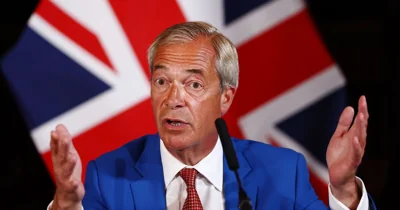
Nigel Farage Vows to Order Royal Marines to Dump Channel Migrants on French Beaches
The crisis surrounding migrants crossing the English Channel in small boats has become one of the most controversial issues in British politics. Few politicians have spoken more forcefully about the issue than Nigel Farage, the leader of Reform UK. In 2024, Farage proposed an extremely controversial response to the Channel crossings: if France refused to cooperate, the United Kingdom should use the Royal Marines to return migrants to French beaches. His proposal immediately attracted attention because it would represent a dramatic escalation in Britain’s approach to illegal Channel crossings.
Farage’s argument was based on the belief that Britain’s existing strategy was failing. He argued that migrants were continuing to cross the Channel because criminal smuggling gangs had created a system in which people could pay to reach Britain in small and often dangerous boats. In his view, simply rescuing migrants and bringing them to the United Kingdom did not solve the underlying problem. Instead, he argued that Britain needed a policy strong enough to discourage people from attempting the journey in the first place.
During his intervention on the issue, Farage said that the Royal Marines should be prepared to take migrants back to France if necessary. He acknowledged that such a policy would create a serious confrontation with the French government, but argued that Britain needed to be prepared to take decisive action. He compared his proposed approach with Australia’s controversial policy of turning boats back as part of its efforts to reduce irregular maritime migration.
The proposal immediately divided opinion. Supporters of Farage believe that Britain has been too weak in dealing with illegal migration. They argue that if people know that crossing the Channel will result in being taken to Britain, rather than being returned or prevented from completing the journey, the incentive for migrants to pay smugglers remains strong. From this perspective, the most effective migration policy is one that changes the calculation of people considering the journey.
There is also an argument that the British government has a responsibility to protect its borders. Supporters say that a country cannot maintain public confidence in its immigration system if large numbers of people are able to enter through irregular routes. They believe that legal immigration and asylum systems can only maintain legitimacy if governments are also capable of controlling illegal crossings. Farage’s supporters therefore see his proposal not simply as a policy toward migrants, but as part of a broader argument about national sovereignty and border control.
However, the proposal raises serious practical, legal, and humanitarian questions. Returning people to France by force would require close cooperation with French authorities and would potentially create a major diplomatic dispute. France has its own responsibilities regarding migration and asylum, but Britain cannot simply assume that French authorities will accept people returned by British military personnel. A policy that ignores French cooperation could create an international confrontation rather than solve the migration crisis.
There are also humanitarian concerns. The English Channel is one of the world’s busiest shipping routes, and small migrant boats can be extremely vulnerable in poor weather and heavy traffic. Any attempt to intercept or turn back boats must consider the safety of everyone on board. A policy designed to deter migration could have tragic consequences if people are forced into increasingly dangerous situations.
This is one of the strongest criticisms of Farage’s approach. Critics argue that the priority should be preventing deaths rather than creating confrontations at sea. Migrants attempting to cross the Channel are often placed in dangerous conditions by criminal smuggling networks. Returning boats could potentially discourage crossings, but it could also encourage smugglers to use more dangerous methods, larger numbers of people, or less predictable routes.
Another major question concerns the role of the military. The Royal Marines are Britain’s elite military force, trained primarily for military operations rather than immigration enforcement. Using them to return migrants would represent an extraordinary expansion of their role. Critics could argue that border officials, coastguards, and law-enforcement agencies should deal with migration rather than military personnel.
The political symbolism of the proposal is nevertheless powerful. By mentioning the Royal Marines, Farage presents himself as a politician willing to take unusually strong action. This fits with his broader political message that successive governments have failed to control Britain’s borders. For voters who are frustrated by the continued arrival of small boats, such language can appear decisive and reassuring.
The issue also demonstrates why immigration has become such an important political advantage for Reform UK. Farage has consistently argued that voters are dissatisfied with the policies of the Conservative and Labour parties. By presenting Reform as willing to adopt tougher measures, he hopes to attract voters who believe the established parties have failed to solve the problem.
At the same time, opponents argue that the language surrounding Channel migrants can become unnecessarily inflammatory. Migrants are individuals with different backgrounds and reasons for travelling to Britain. Some may be fleeing war or persecution, while others may be seeking economic opportunities. Treating all Channel arrivals as criminals or threats risks ignoring the complexity of migration.
This does not mean that governments should have no control over their borders. A functioning asylum system needs clear rules, efficient processing, and effective enforcement. However, the challenge is to balance border control with humanitarian responsibilities and international obligations. Farage’s critics therefore argue that a serious migration policy should focus not only on deterrence but also on improving asylum processing, dismantling smuggling networks, negotiating agreements with other countries, and addressing the reasons people attempt dangerous journeys.
The French dimension is especially important. Britain and France share responsibility for managing one of the busiest maritime borders in Europe. Cooperation between the two countries is essential because migrants and smugglers do not recognize political boundaries in the same way governments do. If Britain and France become locked in a confrontation, smugglers could potentially benefit from the disagreement.
Farage, however, has argued that Britain has already provided substantial financial support to France to help address the small-boats problem and should therefore demand stronger results. He has criticized the practice of French authorities escorting migrant boats toward British waters rather than preventing them from leaving the French coast. His position is that Britain should use its financial and diplomatic influence more aggressively.
The debate also reflects a deeper disagreement about the purpose of deterrence. Supporters of strict border policies believe that migrants will continue attempting the crossing as long as they think reaching Britain is worthwhile. Therefore, the government must make irregular entry less attractive. Critics respond that deterrence alone cannot solve global migration pressures. People who are desperate enough may continue to travel regardless of how difficult governments make the journey.
There is also a question of whether dramatic policies actually work in the long term. Political slogans can be powerful during election campaigns, but implementing them is considerably more complicated. A government would need to determine exactly how boats should be intercepted, what happens to people seeking asylum, how France would respond, and how the policy would operate safely at sea. These questions cannot be solved simply by promising to use military personnel.
Nevertheless, Farage’s proposal has succeeded in keeping the Channel crisis at the center of political debate. It appeals directly to voters who believe that Britain has lost control of its borders. It also forces other political parties to explain what they would do differently. Even critics of the proposal have to address the underlying problem: people continue to risk their lives crossing the Channel, while criminal gangs profit from their desperation.
Ultimately, Nigel Farage’s Royal Marines proposal represents one of the most uncompromising positions in Britain’s debate over illegal migration. Supporters see it as a necessary demonstration of strength and an attempt to break the business model of smugglers. Critics see it as dangerous, legally complicated, diplomatically provocative, and potentially harmful to vulnerable people.
The wider lesson is that the Channel migration crisis cannot be solved by rhetoric alone. Britain needs effective border enforcement, international cooperation, faster and fairer asylum procedures, and determined action against human-smuggling networks. Whatever position people take on Farage’s proposal, the debate demonstrates the enormous political pressure surrounding immigration in Britain.
Farage’s willingness to propose using the Royal Marines has ensured that the issue cannot easily be ignored. Whether such a policy would actually reduce crossings is another question. Ultimately, the British public will judge politicians not only by the strength of their promises but by whether they can deliver a migration system that is secure, effective, humane, and capable of maintaining public confidence.