
Former UN human rights chief and jurist Navanethem “Navi” Pillay has won the 2026 Nobel Peace Prize.
The chair of the Norwegian Nobel Committee said Ms Pillay, who was born in South Africa, was recognised for her efforts to promote peace and international law.
Ms Pillay says she is still “reeling with surprise” and dedicated her prize to “survivors of international crime”.
The committee described the prize as going “to a person who, with extraordinary courage and integrity, has paved the way for a more comprehensive global legal order.”
It hailed her as “one of the great defenders of international legal principles in our time,” adding that her “commitment to justice and human dignity is a source of hope and inspiration to all who seek to bring about a more peaceful world.”
In September 2025, Ms Pillay led the UN Independent International Commission of Inquiry, which concluded that Israel committed genocide against Palestinians in Gaza.
She said the evidence showed “an intent to destroy the Palestinians in Gaza” and placed responsibility with Israeli authorities at the highest levels.
Ms Pillay told the inquiry: “When clear signs and evidence of genocide emerge, the absence of action to stop it amounts to complicity.”
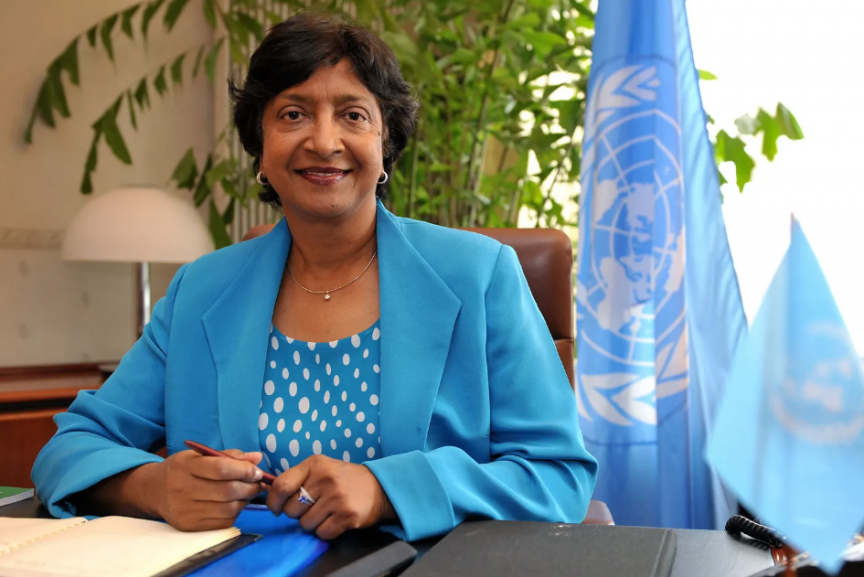
She currently sits as an ad hoc judge at the International Court of Justice, adjudicating the case brought by The Gambia against Myanmar over allegations of genocide.
The Norwegian Nobel Committee stated that her “independence, expertise, and steadfastness” have established her as one of the most highly regarded international law specialists of the present era.
It also noted that she had played a central part in ensuring the prosecution of war crimes, crimes against humanity and genocide on the world stage.
Her “distinguished career reminds us of the need to support, fortify and expand the global rule of law,” the committee said.
Nelson Mandela appointed Ms Pillay to the High Court of South Africa in 1995, making her the first black woman to serve as a judge on that bench.
She went on to spend eight years at the International Criminal Tribunal for Rwanda, presiding over the court as its president from 1999 to 2003.
In the 1998 Jean-Paul Akayesu case, Ms Pillay co-authored the judgment that stated for the first time mass rape and sexual violence were crimes against humanity and acts of genocide.
A further milestone came with the 2003 Media Case, which established that radio broadcasts and newspaper articles had been used to incite the 1994 genocide.
Between 2003 and 2008, Ms Pillay served as a judge in the Appeals Chamber of the International Criminal Court.
She was then appointed UN High Commissioner for Human Rights, a position she held from 2008 to 2014.
During her time as commissioner, she championed the rights of detainees, women, children and torture victims, while also pressing powerful states on war crimes and civil liberties abuses.
She became a pioneer in advocating for LGBTQ+ rights and worked to combat systemic racism globally.
Her mandate also took her to Sri Lanka in 2013, where she raised concerns about accountability for alleged wartime abuses and the intimidation of journalists and activists.
Nobel Peace Prize Awarded to Judge Who Ruled Israel Committed Genocide in Gaza
The 2026 Nobel Peace Prize has been awarded to South African jurist Navi Pillay, a prominent international legal figure whose decades-long career has focused on human rights, international justice, and accountability for serious crimes. The decision has attracted worldwide attention because Pillay chaired a United Nations Commission of Inquiry that concluded in September 2025 that Israel had committed genocide against Palestinians in the Gaza Strip. Her recognition has reignited international debate over the war in Gaza, the responsibilities of governments under international law, and the role of international institutions in protecting civilians.
Announced on October 9, 2026, the award recognises Pillay’s longstanding efforts to strengthen international justice and uphold the rule of law. According to the Norwegian Nobel Committee, her work demonstrates the importance of legal institutions in preventing violence and holding those responsible for serious international crimes accountable. However, the decision has also provoked criticism, particularly from Israeli officials, who strongly reject the conclusions of the UN investigation.
The award therefore represents more than an individual achievement. It highlights the continuing struggle over the interpretation and enforcement of international law in a world increasingly divided by armed conflicts and political disagreements. <Cite refs={[“turn680850news1″,”turn680850news3”]}/>
Who Is Navi Pillay?
Navanethem “Navi” Pillay was born in Durban, South Africa, in 1941, during the apartheid era. Growing up in a society characterised by racial discrimination, she developed a strong commitment to equality, human rights, and justice.
In 1967, Pillay became the first woman to establish a law practice in South Africa’s Natal Province. She subsequently became involved in defending political prisoners and opposing discriminatory practices under apartheid. Her legal career developed during a period when challenging the authorities could involve considerable personal and professional risks.
Following the end of apartheid, Pillay continued to build an international reputation. In 1995, she became the first Black woman appointed as a judge of South Africa’s High Court. She later served at the International Criminal Tribunal for Rwanda, where she contributed to important legal developments concerning genocide and sexual violence during armed conflict.
Between 2003 and 2008, she served as a judge at the International Criminal Court. She subsequently became the United Nations High Commissioner for Human Rights, holding that position from 2008 to 2014.
Throughout her career, Pillay has argued that governments and individuals exercising political or military power must remain accountable under international law. Her work has involved some of the most difficult questions confronting the international community, including genocide, crimes against humanity, discrimination, and the protection of vulnerable populations. <Cite refs={[“turn680850search7″,”turn680850news13”]}/>
The Gaza Investigation That Brought International Attention
Pillay’s recent work on Gaza has become one of the most controversial aspects of her career.
As chair of the UN Independent International Commission of Inquiry on the Occupied Palestinian Territory, including East Jerusalem, and Israel, she oversaw an investigation into events following the Hamas-led attacks on Israel on October 7, 2023, and the subsequent Israeli military campaign in Gaza.
On September 16, 2025, the commission published a report concluding that Israel had committed genocide against Palestinians in Gaza. The investigation examined evidence relating to killings, serious physical and psychological harm, living conditions imposed on the population, and measures affecting Palestinian births.
The commission also assessed statements made by Israeli political and military officials, alongside patterns of military operations and their consequences for civilians. It concluded that the evidence supported a finding of genocidal intent under the definition established by the 1948 Genocide Convention.
Pillay publicly defended the commission’s conclusions, arguing that the findings were based on an examination of evidence and the relevant provisions of international law.
Israel rejected the report and disputed its conclusions. The allegations remain highly contested, and it is important to distinguish the commission’s findings from a final judicial determination of state responsibility by an international court.
Nevertheless, the report intensified international scrutiny of Israel’s conduct in Gaza and renewed discussions about the legal obligations of states during armed conflict. <Cite refs={[“turn680850search9″,”turn680850news3”]}/>
Why Did the Nobel Committee Choose Pillay?
The Nobel Peace Prize is frequently associated with diplomatic negotiations, peace agreements, and efforts to end armed conflicts. However, the committee has also recognised individuals who work to strengthen human rights, international cooperation, and the institutions intended to prevent future atrocities.
In Pillay’s case, the committee emphasised her longstanding commitment to international justice and the principle that powerful individuals and governments should be subject to legal accountability.
The committee also highlighted the pressure facing international legal institutions. In its announcement, it warned against a global political environment in which power increasingly threatens to take precedence over established legal frameworks.
Pillay’s career reflects this broader concern. Her work has extended from opposing apartheid in South Africa to serving in international courts and leading UN investigations into serious human rights violations.
The Nobel Committee’s stated rationale was therefore wider than the Gaza investigation alone. It recognised her contributions to international law over several decades, including her work on genocide, war crimes, and crimes against humanity.
The committee’s chair also clarified that awarding Pillay the prize did not constitute an independent determination that Israel had committed genocide. That question involves legal findings and procedures distinct from the Nobel Peace Prize selection process. <Cite refs={[“turn680850news1″,”turn680850search11”]}/>
International Reactions and Political Controversy
The decision has produced sharply contrasting reactions.
Human rights organisations and supporters of international justice have welcomed the award as recognition of the importance of protecting civilians and ensuring accountability for serious crimes. Amnesty International, for example, praised Pillay’s commitment to human rights and the independence of international legal institutions.
Supporters argue that international law cannot function effectively if governments are able to avoid scrutiny because of their political influence or military power. From this perspective, the award reinforces the principle that allegations of grave violations must be investigated through established procedures.
Israeli officials, however, have strongly criticised the decision. Israel has rejected the genocide allegations and argued that the UN commission’s conclusions are unacceptable. The controversy reflects wider disagreements over the interpretation of the Gaza conflict, the conduct of Israeli military operations, and the responsibilities of the international community.
These competing responses demonstrate how difficult it has become to separate legal debates from broader geopolitical rivalries.
Nevertheless, criticism of a report or an award does not, by itself, settle the underlying legal questions. Those questions require careful consideration of evidence, applicable law, and the authority of the institutions responsible for examining them.
It is equally important to recognise that scrutiny of government actions should not become hostility towards ordinary people because of their nationality, religion, or identity. Protecting Palestinian civilians, addressing Israeli security concerns, opposing antisemitism, and rejecting anti-Palestinian discrimination are not mutually exclusive objectives. <Cite refs={[“turn680850news6″,”turn680850news8”]}/>
What Does International Law Say About Genocide?
Genocide is among the most serious crimes recognised under international law. The 1948 Genocide Convention defines it through specified acts committed with the intention of destroying, in whole or in part, a national, ethnical, racial, or religious group as such.
Establishing genocide requires more than demonstrating that large numbers of civilians have died or that widespread destruction has occurred. Investigators and courts must examine the prohibited acts and the specific intent required by the legal definition.
This distinction is essential when evaluating allegations arising from armed conflict. Civilian casualties, forced displacement, destruction of infrastructure, restrictions on humanitarian assistance, and statements by political leaders may all be relevant evidence. However, their legal significance depends on the circumstances and the applicable standards of proof.
Different international bodies also have different responsibilities. A UN Commission of Inquiry investigates events, gathers evidence, and makes findings within its mandate. The International Court of Justice, by contrast, adjudicates legal disputes between states, including cases brought under the Genocide Convention.
The International Court of Justice has issued provisional measures in the case brought by South Africa against Israel. These measures are legally binding, but they are not themselves a final judgment that genocide has occurred.
As of the reporting surrounding Pillay’s Nobel award, the commission’s conclusion should therefore be described accurately as a UN investigative finding rather than a final judicial ruling establishing Israel’s responsibility for genocide.
Maintaining these distinctions does not diminish the seriousness of the allegations. Instead, it ensures that public discussion remains grounded in the law and the evidence. <Cite refs={[“turn680850search9″,”turn680850news13”]}/>
The Wider Significance for Global Peace
Pillay’s award comes at a time when international institutions face growing challenges in responding to armed conflicts and alleged violations of international law.
The effectiveness of these institutions depends partly on whether states cooperate with investigations, respect judicial decisions, and accept that international rules apply to powerful and weaker countries alike.
When governments reject international scrutiny or when political rivalries prevent consistent enforcement, public confidence in the international legal system can weaken. The consequences may extend beyond one conflict, affecting efforts to prevent future atrocities and resolve disputes peacefully.
Pillay’s recognition highlights the importance of preserving independent investigations, protecting judges and legal professionals from improper political pressure, and ensuring that victims of serious crimes have opportunities to seek justice.
However, legal accountability alone cannot end every conflict. Sustainable peace also requires diplomacy, humanitarian assistance, protection for civilians, political engagement, and efforts to address the conditions that contribute to recurring violence.
The international community must therefore combine legal mechanisms with practical efforts to reduce suffering and establish a durable political settlement.
Conclusion
The 2026 Nobel Peace Prize awarded to Navi Pillay has placed international law and the war in Gaza at the centre of a renewed global debate. Her recognition reflects a career devoted to human rights, accountability, and the principle that no government should be beyond the reach of international justice.
Her leadership of the UN commission that concluded Israel had committed genocide in Gaza has made the award particularly controversial. Israel rejects that conclusion, while human rights advocates have welcomed the investigation as an important contribution to accountability.
Ultimately, the significance of the award extends beyond the controversy surrounding a single report. It raises fundamental questions about how the world responds to allegations of mass atrocities, how international institutions can maintain their independence, and whether legal principles can be applied consistently amid intense geopolitical pressure.
The pursuit of peace requires more than political declarations. It demands credible investigations, respect for international law, protection for civilians, and a willingness to confront evidence even when the conclusions are politically uncomfortable.
Pillay’s Nobel Peace Prize serves as a reminder that justice and peace are closely connected. Whether the international community can translate that principle into meaningful protection for people affected by conflict remains one of the defining challenges of the modern era.