

Reform Is on Fire: The Civil War Raging Inside Nigel Farage’s Party
Reform UK was once the political movement that appeared to have everything going its way. Led by Nigel Farage, the party surged in opinion polls, attracted Conservative defectors and presented itself as the most serious challenger to Britain’s established political order. Yet the picture in August 2026 is considerably more complicated. Behind the confident public image, Reform is facing growing internal tensions, personal rivalries and disagreements over the direction of the party. The suspension of senior figure Tim Montgomerie has exposed divisions that threaten to undermine the unity that helped Reform become one of the most powerful forces on the British right.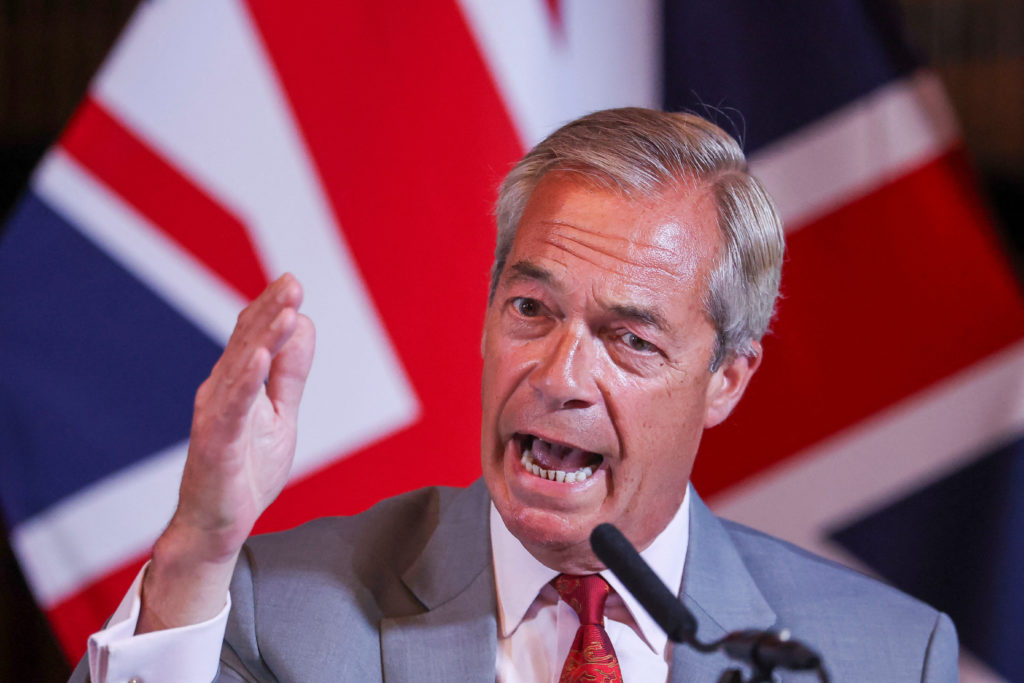
The timing could hardly be more awkward for Farage. Reform has recently demonstrated its electoral strength by winning the Clacton by-election, where Farage regained his parliamentary seat after resigning and forcing a fresh contest. He secured 62.8 percent of the vote, although the result was far less impressive than some opinion polling had predicted. The satirical candidate Count Binface won an unexpectedly large 26.7 percent, while the major political parties largely stayed out of the contest.
On the surface, Farage therefore remains politically powerful. But electoral victories can conceal internal problems. The latest dispute involving Tim Montgomerie demonstrates that Reform’s greatest challenge may not come from Labour, the Conservatives or rival parties. It may come from inside its own ranks.
Montgomerie is not an insignificant figure. A veteran Conservative activist and founder of ConservativeHome, he joined Reform after years of involvement in centre-right politics. His arrival was part of a broader movement of former Conservatives towards Farage’s party. Reform’s growth had benefited enormously from the perception that experienced Conservative politicians and activists were abandoning their old party because they believed Reform offered a more convincing alternative.
That makes his suspension particularly damaging. Rather than representing an attack from an outsider, the dispute involves someone who was once an ally and supporter of the political project Farage is attempting to build.
Montgomerie reportedly criticised Farage after the Clacton by-election, particularly over the Reform leader’s decision not to attend the vote count. Farage said police had warned him about a potential disruption and therefore stayed away. He later cancelled a planned victory speech, arguing that he would not allow himself to be humiliated by people he regarded as insignificant. Montgomerie questioned the tone and judgment of Farage’s response. Reform subsequently suspended him.
The controversy has developed into a much larger argument about freedom of speech within Reform UK.
Montgomerie has vowed to challenge his suspension and turn the dispute into a test of whether the party is capable of tolerating internal criticism. His argument is straightforward: if Reform wants to become a national governing party, it must be able to accommodate disagreement. A political organisation cannot realistically present itself as an alternative government while treating criticism from senior supporters as disloyalty.
Richard Tice, Reform’s deputy leader, has defended the suspension. He has argued that disagreements should largely remain private and insisted that Reform continues to allow debate. His intervention reveals the difficult balance facing the party. Reform wants to project discipline and unity, particularly while it is attempting to convince voters that it is ready for government. But excessive discipline can easily become perceived as intolerance.
The dispute is not isolated.
Reform has also experienced tensions surrounding Zia Yusuf, one of Farage’s most prominent allies. Yusuf has attracted criticism for his aggressive political rhetoric, including a controversy involving his description of a senior Conservative figure as a “traitor.” Such language may energise Reform’s most committed supporters, but it can also create difficulties for a party trying to persuade moderate voters that it is capable of governing responsibly.
This raises a fundamental question: what exactly does Reform UK want to become?
For much of its history, the party’s strength came from protest. Under Farage, the Brexit Party and subsequently Reform UK were highly effective at identifying public anger and turning it into electoral support. Immigration, Brexit, political correctness, government bureaucracy and distrust of Westminster have all provided fertile ground for the movement.
But becoming a serious governing party is different from being a successful protest movement.
A protest party can survive on strong personalities, dramatic rhetoric and simple political messages. A governing party requires organisation, internal discipline, detailed policies and the ability to resolve disagreements without public breakdowns. Reform is now attempting to make that transition while still relying heavily on Farage’s personality.
This creates a structural weakness.
Farage is undoubtedly Reform’s greatest political asset. His name is known across Britain, and his ability to attract media attention remains extraordinary. His supporters regard him as authentic, direct and willing to challenge subjects that other politicians avoid. Reform’s strong polling earlier in 2026 demonstrated how effectively his political brand can translate into national support. Reuters reported in March that Reform was leading Labour in national opinion polling and that Farage was openly presenting the party as a potential future government.
Yet the same personal dominance that makes Farage electorally powerful can create internal tensions. If the party’s identity becomes too closely associated with one individual, disagreement with that individual can quickly become disagreement with the entire organisation.
This is precisely what the Montgomerie dispute appears to demonstrate.
There is also a wider ideological battle taking place on Britain’s right. Reform is not operating in a vacuum. Rupert Lowe, a former Reform MP, has established Restore Britain, a rival political movement seeking to occupy territory further to the right. Restore has attempted to attract voters who believe Reform has not gone far enough on immigration and other cultural issues. The emergence of such a rival creates additional pressure on Farage.
Farage therefore faces two competing dangers.
If he moderates Reform, he risks losing supporters to more radical rivals. If he maintains an uncompromising political style, he risks alienating voters who might otherwise consider supporting Reform as a mainstream alternative to the Conservatives.
The problem is especially important because Reform’s electoral coalition is broader than its most vocal online supporters. Many people who vote for Reform are motivated by concerns about immigration, public services, living costs and distrust of established political parties. They may not necessarily want a permanent culture war. They may simply want a government they believe will be more effective.
Reform’s own policy platform reflects its desire to appear ready for government. The party advocates reducing the size of the civil service, cutting what it describes as waste, reducing regulation and focusing the state on delivery and value for money.
Those policies require a very different political organisation from the one traditionally associated with Farage’s campaigns.
A government cannot function through constant confrontation. Ministers need to work with civil servants, local authorities, businesses, international governments and other political institutions. They also need to persuade Parliament and the public that difficult decisions are based on coherent principles rather than personal disputes.
The internal arguments within Reform therefore matter because they offer voters a preview of how the party might behave in government.
The party’s defenders argue that every successful political movement experiences internal disagreements. Reform’s rapid expansion means that it has brought together people from very different political backgrounds. Former Conservatives, Brexit campaigners, libertarians, social conservatives and populist activists do not necessarily agree on every issue. Some disagreement is therefore inevitable.
But the question is whether Reform can manage those disagreements constructively.
The suspension of Montgomerie has created doubts precisely because it appears to punish criticism from within the movement. His challenge has consequently become symbolic. It is no longer simply about whether one activist broke party rules. It is about whether Reform can tolerate competing personalities and opinions while maintaining a coherent political identity.
The irony is that Farage built much of his career criticising the traditional parties for being closed, elitist and disconnected from ordinary members. Reform’s supporters expect it to be different. If senior figures begin to feel that disagreement is unacceptable, critics will inevitably accuse the party of reproducing the same political culture it once condemned.
Farage’s recent Clacton victory gives him some protection. He remains an exceptionally effective campaigner, and his ability to mobilise voters should not be underestimated. But the result also contained warnings. Count Binface’s unexpectedly strong performance and the lack of serious competition from the major parties meant that the election was hardly a conventional test of Reform’s national popularity.
At the same time, national momentum has become less certain. The rise of Labour under Prime Minister Andy Burnham, the Conservatives’ attempts to recover under Kemi Badenoch and the emergence of Restore Britain have all complicated Farage’s path to power. The political environment that previously appeared to favour Reform is becoming more competitive.
This makes internal unity more important than ever.
If Reform is to transform itself from a protest movement into a credible government-in-waiting, it will need more than Farage’s popularity. It will require competent MPs, disciplined spokespeople, credible economic policies and a leadership culture that can withstand disagreement.
The party is therefore approaching a crucial crossroads.
One path is to remain a highly personalised populist movement centred on Farage. That model could continue to deliver impressive electoral performances, particularly if public frustration with the established parties remains high.
The other path is to become a more conventional political organisation capable of governing. That would mean developing stronger institutions, accepting internal disagreement and demonstrating that political differences can be resolved without public warfare.
The civil war now unfolding inside Reform UK may ultimately determine which path it chooses.
Farage has spent decades proving that he can create political movements and reshape Britain’s political debate. The harder task now is proving that the movement he has created can survive the pressures of success.
Reform is still a formidable force. It has councillors across the country, a growing parliamentary presence, substantial public attention and a leader with extraordinary political experience. But political success brings new expectations. Voters who once wanted Reform to disrupt the system may eventually ask a different question: can Reform actually run it?
The answer will depend not only on Farage’s ability to defeat his political opponents, but also on his ability to manage the people standing beside him.
The current dispute with Tim Montgomerie is therefore more than an internal quarrel. It is a test of Reform UK’s political maturity. If the party can emerge from the conflict stronger, more organised and more tolerant of disagreement, the episode may eventually be forgotten. If the divisions deepen, however, the internal battles could become more damaging than any attack launched by Labour or the Conservatives.
For Nigel Farage, the greatest threat may no longer be whether Reform can win voters.
It may be whether Reform can keep its own people together long enough to turn that support into lasting political power.