
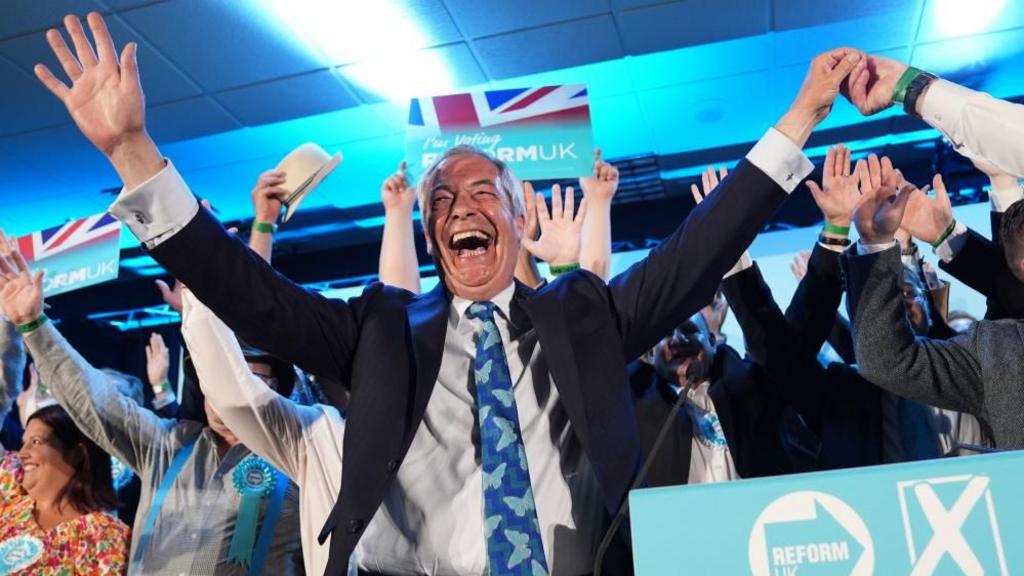
Reform UK Storms to Double By-Election Victory as Labour Suffers a Devastating Political Blow
Reform UK’s latest by-election successes have delivered another powerful warning to Britain’s established political parties.
Two victories in Bury and Luton have strengthened Nigel Farage’s argument that Reform UK is no longer simply a protest movement. It is becoming a serious electoral force capable of taking seats from parties that have dominated British politics for generations.

The results are particularly significant because Reform’s gains came in areas with very different political traditions. The party has demonstrated that its appeal is not confined to one narrow section of the electorate.
In Bury, Reform took a council seat from the Conservatives, polling 39.5 per cent. In Luton’s Wigmore ward, Reform also secured victory, adding another local success to an increasingly impressive sequence of results.
The wider context makes these results even more important.
In the 2026 English local elections, Reform secured the largest overall vote share, 23.8 per cent, and won 1,454 of the 5,036 contested council seats.
For Labour, the warning signs are particularly serious.
A Political Earthquake at Local Level
By-elections are often treated as minor political events.
They should not be.
A by-election strips away many of the advantages enjoyed by established parties during a national contest. There is no enormous general-election campaign dominating the news for weeks. Instead, candidates must convince voters directly.
That makes individual results useful indicators of political mood.
Reform’s victories in Bury and Luton therefore provide another indication that the party’s support has penetrated areas where Labour and the Conservatives have traditionally competed strongly.
The numbers matter, but the direction of travel matters even more.
Reform is winning.
And it is winning from different parties.
That is one of the most dangerous characteristics of an insurgent political movement.
Bury: Reform Takes a Conservative Seat
The Bury result was particularly significant because Reform took the seat from the Conservatives.
That demonstrates the pressure Nigel Farage is placing on the political right.
For decades, Conservative candidates could rely on a substantial bloc of voters who supported the party because they wanted lower taxes, stronger borders, reduced regulation and a more conservative approach to social issues.
Reform is now competing directly for those voters.
The Conservative Party therefore faces a difficult problem.
If it moves towards Reform on issues such as immigration and taxation, it risks appearing to imitate Farage.
If it refuses to move in that direction, it risks losing more voters to Reform.
The Bury result shows that this is not merely a theoretical problem.
The Conservative vote can be transferred directly to Reform.
Luton: A Different Kind of Challenge
The Luton result is potentially even more interesting because it demonstrates Reform’s ability to make progress outside traditional Conservative territory.
Reform’s expansion into areas where Labour has historically been competitive is critical to Farage’s long-term ambitions.
A party cannot become Britain’s governing force simply by replacing the Conservatives as the dominant party on the right.
It needs to take votes from Labour as well.
That is why local results such as these matter.
They help answer the question of whether Reform can build a genuinely national coalition.
Labour’s Vulnerability
Labour’s problem is not simply losing individual seats.
It is the possibility that Reform is becoming the vehicle for voters who are increasingly frustrated with the Government.
Labour entered office with a large parliamentary majority and a powerful mandate.
But governments often experience a honeymoon period followed by increasingly difficult political realities.
Once voters begin focusing on taxes, household finances, immigration, public services and the cost of living, the governing party becomes responsible for the problems it previously promised to solve.
Every disappointment creates an opportunity for the opposition.
Reform is trying to turn those opportunities into permanent electoral support.
Farage’s Political Strategy
Nigel Farage understands that winning national elections requires more than a strong personal following.
Reform needs councillors.
It needs local activists.
It needs candidates.
It needs campaign infrastructure.
And, above all, it needs evidence that its support exists beyond Farage himself.
Local election victories provide exactly that evidence.
When Reform wins a council seat without Farage appearing on the ballot paper, the party can demonstrate that voters are supporting the organisation rather than simply voting for its leader.
That is enormously important.
The Transformation of Reform UK
These victories are also part of Reform’s broader transformation.
The party has moved a long way from its origins as a vehicle for Brexit and protest politics.
It now controls councils and has built a substantial presence in local government.
The May 2026 local elections were particularly dramatic.
Reform won 18 of 19 contested seats in Tameside, overtaking the Conservatives to become the official opposition while Labour lost its long-standing majority.
In Newcastle-under-Lyme, Reform won 27 of 44 seats and took overall control of the council. Labour was reduced to just two seats.
These are not the results of a marginal protest party.
They demonstrate a movement capable of building an increasingly extensive political organisation.
The Collapse of the Two-Party Model
The most important implication may be the weakening of Britain’s traditional two-party system.
For generations, British politics has been structured around Labour and the Conservatives.
Other parties have existed, sometimes with substantial support.
But national political power has generally remained concentrated between the two major parties.
Reform threatens that structure.
If voters who once supported the Conservatives move to Reform, while working-class Labour voters also become available to Farage, the traditional political map begins to break down.
That is exactly the environment in which a new political force can grow rapidly.
Why Reform Appeals to Former Conservative Voters
The Conservative-Reform competition is relatively straightforward.
Farage offers voters a harder line on immigration, a stronger emphasis on national sovereignty and a more aggressive challenge to government spending and regulation.
For some Conservative voters, that is precisely what they believe the Conservative Party has failed to deliver.
Reform therefore does not need to persuade these voters that they are naturally Reform supporters.
It only needs to persuade them that the Conservatives are no longer capable of representing them.
The More Difficult Labour Challenge
Winning Labour voters is more complicated.
Labour’s traditional coalition is broader and more diverse.
It includes urban professionals, public-sector workers, working-class voters, younger people and socially liberal voters.
Reform cannot appeal equally strongly to all of them.
But Farage does not need to.
He only needs to persuade a significant minority that Labour has abandoned their priorities.
Immigration, housing, taxation and public services can become particularly important in this respect.
If voters believe that Labour is spending too much, taxing too much or failing to control immigration, Reform can offer itself as the alternative.
The Importance of Local Results
Local elections are especially useful for Reform because they allow the party to build credibility gradually.
A parliamentary election can produce a dramatic result overnight.
Local politics develops differently.
Councillors gain experience.
Party organisations develop.
Campaign teams become stronger.
Voters see Reform representatives actually governing.
That last point is crucial.
If Reform wants to become a national governing party, it must demonstrate that it can administer councils effectively.
Winning is only the first test.
Governing is the second.
Reform’s Greatest Opportunity
The party’s greatest opportunity is the apparent weakness of its traditional opponents.
Labour remains vulnerable to criticism over its governing record.
The Conservatives continue to struggle with the question of how to compete with Farage without simply becoming a second Reform.
The Liberal Democrats have their own geographical strengths but are unlikely to absorb the entire anti-establishment vote.
The Greens are also growing in some parts of England but represent a fundamentally different political alternative.
That leaves Reform with an unusual opportunity.
It can present itself as the main challenger to the established parties.
But the Momentum Could Change
There is an important warning against assuming that Reform’s rise is inevitable.
Politics changes quickly.
Indeed, recent developments demonstrate how volatile the situation remains.
A YouGov survey reported by The Times has shown Labour overtaking Reform nationally, with Labour on 24 per cent and Reform on 22 per cent. The figures suggest that Reform’s earlier momentum can be challenged and that voters remain highly fluid.
More importantly, Reform has suffered setbacks as well as victories.
In the Greater Manchester mayoral by-election, Labour’s Bev Craig defeated Reform’s candidate Sian Astley decisively in the final result, winning 66.3 per cent after second preferences compared with Reform’s 33.7 per cent.
That is an important reminder.
Reform is rising in some places.
But it is not unstoppable.
The Manchester Warning
The Greater Manchester result illustrates a crucial point about Reform’s national ambitions.
A party can perform extraordinarily well in local elections while still encountering serious obstacles in larger metropolitan areas.
Greater Manchester remains politically distinctive.
Labour’s local organisation is strong.
Andy Burnham’s political legacy remains influential.
And Labour can still mobilise voters when the contest becomes sufficiently important.
Reform therefore cannot simply assume that national polling will translate automatically into every constituency.
The First-Past-the-Post Problem
This is particularly important for Farage.
Britain’s parliamentary electoral system rewards concentrated support.
A party can win millions of votes nationwide but fail to win constituencies if those votes are spread too evenly.
Reform’s local-election victories are encouraging because they demonstrate geographical strength.
But the party still needs to convert that strength into parliamentary seats.
That will be one of Farage’s greatest strategic challenges.
From Protest to Power
The latest by-election victories nevertheless strengthen the argument that Reform is moving beyond protest politics.
A protest party can win attention.
A serious political party wins seats.
Reform is now doing the latter.
The party’s representatives are increasingly involved in the practical business of local government.
That creates both opportunities and risks.
Success makes Reform more credible.
But governing exposes the party to scrutiny.
Once Reform controls a council, voters can judge its performance.
If services improve and taxes are controlled, Reform can claim that its approach works.
If councils struggle, opponents will use those failures against Farage.
The “Can They Govern?” Question
This is perhaps the central issue for Reform now.
For years, Farage could criticise governments without being responsible for their decisions.
That is becoming increasingly difficult.
If Reform wants to win a general election, voters will eventually ask what it would actually do in government.
They will want detailed answers about the NHS.
They will want to know how welfare would be reformed.
They will want to understand the economics of tax cuts.
They will ask how immigration targets would be implemented.
And they will want to know whether Reform can maintain public services while reducing the size of government.
Local government victories give Reform an opportunity to begin answering those questions.
The Conservatives Face an Existential Threat
The Bury victory demonstrates why the Conservatives should be particularly worried.
A Reform victory over Labour can be explained as dissatisfaction with the Government.
A Reform victory over the Conservatives demonstrates something deeper.
It suggests that some voters who previously considered themselves naturally Conservative now believe Reform is a better vehicle for their political priorities.
That could permanently reshape the British right.
If the Conservatives become the third party in large numbers of constituencies, their path back to government becomes extremely difficult.
Labour’s Strategic Dilemma
Labour has a different problem.
It cannot simply copy Reform.
Its political coalition is different.
But it also cannot ignore the issues that are driving voters towards Farage.
That creates a difficult balancing act.
Labour must appeal to its traditional supporters while attempting to recover voters who have moved towards Reform.
If it shifts too far right, it could alienate younger and more progressive voters.
If it stays where it is, Reform may continue attracting dissatisfied working-class voters.
Farage’s Biggest Advantage
Farage’s greatest advantage is that he can attack both major parties simultaneously.
He can tell Conservative voters that their party failed.
He can tell Labour voters that the Government has failed.
And he can tell everyone that Reform is different.
That is a powerful political position.
It allows him to benefit from dissatisfaction regardless of which established party is currently unpopular.
The Importance of Candidate Quality
However, Reform’s expansion creates another challenge.
Winning hundreds of council seats requires hundreds of candidates.
Rapid recruitment can produce problems.
A national political party needs people who understand local government, public administration and ethical standards.
As Reform grows, candidate selection will become increasingly important.
The party can no longer afford to behave like a purely protest organisation.
Its representatives will be scrutinised.
Every controversial statement can become a national story.
Reform’s Double Victory Is Symbolic
The Bury and Luton victories are therefore important not merely because of the individual seats.
They symbolise something broader.
Reform can win.
Reform can take seats from established parties.
And Reform can do so in different political environments.
That is precisely the kind of evidence Farage needs as he attempts to convince voters that Reform can become a governing party.
A New Political Map
Britain’s political geography may be changing.
The old map was relatively simple.
Conservatives dominated much of southern England and rural areas.
Labour dominated many northern cities and industrial communities.
The Liberal Democrats had pockets of strength.
That map is becoming increasingly complicated.
Reform is now competing across both traditional Conservative and Labour territory.
The 2026 local-election results provide evidence of this transformation.
Reform’s largest vote share nationally, combined with substantial gains across councils, suggests that its appeal is no longer restricted to one region or social group.
The Road to Westminster
Local victories alone will not put Farage into Downing Street.
But they can build the infrastructure required to make that possibility realistic.
Every councillor creates another political contact.
Every successful campaign produces experienced activists.
Every council victory demonstrates organisational capability.
Every former mainstream voter who switches to Reform weakens the established parties.
Over time, these small developments can become a national movement.
What Labour Should Fear Most
The biggest danger for Labour is not necessarily that Reform wins every seat.
It is that Reform changes the political conversation.
If Labour begins changing its policies simply because it fears Reform, Farage has already achieved something important.
He can influence government without being in government.
That is one of the defining characteristics of successful populist movements.
What Reform Must Do Next
The party now has to prove that its electoral success is sustainable.
It needs to demonstrate competence in local government.
It needs to avoid internal divisions.
It needs to recruit credible candidates.
It needs detailed economic policies.
And it needs to show voters that its representatives can deliver rather than simply protest.
That is the difference between political popularity and governing credibility.
Conclusion
Reform UK’s double by-election success in Bury and Luton represents another significant moment in Britain’s rapidly changing political landscape.
The victories demonstrate that Nigel Farage’s party can take seats from established political forces and expand its presence beyond the areas where it was initially strongest. Reform’s 39.5 per cent result in Bury and its victory in Luton’s Wigmore ward fit into a much wider pattern of local electoral growth.
The wider 2026 local-election results reinforce the point.
Reform won the largest share of the English local-election vote and took more seats than any other party.
Yet the story is not one of unstoppable Reform dominance.
Labour has demonstrated that it can recover ground, particularly in Greater Manchester, while recent polling has shown the two parties extremely close nationally.
That makes the next stage of the political battle even more important.
Farage has successfully turned Reform into a serious electoral organisation.
Now he must prove that it can do something much harder:
win consistently, govern competently and persuade millions of voters that Reform is not merely the party of protest, but the party capable of running Britain.
The Bury and Luton victories bring him another step closer to that objective.
For Labour, they are a warning.
For the Conservatives, they are an even bigger threat.
And for Farage, they provide the political momentum he needs to make his most ambitious argument yet:
Britain’s old political order is no longer guaranteed—and Reform UK may be the force that replaces it.