
-
Reform Storms to Historic Victory as Nigel Farage Celebrates Biggest-Ever By-Election Win
-
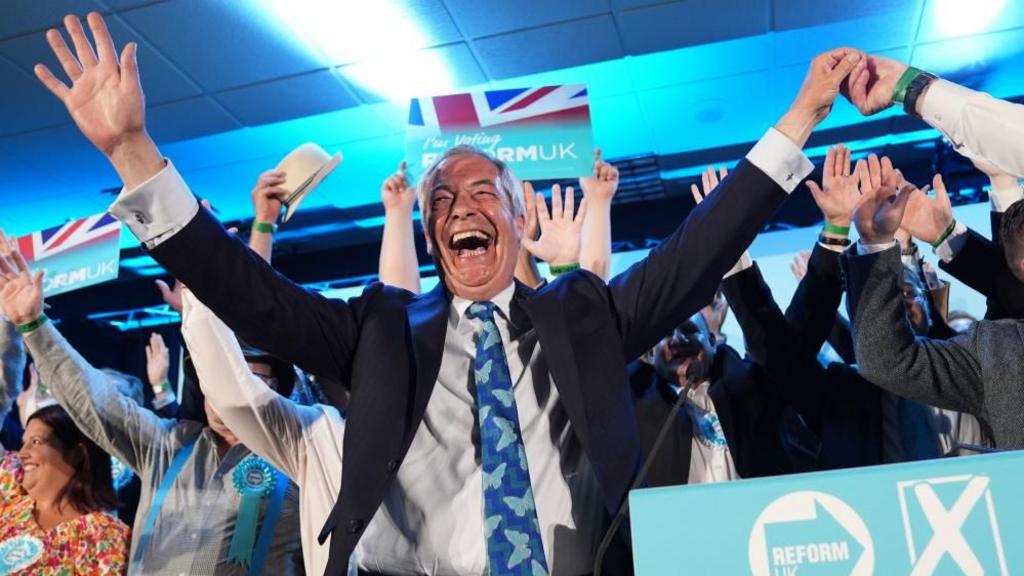 Britain’s political landscape has been shaken once again as Reform UK and its leader Nigel Farage celebrate another dramatic electoral breakthrough, with the party presenting its latest successes as evidence that the traditional two-party system is rapidly losing its grip on the country.
The result comes after a remarkable period for Reform UK, which has expanded far beyond its origins as a Brexit-focused political force and established itself as a major challenger to both Labour and the Conservatives. In May’s local elections, Reform won more than 1,450 council seats and took control of 14 councils, while Farage declared that Britain was witnessing a “historic shift” in politics.
-
 That momentum has now been reinforced by a series of electoral contests, including the latest high-profile by-election victory involving Farage himself.
The atmosphere surrounding Reform has been transformed. Only a few years ago, the party was widely regarded as a protest movement capable of influencing the political debate but unlikely to become a serious governing force. Today, its candidates are winning in areas that once appeared firmly controlled by Labour or the Conservatives.
For Farage, the significance extends beyond any single constituency.
He has repeatedly argued that voters are no longer willing to accept the political choices offered by the established parties. Reform’s message is built around immigration, national sovereignty, government reform, taxation, public spending, crime, and dissatisfaction with Westminster politics.
The party’s supporters believe those issues have created a new political coalition—one that cuts across traditional class and regional divisions.
A Political Earthquake
The scale of Reform’s rise became particularly clear during the 2026 local elections.
The party claimed 1,454 council seats, took control of 14 councils and received around 3.6 million votes. Reform made gains from both Labour and the Conservatives, demonstrating that its appeal was not restricted to one part of England.
Among the most symbolically important victories were gains in places associated with Labour for generations.
Sunderland, traditionally regarded as a Labour stronghold, fell under Reform’s control. The party also made major advances in Essex and other areas historically dominated by the Conservatives. Farage seized on the results as evidence that the old political map was being redrawn.
The message was simple: Reform was no longer merely taking votes from one particular party.
It was challenging the entire political establishment.
That argument has become central to Farage’s political strategy. Rather than presenting Reform as a conventional centre-right party, he portrays it as a movement challenging the assumptions that have governed British politics for decades.
“We are the dominant force in centre-right politics in Britain,” Farage has argued, while describing Reform’s growth as a broader political revolution.
Farage’s Return to the Front Line
At the centre of the movement is Farage himself.
Few British politicians have been as closely associated with a single political cause as Farage has been with Brexit. He spent years campaigning for Britain to leave the European Union before eventually returning to frontline politics and winning the Clacton parliamentary seat in 2024.
He has since turned Reform UK into a much more ambitious political organization.
The party’s rise has also placed enormous pressure on the Conservatives, who are competing for many of the same voters. But Reform’s expansion has not been limited to traditionally Conservative territory. Its success in Labour heartlands has made the threat considerably more serious for the entire political establishment.
The latest by-election developments therefore carry significance far beyond the immediate result.
For Farage, every successful contest provides another opportunity to argue that Reform has moved from the margins into the centre of British political competition.
The Clacton Test
Farage’s most recent parliamentary victory came in the Clacton by-election, which he himself triggered after resigning his seat.
The contest was highly unusual. Major political parties chose not to participate, while the ballot paper contained an extraordinary 34 candidates. Satirical candidate Count Binface finished second with 9,455 votes, while Farage secured 22,239 votes, representing roughly 63% of the vote. Turnout was around 44%.
Farage did not attend the official count, instead appearing at his own event outside the town.
The unusual circumstances meant that the victory cannot be compared directly with a conventional general election contest. Nevertheless, the scale of Farage’s vote demonstrated that he retains substantial personal support in Clacton.
It also showed how unusual British politics has become.
A parliamentary by-election normally attracts intense competition between the country’s major political parties. In Clacton, however, the established parties effectively stepped aside, leaving Farage facing a collection of independent, fringe and novelty candidates.
That did not prevent the result from generating headlines across Britain.
Beyond One Man
The biggest question now is whether Reform’s success can survive without being entirely dependent on Farage.
The party has attempted to build a nationwide organization capable of contesting thousands of seats. Its local election performance suggests that this process is already producing results.
Reform says its 2026 local election performance demonstrated national reach, with victories stretching from the North of England to the Midlands and the South. The party also made gains in Wales and Scotland, strengthening its argument that it is becoming a genuinely nationwide political organization.
That development could have profound consequences.
For decades, British politics was dominated by two parties: Labour and the Conservatives. Smaller parties could occasionally win large numbers of votes, but translating national support into parliamentary power was much harder.
Reform’s challenge is therefore not simply to win elections.
It is to break the political structure that has existed for generations.
A Warning for Labour
For Labour, Reform’s rise represents a serious strategic challenge.
The party has traditionally relied on strong support in working-class communities across northern and central England. But those voters are no longer automatically loyal to Labour.
Immigration, economic insecurity, public services, housing, crime and distrust of politicians have created an environment in which Reform can compete directly for voters who previously supported Labour.
The Makerfield by-election demonstrated that Reform can still face strong resistance. Labour’s Andy Burnham won that contest with 24,927 votes against Reform candidate Rob Kenyon’s 15,696.
That result was a reminder that Reform’s rise is not unstoppable.
But it also revealed something else: the party is now strong enough to make virtually every major electoral contest a potential test of the political establishment.
Conservatives Under Pressure
The Conservatives face an equally difficult challenge.
For years, Conservative leaders attempted to balance traditional conservative voters with a broader electoral coalition. Reform’s emergence has made that strategy much harder.
On issues such as immigration, taxation, regulation and Brexit, Reform frequently takes positions that appeal to voters who believe the Conservatives have become too moderate or too cautious.
Farage’s argument is that the Conservative Party had opportunities to deliver change but failed to do so.
That criticism has become increasingly effective.
The 2026 local elections showed Reform taking seats from the Conservatives in areas that had once been considered safe territory. Farage subsequently argued that the political landscape had changed permanently.
The Conservatives therefore face a dilemma.
Move closer to Reform and risk losing moderate voters—or attempt to occupy the political centre and risk losing more supporters to Farage.
The Road to Westminster
The ultimate objective is much larger than winning council seats or by-elections.
Reform wants to govern Britain.
Farage has repeatedly called for an early general election, arguing that voters should have the opportunity to decide the country’s political direction rather than allowing Westminster politics to determine it without a fresh national mandate.
Whether Reform can convert its electoral momentum into parliamentary power remains uncertain.
Britain’s first-past-the-post electoral system creates major obstacles for parties whose support is spread relatively evenly across the country. A party can win millions of votes without winning a proportional number of parliamentary seats.
Reform therefore needs more than popularity.
It needs concentrated support in constituencies where it can actually finish first.
The party’s local election successes suggest that this transformation may already be underway.
A New Political Era?
The remarkable feature of Reform’s rise is not simply the number of seats it has won.
It is the changing expectations surrounding the party.
Political commentators once debated whether Reform could survive beyond a single election cycle. Now the debate is increasingly about whether it could eventually become the largest force on the British right—and potentially a governing party.
Farage clearly believes that possibility is real.
His supporters see Reform as the vehicle for voters who feel ignored by Westminster. Critics, however, argue that the party’s ambitions are far greater than its current institutional experience and that converting protest votes into a functioning national government would be a very different challenge.
The truth will ultimately be determined by voters.
For now, one thing is undeniable: Reform UK is no longer an insignificant force on the edge of British politics.
Its victories have forced Labour and the Conservatives to rethink their strategies. Its candidates are winning seats in unexpected places. Its policies dominate debates about immigration and government reform. And its leader, Nigel Farage, remains one of the most recognizable and controversial figures in British politics.
The latest victory may be celebrated by Reform as another historic breakthrough.
But the bigger story is the political movement developing behind it.
Britain’s old political certainties are weakening. Voters are moving between parties in ways that would have seemed unlikely a decade ago. Former Labour voters are considering Reform. Former Conservative voters are doing the same. Traditional party loyalties are being replaced by increasingly fluid political identities.
For Farage, this is exactly the transformation he has spent years trying to achieve.
The question now is not whether Reform UK has changed British politics.
It already has.
The real question is how far that change will go—and whether Nigel Farage can turn an extraordinary sequence of electoral victories into something even more consequential: a genuine bid for power at Westminster.

Plus-Size-Influencerin geht mit Streiterei um Flugzeugtoilette viral
Übergewichtiger Mann im Flugzeugsitz. Bildnachweis: Shutterstock Fliegen mag zwar die schnellste Art zu reisen sein,...
24
Th3
Th3