
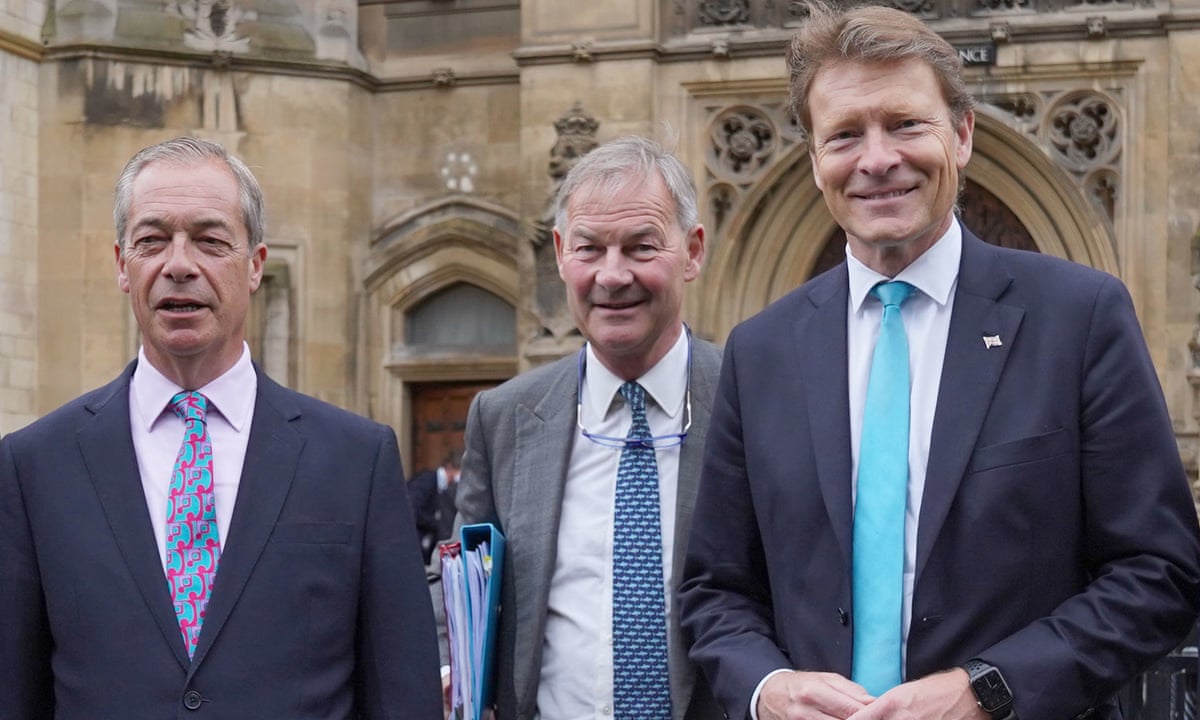
The bitter political feud between Rupert Lowe and Nigel Farage has entered another dramatic chapter, with claims of a supposed “revenge plot” against the Reform UK leader being fiercely disputed.
What began as an internal dispute within Reform UK has developed into a much broader political confrontation involving Lowe’s new political organisation, Restore Britain, and Farage’s Reform UK. Both figures have sought to present themselves as champions of voters who are dissatisfied with the established political parties, but their increasingly hostile relationship has created a new division on Britain’s political right.
Suggestions that Lowe’s political project is primarily an attempt to take revenge on Farage have been dismissed by Lowe and his supporters. At the same time, commentators and political opponents have interpreted the emergence of Restore Britain as a direct challenge to Reform UK and, by extension, to Farage’s leadership.
The reality is more complicated than a simple personal feud.
From Reform Ally to Political Rival
Rupert Lowe was elected to Parliament for Reform UK at the 2024 general election, becoming one of the party’s MPs.
His relationship with Farage and the wider Reform leadership subsequently deteriorated. Lowe publicly criticised aspects of the party’s direction and Farage’s leadership, while Reform accused Lowe of serious misconduct, including allegations concerning threats and bullying. Lowe denied the allegations and argued that his suspension was politically motivated.
The dispute became increasingly public during March 2025, when Reform suspended Lowe and removed the party whip. The party also referred allegations involving Lowe to the police.
Lowe strongly rejected the accusations. His parliamentary staff also issued an open statement disputing the allegations.
The breakdown was therefore not simply a disagreement over policy. It became an institutional and personal conflict involving accusations, counter-accusations and competing accounts of what had happened behind the scenes.
Farage subsequently made his own criticisms of Lowe, while Lowe continued to attack what he described as the leadership culture within Reform.
The dispute eventually resulted in Lowe developing a separate political organisation.
The Emergence of Restore Britain
Lowe initially established Restore Britain as a political movement and later developed it into a political party.
That development inevitably created a direct political challenge to Reform UK.
Restore Britain has presented itself as an organisation seeking major changes to Britain’s political system and policies. Its programme includes proposals concerning immigration, criminal justice, national identity, government spending and cultural issues.
The emergence of a new party led by a former Reform MP inevitably raised questions about whether Lowe intended to compete directly with Farage.
Some commentators have described the confrontation as a battle for the same electorate.
Others have gone further, portraying Restore as a deliberate attempt to damage Reform UK.
But the evidence for describing the entire project as a personal “revenge plot” is less straightforward.
Lowe has repeatedly presented Restore Britain as a political alternative rather than simply an instrument for settling personal scores.
In one public statement, he described the organisation as being opposed to what he called the established political system and said it intended to challenge the Westminster establishment.
That rhetoric suggests that Lowe sees his project as considerably broader than his disagreement with Farage.
Why the “Revenge” Narrative Has Emerged
Nevertheless, the revenge narrative has an obvious political context.
Lowe and Farage once belonged to the same political movement. Lowe was elected under the Reform banner, while Farage was the party’s most prominent national figure.
Their subsequent split meant that Lowe had moved from being a Reform representative to leading an organisation competing for voters who might otherwise support Farage.
This creates an unavoidable strategic conflict.
Every vote won by Restore Britain in a constituency where Reform is competing could potentially affect the balance between the parties.
That is why Reform supporters have accused Lowe of dividing the right-wing vote.
Lowe’s supporters, by contrast, argue that voters should have a genuine choice and that Reform should not be treated as the only political vehicle available to voters dissatisfied with the Conservative and Labour parties.
The disagreement is therefore not merely personal. It concerns political strategy and the future shape of Britain’s non-establishment right.
“It’s Tosh!”
The language surrounding the dispute has become increasingly colourful.
Claims that Lowe’s activities are simply about revenge have been dismissed by supporters as “tosh” — a British expression meaning nonsense or something regarded as untrue or exaggerated.
The argument from Lowe’s side is that focusing on personal animosity distracts from the policies that Restore Britain is actually proposing.
Lowe has argued that his movement is responding to what he sees as failures by the political establishment.
In his own public messaging, he has described Restore Britain as a challenge to the existing Westminster system and encouraged supporters to join the organisation.
Whether voters accept that explanation is ultimately a matter for them, but it is important to distinguish Lowe’s stated political objectives from claims about his private motives.
Farage Faces a New Challenger
For Farage, the emergence of Lowe as an independent political figure creates an unusual situation.
Reform UK has spent years attempting to consolidate support among voters dissatisfied with the traditional parties. Farage has positioned Reform as a major force capable of challenging Labour and the Conservatives.
A separate party attempting to attract voters from the same political territory creates the possibility of competition between organisations with overlapping concerns.
This has already been visible in political commentary surrounding elections and by-elections.
Commentators have discussed whether Restore Britain could attract enough support to affect Reform’s performance in individual constituencies. Some have described Lowe’s campaign as an attempt to undermine Farage.
But predicting the eventual electoral effect of Restore Britain would go beyond what the available evidence can establish.
What is clear is that the two organisations are competing for attention among at least some of the same voters.
The Role of Media and Social Media
The dispute has also been amplified by social media.
Both Farage and Lowe have substantial online audiences, allowing them to communicate directly with supporters without relying entirely on traditional broadcasters or newspapers.
Lowe has used social media to argue that Restore Britain is facing attacks from political opponents and the establishment. In one statement, he accused critics of attempting to undermine the movement through allegations, media coverage and political attacks.
At the same time, media personalities have interpreted the dispute in different ways.
Some commentators see Lowe’s challenge as evidence of a deeper ideological disagreement within Britain’s political right. Others see it primarily as a struggle between two individuals who once belonged to the same political organisation.
The difference between those interpretations matters because it affects how the public understands the origins of the conflict.
A History of Political Breakups
British politics has a long history of political organisations splitting into competing factions.
The emergence of a rival organisation does not necessarily mean that personal revenge is the primary motivation.
Political disagreements can involve policy, leadership, organisational culture, personality and electoral strategy simultaneously.
The Lowe-Farage dispute appears to contain elements of all these factors.
Lowe has criticised Reform’s leadership and policy direction, while Reform has defended its decision to remove him. The two sides have therefore developed competing explanations for the breakdown.
Neither side’s interpretation should automatically be treated as an independently established account of every disputed event.
That is particularly important when allegations about private motives are involved.
What Happens Next?
The future relationship between Reform UK and Restore Britain will depend heavily on electoral competition and political positioning.
If Restore concentrates on issues that overlap substantially with Reform’s platform, the two organisations will inevitably compete for some of the same supporters.
If Restore develops a distinctive identity, it may instead establish itself as a separate political force.
Lowe has already demonstrated that he is willing to challenge Farage publicly. His political messaging indicates that he does not intend to quietly disappear from national politics.
Farage, meanwhile, remains the central figure in Reform UK and has continued to build the party’s national profile.
Their political paths may therefore continue to intersect for some time.
More Than a Personal Feud
The description of Lowe’s political project as a “revenge plot” makes for a striking headline, but it risks reducing a complicated political dispute to a personal story.
The documented sequence is clearer.
Lowe became a Reform MP in 2024. His relationship with the party leadership deteriorated. Reform suspended him in 2025 following allegations that Lowe denied. He subsequently developed Restore Britain into an independent political organisation. The new organisation now occupies political territory that overlaps with Reform UK.
Those facts provide enough material for a major political conflict without assuming that every action is motivated by revenge.
The central question is therefore not simply whether Rupert Lowe wants revenge against Nigel Farage.
It is whether Restore Britain can establish itself as a sustainable political organisation, what policies it will pursue, and how voters who previously supported Reform UK respond to the new competition.
For Farage, the challenge is equally significant. Reform’s political project now faces competition from someone who understands its organisation from the inside and has built his own platform around a claim that Britain needs a different political direction.
For Lowe, the challenge is to demonstrate that Restore Britain is more than a reaction to his break with Reform.
The coming political contests will provide the clearest evidence.
For now, the “revenge plot” remains an interpretation of the feud rather than an established explanation for Lowe’s political ambitions. What is beyond dispute is that the former allies have become political rivals — and their confrontation has created another fault line in Britain’s rapidly changing political landscape.