
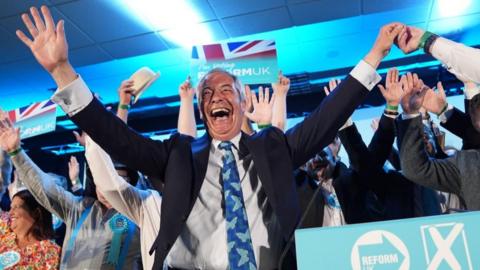
Shock Win for Reform: Is Britain’s Political Map About to Change?
Britain’s political landscape is undergoing a transformation that would have seemed almost unimaginable only a few years ago. Reform UK, led by Nigel Farage, has moved from being a protest force on the political fringe to becoming a serious challenger to the established parties. Its remarkable performance in the 2026 local elections, followed by Farage’s victory in the Clacton by-election, has raised a fundamental question: is Britain witnessing a temporary protest against the political establishment, or is the country’s electoral map being permanently redrawn?
The evidence suggests that something significant is happening. In the May 2026 local elections, Reform emerged as the strongest party in England, gaining around 1,450 council seats and taking control of numerous local authorities, while Labour suffered one of its worst performances in decades. The significance of these results goes beyond the number of councillors. Reform demonstrated that it could win in areas that had previously appeared secure for Labour or the Conservatives.
For decades, British politics was dominated by a relatively predictable geographical pattern. Labour controlled many urban and industrial areas, particularly in the North and Midlands, while the Conservatives dominated much of southern England and affluent suburban and rural communities. The Liberal Democrats maintained pockets of support, but the basic political map remained recognisable.
Reform has disrupted that pattern.
Its greatest achievement has been its ability to appeal to voters who are dissatisfied with both Labour and the Conservatives. The party’s central messages — tougher immigration controls, lower taxation, opposition to what it sees as excessive political correctness, and a rejection of the traditional Westminster establishment — have resonated with voters who believe the major parties have failed to address their concerns.
The 2026 elections provided dramatic evidence of this realignment. Analysis of the results showed Labour losing ground not only to Reform on the political right but also to the Greens on the left. In dozens of English councils, Labour’s share of seats fell to levels not seen for generations.
This is particularly dangerous for Labour because it means the party is being squeezed from both directions.
Traditional working-class voters who once regarded Labour as their natural political home can now choose Reform. Younger, environmentally conscious and socially progressive voters can move towards the Greens. In some areas, particularly those with large Muslim populations, independent candidates campaigning around Gaza have also challenged Labour.
The result is a fragmentation of the coalition that once allowed Labour to dominate many parts of Britain.
Yet Reform’s success should not be interpreted simply as a Conservative collapse. The Conservatives themselves have been severely weakened, and Reform is increasingly competing for voters who might once have supported the Tories. Indeed, the rise of Reform has created an existential question for the Conservative Party: can it recover its traditional supporters, or will it eventually be replaced as Britain’s main party of the right?
That possibility explains why Reform’s advance is so significant.
The party’s projected national vote share and local-election performance have already demonstrated that it can operate beyond the level of a protest movement. The 2026 local elections were particularly important because Reform had relatively few seats to defend, giving it an opportunity to expand rapidly across councils. Nevertheless, the scale of its gains showed that its organisation and electoral appeal had developed considerably.
The party’s success has also been strengthened by Nigel Farage’s personal political brand.
Farage has spent more than a decade presenting himself as an outsider challenging the political establishment. His role in the Brexit campaign transformed him into one of Britain’s most recognisable political figures. His decision to lead Reform rather than allow it to remain a small protest organisation has given the party a level of visibility that few new political movements achieve.
The Clacton by-election in August provided another demonstration of his personal appeal. Farage resigned his parliamentary seat and sought a fresh mandate, ultimately winning 63 per cent of the vote in an unusual contest dominated by fringe and novelty candidates after the major parties chose not to participate.
The result was politically useful for Farage, although it must be interpreted carefully. Because the main parties largely boycotted the election, it was not a normal test of national opinion. Nevertheless, Farage’s ability to secure such a large majority demonstrated that his support in Clacton remained extremely strong.
The bigger question is whether that personal popularity can be translated into a nationwide electoral coalition.
There are reasons to believe it can — but also reasons to be cautious.
Reform’s most obvious strength is immigration. For years, concern about legal and illegal immigration has remained one of the most important political issues for many voters. Reform has made the subject central to its identity, promising dramatically tougher policies on border control and asylum.
This has allowed the party to capture voters who believe Labour and the Conservatives have failed to control immigration effectively. But it also creates a potential ceiling. Some voters who share concerns about immigration may still be uncomfortable with Reform’s more controversial policies or rhetoric.
The party therefore faces a strategic dilemma. If it moderates its policies, it risks disappointing its core supporters. If it remains uncompromising, it may struggle to attract the broader coalition required to form a government.
The same problem applies to economic policy. Reform has positioned itself as a party of lower taxes and smaller government, but the modern British electorate simultaneously expects high-quality public services. Voters want affordable housing, functioning hospitals, reliable transport and safe communities. Delivering those objectives while significantly reducing taxation would be extremely difficult.
Reform’s future therefore depends on whether it can move from protest to government.
That transition is harder than it looks.
Opposition parties can identify problems without having to explain every detail of how they would solve them. Governments do not have that luxury. Once Reform controls councils, voters can judge it directly on bin collections, housing, local taxation and public services.
This has already created challenges for the party. Internal disagreements have emerged, and recent reports suggest that tensions within Reform are becoming increasingly visible. Former supporters and prominent figures have questioned the leadership and direction of the organisation.
This is not necessarily fatal. Every rapidly growing political movement experiences internal disputes. But Reform must prove that it can turn an energetic campaign organisation into a disciplined governing party.
Its greatest challenge may therefore be organisational rather than electoral.
Meanwhile, Labour under Prime Minister Andy Burnham is attempting to reverse the political tide. Burnham’s arrival at Downing Street has already changed the political conversation. He has sought to reconnect Labour with working-class voters through a programme emphasising council housing, regional devolution, industrial strategy and greater public intervention. Recent polling has suggested that Labour briefly moved ahead of Reform after Burnham became Prime Minister.
That development is important because it demonstrates that Reform’s rise is not necessarily irreversible.
In Barnsley, one of Labour’s historic strongholds, Reform’s dramatic victory in May initially appeared to symbolise the collapse of traditional Labour politics. Yet recent conversations with voters suggest that some people who switched to Reform are reconsidering their decision following Burnham’s arrival.
This is a crucial warning against assuming that election results automatically represent permanent political realignment.
Voters are increasingly volatile. They may move from Labour to Reform, Reform to Conservative, or Labour to Green depending on circumstances. Party loyalty has weakened substantially compared with previous generations.
Britain may therefore be entering an era of electoral fluidity rather than a simple transition from one dominant party to another.
The Conservatives face the greatest danger from this uncertainty. Reform’s rise has already taken substantial support from the right, while Labour’s attempt to reclaim working-class voters threatens to leave the Conservatives squeezed between two increasingly competitive parties.
The Tory response has so far been complicated by disagreements over immigration, taxation, cultural issues and relations with Reform. Some Conservatives believe the party should adopt tougher positions to win back Reform voters. Others fear that moving too far towards Farage would simply strengthen Reform by making it the more authentic version of the same politics.
There is no easy answer.
If Reform continues to grow, Britain could eventually develop a genuinely multi-party system in which no single party can expect to dominate Parliament. Labour, Reform, Conservatives, Liberal Democrats and Greens could all possess substantial blocs of support.
Such a system would fundamentally change British politics.
Governments might need coalition agreements. Tactical voting would become more important. Local political identities could become increasingly significant. Constituencies that were once regarded as safe would become competitive.
The old concept of the “red wall” could become obsolete.
Instead of Labour versus Conservative, voters might choose between several competing political identities: economic interventionism, populist nationalism, traditional conservatism, liberal centrism and environmental progressivism.
That would represent a genuine transformation of the British political map.
Yet Reform must still overcome one enormous obstacle: winning a general election requires support across the entire country.
Local-election victories are important, but parliamentary elections are different. Reform needs candidates, organisation, funding and credible policies for every part of Britain. It must appeal not only to angry voters but also to people who are satisfied with their lives but want competent government.
The party also needs to persuade voters that it can manage the machinery of state.
That is the point at which protest movements often struggle.
Farage has been exceptionally effective at identifying public frustration. The harder task is demonstrating that Reform can convert that frustration into stable government.
The party’s current political momentum therefore presents both an opportunity and a danger. If it professionalises its organisation, broadens its appeal and maintains discipline, it could become one of the most powerful forces in modern British politics. If internal disputes intensify or controversial policies dominate the public conversation, its momentum could disappear as quickly as it emerged.
For Labour, the lesson is equally clear. The party cannot assume that its 2024 general-election victory guarantees long-term support. The 2026 local elections demonstrated how rapidly traditional loyalties can collapse.
For the Conservatives, the challenge is even more existential. The question is no longer simply how to defeat Labour. It is how to prevent Reform from permanently occupying the political territory that Conservatives once considered their own.
And for Reform, the question is whether it can become something more than Nigel Farage.
A political party built around one exceptionally recognisable leader can rise quickly, but lasting political movements require institutions, local representatives and policies capable of surviving changes in leadership.
Britain’s political map is therefore undoubtedly changing, but its final shape remains uncertain.
The shock victories of Reform UK have broken the assumption that Labour and the Conservatives will automatically dominate British politics. The 2026 local elections demonstrated that voters are willing to abandon traditional loyalties, while Farage’s Clacton victory showed that his personal political appeal remains powerful.
But political earthquakes do not always produce permanent changes to the landscape.
Andy Burnham’s early polling improvement shows that Labour can still recover. Conservative divisions may eventually weaken Reform’s advance. Greens and Liberal Democrats could benefit from further fragmentation.
The next general election will therefore be more than a contest between parties. It may be a referendum on whether Britain has entered a new political era.
For the first time in generations, the question is no longer simply who will govern Britain — Labour or Conservative?
The more consequential question may be whether that old choice still describes British politics at all.
If Reform can turn its local-election revolution into a national movement, the answer could be no. Britain may be witnessing the beginning of a political map in which the old red and blue territories disappear, and a much more unpredictable — and potentially permanently fragmented — political landscape takes their place.