
Andy Burnham Faces Brutal US Showdown over Chagos Surrender Deal
Andy Burnham is facing a major political and diplomatic challenge over the controversial Chagos Islands agreement, with the United States becoming an increasingly important part of the dispute. The proposed deal, which would transfer sovereignty of the Chagos Islands to Mauritius while allowing Britain and the United States to maintain access to the strategically important military base on Diego Garcia, has already generated fierce opposition in Britain. Now, with Washington expressing serious concerns about the arrangement, the issue could become one of the most difficult foreign-policy tests facing Burnham.
The Chagos Islands are not simply a remote group of islands in the Indian Ocean. They have enormous strategic importance because Diego Garcia hosts a major military facility used by the United States and Britain. The base has played an important role in military operations, intelligence and regional security for decades. As a result, any decision concerning the sovereignty of the islands inevitably has consequences far beyond the people living there. It affects Britain’s relationship with the United States, the balance of power in the Indian Ocean and the wider competition between Western countries and China.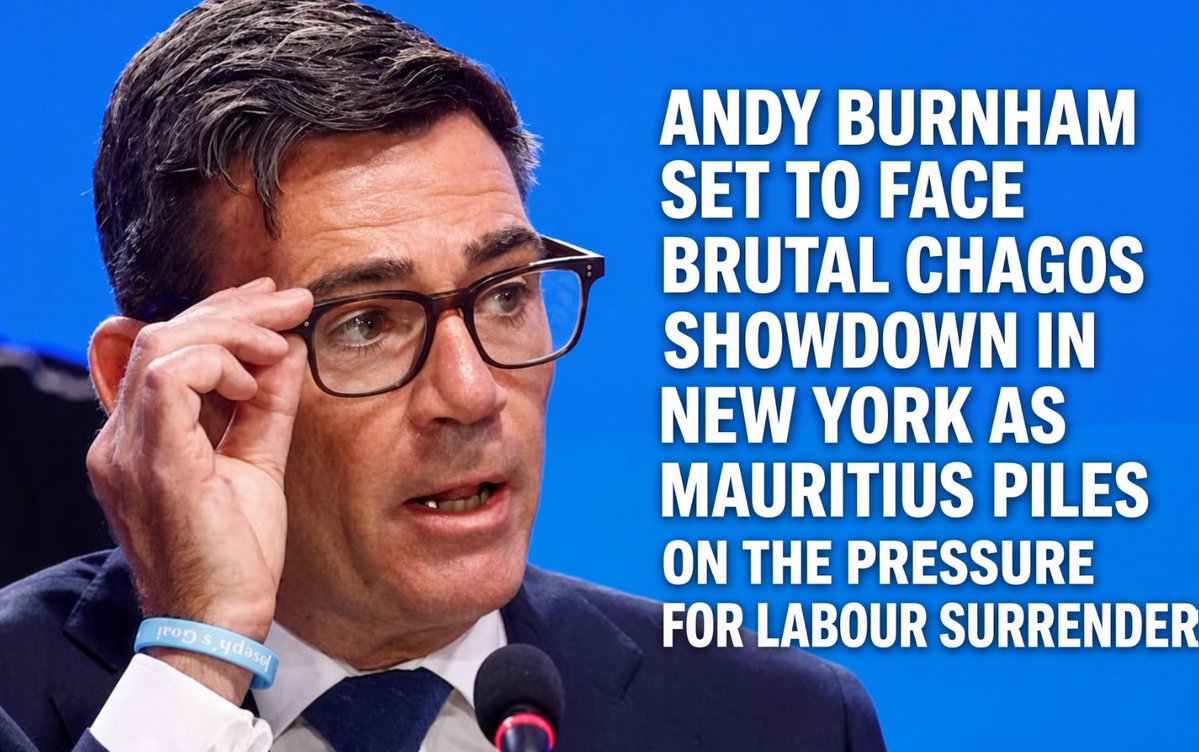
The proposed agreement has been defended by its supporters as a practical solution to a long-running international dispute. Britain’s sovereignty over the Chagos Islands has faced sustained legal and diplomatic challenges, while Mauritius has consistently argued that the territory should belong to it. Supporters of the agreement believe that transferring sovereignty while securing continued access to Diego Garcia could protect the military base and provide a more stable legal framework for the future.
However, opponents see the proposal very differently. They argue that Britain would effectively be giving away strategically important territory and then paying an enormous amount of money to retain the right to use it. For these critics, the arrangement represents a serious failure of national interest. They question why Britain should surrender sovereignty over territory that has major military value, particularly at a time when geopolitical tensions are increasing around the world.
The financial cost has also become a major political issue. Critics have described the agreement as an extremely expensive arrangement that would place a substantial burden on British taxpayers. At a time when households are struggling with the cost of living and public services face financial pressures, opponents argue that the government should not commit billions of pounds to an international agreement whose long-term benefits remain uncertain.
For Burnham, the political danger is particularly serious because the Chagos issue brings together several sensitive questions. It involves national sovereignty, defence, international law, public spending and Britain’s relationship with America. A politician can disagree with the government’s position on one of these issues, but Burnham must consider all of them simultaneously. A decision that satisfies one group may anger another.
The American dimension makes the situation even more complicated. The United States has a direct strategic interest in Diego Garcia. Washington wants to ensure that the military base remains secure and operational, particularly as the international security environment becomes increasingly unstable. The Indian Ocean is becoming more important because of competition between the United States and China. A secure military presence in the region is therefore considered essential to American strategic planning.
This explains why any uncertainty surrounding the Chagos agreement could create tension between London and Washington. Britain traditionally regards the United States as its most important strategic ally. Cooperation between the two countries extends from defence and intelligence to nuclear security and international diplomacy. If Washington believes that the Chagos arrangement could weaken the security of Diego Garcia, British leaders will face enormous pressure to reconsider or modify the agreement.
The issue is particularly sensitive because Diego Garcia is not an ordinary military base. Its location gives the United States and Britain the ability to operate across a vast area of the Indian Ocean and beyond. The base has been important for military operations in the Middle East and other regions. Its strategic position also provides a valuable counterweight to the growing influence of other powers.
China is an important part of this calculation. Beijing has expanded its economic and military presence across the Indian Ocean, including through infrastructure projects and closer relations with countries in the region. Any change to the political or military status of the Chagos Islands must therefore be considered in the context of a broader global competition. Western governments cannot afford to treat Diego Garcia as an isolated issue.
Burnham’s opponents will argue that this is precisely why Britain should retain sovereignty. In their view, giving up control over strategically important territory at a time of growing international competition is dangerous. They believe that Britain should strengthen its own strategic position rather than become increasingly dependent on agreements with other countries.
Supporters of the deal, however, would argue that sovereignty alone does not guarantee strategic influence. If Britain’s legal position over the Chagos Islands is becoming increasingly difficult to defend internationally, maintaining formal sovereignty could eventually become less useful than securing a long-term agreement that protects access to Diego Garcia. From this perspective, the priority should be the military base and regional security rather than the symbolic question of who owns the territory.
Another important issue is the Chagossian people themselves. The history of the Chagos Islands is deeply controversial. Chagossians were displaced from their homes when the islands were developed for military purposes, and questions about their right to return remain central to the dispute. Any serious discussion of the future of the islands must therefore consider not only Britain, Mauritius and the United States, but also the people whose lives have been directly affected by decisions made by governments.
This makes the political debate more complicated than a simple argument about British sovereignty. There are competing principles involved. One is the principle of national territorial control. Another is the right of peoples to self-determination. A third is the strategic necessity of maintaining a major military base. Finally, there is the question of whether taxpayers should be required to finance a long-term international agreement.
Burnham must also consider the wider political consequences. The Chagos dispute could become a symbol for voters who believe that successive British governments have been too willing to compromise national interests. Opposition parties can portray the agreement as evidence of weakness, particularly if the government appears unable to explain clearly why the deal is necessary.
At the same time, Burnham cannot ignore the importance of international cooperation. Britain is no longer an imperial power capable of acting entirely alone. Modern security depends heavily on alliances. The United States remains Britain’s most important military partner, and cooperation with Washington is essential in areas ranging from intelligence sharing to nuclear deterrence. A confrontation with the American government over Diego Garcia could therefore have consequences extending far beyond the Chagos Islands.
The challenge is to find a solution that protects British interests while maintaining the confidence of the United States and respecting the rights of the Chagossian people. This will not be easy. Any agreement that is perceived as surrendering British territory without sufficient strategic compensation could become politically toxic. Conversely, refusing to compromise could damage Britain’s international reputation and create uncertainty over the future of Diego Garcia.
Ultimately, the Chagos controversy demonstrates how difficult modern foreign policy can be. A decision that appears straightforward from one perspective can look completely different from another. Supporters of the agreement see a way to resolve a decades-old dispute and preserve access to a strategically important military facility. Opponents see an unnecessary surrender of territory, an enormous financial commitment and a potential threat to British sovereignty.
For Andy Burnham, the coming confrontation with Washington could therefore be a defining test of his leadership. He will have to demonstrate that Britain is capable of defending its national interests while maintaining its most important international alliances. He will also have to convince the public that the government has considered the financial, military, legal and humanitarian consequences of the agreement.
The Chagos Islands may be thousands of miles from Britain, but the political battle surrounding them is much closer to home. It raises fundamental questions about sovereignty, national security, public money and Britain’s place in the world. If Burnham chooses to proceed with the agreement, he will need a convincing explanation of why it represents the best option for Britain. If he chooses to resist or renegotiate it, he will need to explain how Britain can protect Diego Garcia and maintain its relationship with the United States.
The real test, therefore, is not simply whether Burnham can survive a confrontation with Washington. It is whether he can demonstrate that Britain has a clear and coherent strategy for protecting its interests in an increasingly uncertain world. The Chagos dispute may ultimately become much more than a disagreement over a group of islands. It could become a defining debate about what Britain believes its sovereignty, security and international responsibilities should mean in the twenty-first century.