
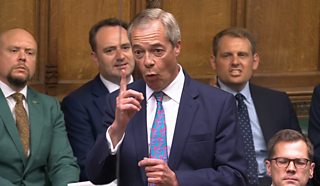
Nigel Farage Warns of Policing Crisis During Furious PMQs Clash With Keir Starmer
Nigel Farage has issued a stark warning that Britain could face an escalating policing crisis as he clashed furiously with Prime Minister Keir Starmer over the treatment of murdered teenager Henry Nowak and the violent disorder that followed in Southampton.
The extraordinary confrontation erupted during Prime Minister’s Questions after Farage accused Britain of operating a system of “two-tier policing”, claiming that public confidence in the police was being destroyed by policies that treated different ethnic groups differently.
Starmer hit back with a furious accusation of his own, accusing the Reform UK leader of exploiting a family tragedy and attempting to fuel division at a moment when tensions were already dangerously high.
The confrontation came after violent scenes in Southampton, where 11 police officers and a police dog were injured during clashes with protesters following the murder of 18-year-old Nowak.
The extraordinary exchange has now turned a tragic criminal case into one of the most explosive political arguments of the year.
Farage raises the issue in the Commons
Farage used his question at PMQs to challenge Starmer directly over policing.
He argued that growing numbers of people believed Britain was operating under a system of unequal policing.
His central claim was that officers were being given guidance that required them to treat different ethnic groups differently.
Farage warned that the consequences could be extremely serious.
His argument was that if ordinary people stopped believing that the police would treat them fairly, confidence in law enforcement would collapse.
And once public confidence disappears, he suggested, disorder could become considerably worse.
Farage’s intervention came after days of intense anger over the circumstances surrounding Nowak’s death and the subsequent police response.
The Reform leader therefore attempted to turn the debate from one about a single tragic incident into a wider discussion about policing, equality and public trust.
Starmer delivers a furious response
The Prime Minister responded in uncompromising terms.
Starmer rejected Farage’s claim that Britain operates under “two-tier policing”.
But he went further.
He accused Farage of exploiting the tragedy for political purposes and criticised his decision to use inflammatory language after Nowak’s death.
Starmer said Nowak’s family had demonstrated extraordinary dignity following the loss of their son.
He argued that their wishes should be respected rather than the tragedy being used to create further division.
The Prime Minister described Farage’s approach as “unforgivable”, particularly because the victim’s family had appealed for people not to use the tragedy to generate hatred or tension.
The exchange immediately became heated, with MPs interrupting and shouting across the Commons.
It was a remarkable moment even by the standards of PMQs.
The tragedy behind the political storm
The political confrontation stems from the death of Henry Nowak, an 18-year-old university student who was fatally stabbed in Southampton in December 2025.
Vickrum Digwa was subsequently convicted of the murder and sentenced to life imprisonment.
Police officers who attended the scene initially treated Nowak as a suspect after Digwa falsely claimed that he had been the victim of a racist attack.
Body-camera footage later showed Nowak being handcuffed while seriously injured and repeatedly telling officers that he had been stabbed.
The circumstances have understandably generated enormous public anger.
Hampshire and Isle of Wight Constabulary has apologised for the treatment of Nowak, and the force referred itself to the Independent Office for Police Conduct for investigation.
That investigation is highly significant.
It means the full circumstances surrounding the officers’ decisions are not simply a matter of political opinion.
They are now subject to formal scrutiny.
The protests turned violent
What began as anger over Nowak’s death and the police response escalated into violent disorder in Southampton.
Crowds gathered near police facilities, with clashes breaking out between protesters and officers.
Objects including bottles and other missiles were thrown.
Eleven officers and a police dog were injured.
The violence immediately created a second political crisis.
Whatever concerns people may have had about the original police response, attacking officers could not be justified.
Starmer made precisely that point in the Commons.
He condemned the violence as “disgraceful and completely unacceptable” and warned that anyone involved in disorder would face the full force of the law.
For the Government, the priority became restoring calm.
For Farage, however, the disorder was evidence of something deeper: a collapse in public trust.
Farage’s warning about policing
Farage’s argument is built around the idea that fairness is fundamental to effective policing.
He believes that if people think the police apply different standards to different communities, confidence in the justice system will suffer.
That is why he repeatedly returned to the phrase “two-tier policing” during the Commons confrontation.
Farage argued that police guidance relating to race and discrimination could result in different treatment depending on the ethnicity of those involved.
He told MPs that this was creating anger among members of the public.
His warning was stark: if people lose confidence that the police will treat them fairly, the situation could deteriorate further.
That is a serious claim.
But it is also a politically contentious one.
Starmer rejects the premise that Britain’s police forces operate a system of two-tier policing.
The dispute therefore goes beyond the individual case.
It is about whether institutional policies intended to prevent discrimination can themselves create perceptions of unequal treatment.
The Government’s position
Starmer has attempted to separate two issues.
The first is whether the police response to Nowak was appropriate.
The second is whether that incident proves that Britain operates a system of systematic two-tier policing.
The Government accepts that there are serious questions surrounding the treatment of Nowak.
That is why the police watchdog investigation is taking place.
But Starmer does not accept that the case demonstrates a wider policy of deliberately treating people differently according to race.
That distinction is crucial.
An individual failure by police officers, even a serious one, does not automatically establish that the entire policing system operates on discriminatory principles.
The Government therefore wants the independent investigation to establish exactly what went wrong.
Farage, meanwhile, believes the incident illustrates a broader problem.
A battle over public trust
At the heart of the argument is trust.
Police forces depend on public cooperation.
People report crimes, provide information and act as witnesses because they believe the system will protect them and treat them fairly.
If sections of the population believe the system is biased against them, they may become less willing to cooperate.
That could make policing more difficult.
Farage is attempting to make that concern central to his political argument.
He wants Reform UK to be seen as the party willing to confront what it regards as institutional failures in law enforcement.
The Government, meanwhile, is trying to prevent the debate from becoming a broader confrontation between different ethnic or political communities.
That explains why Starmer’s response was so forceful.
Starmer says there is no justification for violence
The Prime Minister’s strongest message was that legitimate concerns about policing could not justify attacks on police officers.
The distinction matters.
There is nothing inherently wrong with questioning police conduct.
Indeed, independent oversight exists precisely because police forces can make mistakes.
But throwing objects at officers and damaging property is a completely different matter.
Starmer warned that those responsible would face prosecution.
That message was supported by senior police figures.
Hampshire’s Chief Constable Alexis Boon said some people had attended the protests with the intention of causing disorder and warned that violent behaviour would not be tolerated.
The challenge for the Government is therefore twofold.
It needs to investigate what went wrong in the treatment of Nowak.
But it must also protect police officers from retaliation.
The danger of political escalation
The case demonstrates how quickly a criminal tragedy can become a national political flashpoint.
A young man was murdered.
Police officers made controversial decisions at the scene.
Footage emerged showing how the victim was treated.
Public anger followed.
Politicians then entered the debate.
Protests took place.
Violence erupted.
And finally the issue reached the floor of the House of Commons.
Each stage increased the political temperature.
That creates an obvious danger.
Once a tragedy becomes a symbol in a wider political conflict, the facts of the individual case can become overshadowed by competing narratives.
One side sees evidence of institutional discrimination.
Another sees evidence of irresponsible political rhetoric.
The victim’s family is left at the centre of an argument they did not create.
Farage faces criticism over his rhetoric
Farage has been criticised for his response to the case, particularly after he urged people to react with “pure, cold rage”.
Critics argued that such language risked inflaming an already tense situation.
The Guardian reported that his comments came shortly before the violent scenes in Southampton and that opponents accused him of encouraging anger.
Farage has rejected the suggestion that he was calling for violence.
His argument is that he was expressing anger at what he considers a profound injustice.
That distinction will remain politically important.
Calling for people to be angry is not automatically the same as calling for violence.
But politicians also have to consider the consequences of their words when emotions are running extremely high.
That is precisely why Starmer attacked Farage so strongly.
The role of the police watchdog
The independent investigation could ultimately become one of the most important elements of the entire controversy.
If investigators find serious failings by officers, Farage will be able to argue that the incident demonstrated the need for fundamental reform.
If the investigation finds that officers were acting in accordance with existing procedures but that those procedures themselves created problems, the political debate could become even more significant.
Alternatively, if the investigation finds that the officers’ decisions were the result of individual mistakes rather than institutional policy, the Government will have stronger grounds for rejecting broader claims about two-tier policing.
Until that process is complete, politicians are effectively arguing over conclusions that have not yet been established.
Reform UK’s opportunity
For Reform UK, the controversy represents a major political opportunity.
Law and order is already one of the party’s strongest issues.
Farage has built much of his political career around challenging established institutions and arguing that governments have failed to protect ordinary citizens.
The Nowak case allows him to connect those themes directly.
He can argue that the police have lost sight of basic principles of fairness.
He can argue that political correctness has interfered with effective policing.
And he can present Reform as the party willing to challenge the system.
That message is likely to appeal strongly to voters who already feel that traditional political parties have ignored their concerns.
But there is a risk for Farage
The same issue also presents Farage with political dangers.
If the debate becomes associated primarily with street violence, Reform could find itself accused of contributing to disorder rather than solving the underlying problem.
The images from Southampton are powerful.
Police officers being attacked, objects being thrown and crowds confronting riot police are likely to alarm many voters who want stronger law enforcement.
Farage therefore has to walk a difficult line.
He wants to maintain anger over the original police failure.
But he also needs to make clear that violence against officers is unacceptable.
Otherwise, opponents can argue that his rhetoric is helping to destabilise the situation.
Starmer faces his own dilemma
The Prime Minister is not free of political risk either.
If he appears too defensive of the police, he could be accused of ignoring the failures that contributed to public anger.
If he accepts too much of Farage’s argument, he risks legitimising the claim that Britain operates systematic two-tier policing.
His safest position is therefore to insist on an independent investigation.
That allows him to acknowledge serious concerns without accepting Farage’s wider political interpretation.
At the same time, he can take a firm line against violence.
This is essentially the position Starmer adopted during PMQs.
A national debate about fairness
The argument is now larger than Southampton.
Britain is having a wider conversation about whether institutions treat people equally.
Police forces have introduced extensive policies designed to tackle discrimination and improve relationships with minority communities.
Supporters say those policies are necessary to ensure fairness.
Critics argue that some approaches can themselves create unequal treatment or give the appearance that certain groups receive different standards.
The challenge is finding a system that protects people from discrimination while maintaining absolute confidence that the law applies equally to everyone.
That is not an easy political problem.
And the Nowak case has placed it directly in the national spotlight.
Why the PMQs clash matters
The confrontation between Farage and Starmer was important because it revealed two fundamentally different political responses to the crisis.
Starmer’s message was one of restraint.
Investigate the police response.
Support the victim’s family.
Reject violence.
Allow the law to take its course.
Farage’s message was one of institutional challenge.
Question the policing system.
Address public perceptions of unequal treatment.
Restore confidence.
And act before anger becomes even more widespread.
Both arguments are likely to resonate with different sections of the electorate.
That is why this issue is unlikely to disappear.
What happens next?
The independent investigation into the police response will be crucial.
The Government will also have to deal with the aftermath of the Southampton disorder and ensure that officers can maintain public order without creating further tensions.
For Farage, the challenge is to turn anger into a coherent political argument without allowing the issue to become dominated by violence.
For Starmer, the task is even more complicated.
He must demonstrate that his Government takes legitimate concerns about policing seriously while preventing the idea of “two-tier policing” from becoming an established political narrative.
Above all, he needs to restore confidence.
A policing crisis that could grow
The most worrying element of the entire dispute is the possibility that public confidence could become permanently damaged.
Farage’s warning that the situation could get considerably worse if people stop believing that police treat them fairly should not simply be dismissed as political rhetoric.
Public trust is genuinely important to effective policing.
At the same time, claims about systematic two-tier policing need to be tested against evidence rather than established through political assertion.
That is why independent investigations and transparent policing standards matter.
Britain needs a police service that can act decisively while treating every person equally.
It needs politicians who can challenge failures without inflaming tensions.
And it needs a public debate that distinguishes legitimate criticism from violence.
The final showdown
The PMQs clash between Nigel Farage and Keir Starmer has exposed one of the most difficult political fault lines in modern Britain.
For Farage, Henry Nowak’s death and the police response represent evidence that something has gone seriously wrong with the way law enforcement operates.
For Starmer, the tragedy demands serious investigation rather than political exploitation.
And for the public, the central question is perhaps simpler:
Can Britain trust its police to treat everyone equally, regardless of race, background or political pressure?
The answer cannot be decided by one PMQs exchange.
It will depend on the evidence emerging from the independent investigation, the response of police leaders and the ability of politicians to lower the temperature.
But after the violence in Southampton, the stakes are unmistakably high.
Eleven officers and a police dog were injured.
A grieving family has been placed at the centre of a national political argument.
And Parliament has witnessed one of the fiercest confrontations yet between Starmer and Farage.
For the Prime Minister, the priority now is restoring calm while demonstrating that genuine failures will be addressed.
For Farage, the political battle is only beginning.
If public confidence in policing continues to deteriorate, his warning could become one of Reform UK’s most powerful arguments.
But if the Government can demonstrate that the Nowak case is being investigated independently, that those responsible for failures are held accountable and that the police continue to apply the law equally, Starmer will have a much stronger answer.
The battle over policing has moved from the streets of Southampton to the heart of Westminster — and neither Farage nor Starmer appears ready to back down.
Leave a Reply
You must be logged in to post a comment.